Ready-made ETF portfolios built for real investor needs. Explore now →



Risk parity ETFs: Were they effective in 2022?
Risk parity ETFs have had a rough year so far. Here are the reasons why.


Keep up with what matters in ETFs
Get timely ETF insights, market trends, and top ideas straight to your inbox.
Your newsletter subscriptions with us are subject to ETF Central's Privacy Policy and Terms and Conditions.
For a while, it seemed like risk parity strategies offered the best of both worlds – broad diversification without sacrificing total returns. The ability to weather all market conditions without excessive volatility and drawdowns. Delivering growth and capital preservation through all economic climates.
So, it was much to my surprise when I realized that the most popular risk parity ETF on the market, the RPAR Risk Parity ETF (RPAR) is actually down -28.46% year-to-date, compared with the -23.95% loss seen by the S&P 500 and the -20.85% loss suffered by a benchmark 60/40 stock/bond portfolio.
I think this question is important to answer because, for retail investors, it offers a valuable lesson about the limitations of diversification and the dangers of leverage. It also brings into question many of the assumptions underlying portfolio theory, namely a heavy reliance on historically negative correlations between certain asset classes. Let's figure out what exactly happened.
Like what you're reading?
Stay in the loop — get the latest ETF insights: trends, analysis, and expert picks.
What is risk parity?
When it comes to your asset allocation, different investments will contribute different levels of risk to your portfolio's overall level of risk. Generally, this is expressed as volatility in the form of standard deviation, which is how much an investment's return has fluctuated around its average. The higher this is, the more volatile and riskier the asset.
The interesting thing to note here is that your average investment portfolio does not spread risk evenly. For example, we know that as an asset class, stocks are historically more volatile than bonds. So even though a 60/40 portfolio of stocks and bonds might be considered "balanced," from a risk parity perspective it really is not.
For a 60/40 portfolio backtested from 1987 to the present, 94.83% of the risk is contributed by stocks. Bonds only contributed 5.17% of the portfolio's risk. Risk parity, on the other hand, attempts to allocate the risk contributed by each asset equally within a portfolio.
For a portfolio of stocks and bonds backtested from 1987 to the present, risk parity weightings that have both assets contributing 50% of the risk each would take the following allocations:
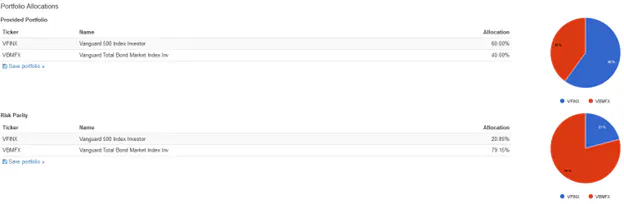
The bonds are less volatile than the stocks, so to balance out their contribution to portfolio risk, we have to overweight bonds. It also results in an overall better risk-adjusted return, with a higher Sharpe ratio of 0.70 versus 0.59 for the 60/40, lower drawdowns, and less excess kurtosis (tail risk).
Investors can then employ leverage to target the desired level of return they're seeking instead of relying on a single risky asset (like stocks) to contribute the portfolio's returns. This can potentially offer better efficiency in the form of more units of return per less units of risk.
Breaking down risk parity ETFs
I'm a pretty big fan of RPAR, as I think that ETF is constructed quite well. It's very popular with investors too, having attracted just over a billion in assets under management over its short lifetime. The ETF is allocated between equities, commodity producer stocks, Treasurys, and TIPs in risk-parity weightings. Here's what it looks like from their fund materials:
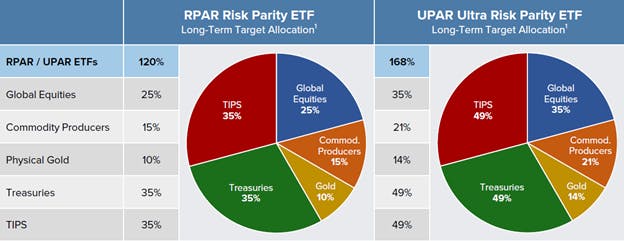
Those who read my previous article on the Ray Dalio All-Weather portfolio will note that each one of these assets is expected to perform well in different economic and market conditions. Equities provide growth during bull markets, Treasuries provide deflationary crash protection when interest rates are dropped, and commodities producers and TIPS provide inflation protection.
In addition, they all have a positive expected return. Stocks and bonds are productive assets – they generate dividends and interest payments. This is unlike commodities and precious metals, which incur storage costs and suffer from contango, hurting their long-term expected returns. So, what happened this year that made RPAR underperform?
Why risk parity failed this year?
In short, it was a combination of rising correlations between asset classes, coupled with RPAR's use of leveraged long bonds. RPAR's overall leverage ratio is 1.2, or 120%. Its cousin, the UPAR Ultra Risk Parity ETF (UPAR) is leveraged even higher at 1.68, or 168%. This is done on the bond side using futures, which are tax-efficient and avoids the volatility drag usually associated with leveraged ETFs.
For its bonds, RPAR makes use of long-term Treasurys and long-term TIPs. Bond prices are inversely related to interest rate movements, with duration determining how sensitive they are. For example, a Treasury bond with a duration of 2.7 years might be expected to lose 2.7% if interest rates increased 1%, all else being equal, and vice-versa if interest rates fell. That was the problem this year.
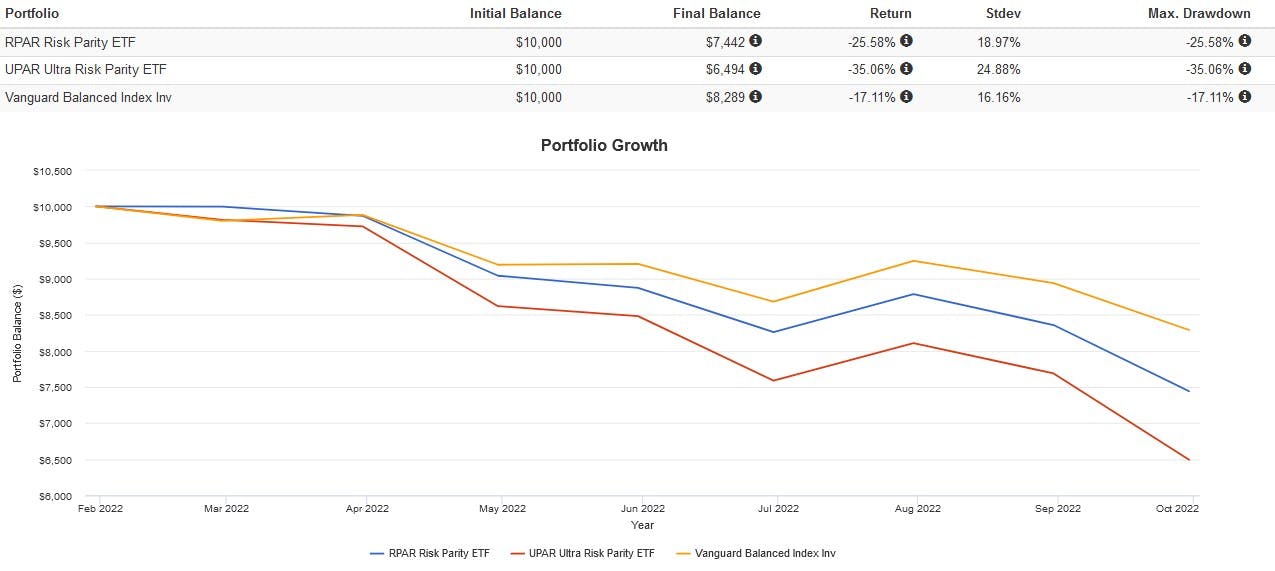
When interest rates got hiked aggressively to combat inflation, bonds, especially long-term ones, took a nosedive. This also increased their correlation to stocks, meaning that for the first time since the late 1970s and 1931, bonds fell along with stocks. You can see below how RPAR and UPAR fell harder than a 60/40 portfolio from February 2022 to the present, amplified by the use of leverage.
In fact, we can look at the individual performance and correlation of all the assets in RPAR and UPAR relative to each other below via closely related index ETFs to see this in play:
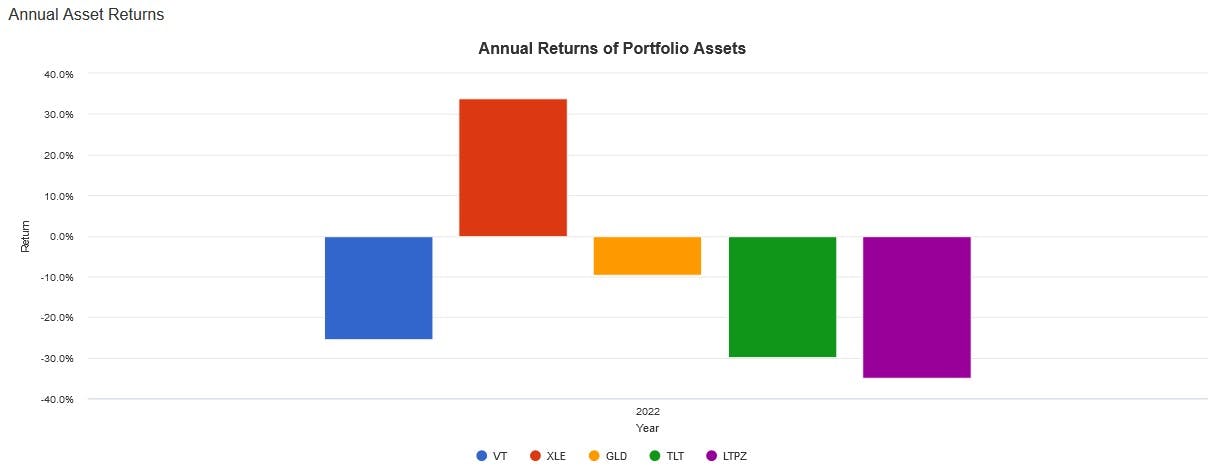

With the exception of commodity producer stocks, every other asset returned negative in 2022. Correlations between Treasurys, TIPS, and global equities also increased sharply whereas they were historically low or negative altogether. As mentioned earlier, this significantly hurt the performance of RPAR and led to some higher-than-expected unrealized losses.
My thoughts on risk parity
Still, I think RPAR and UPAR are theoretically sound ETFs. All they're doing is taking a blend of assets with a positive expected return, allocating them in risk-parity weightings, and leveraging up to the desired level of risk and return. This worked great in 2020, where RPAR soundly outperformed both the S&P 500 and a 60/40 portfolio while incurring lower volatility and drawdowns.
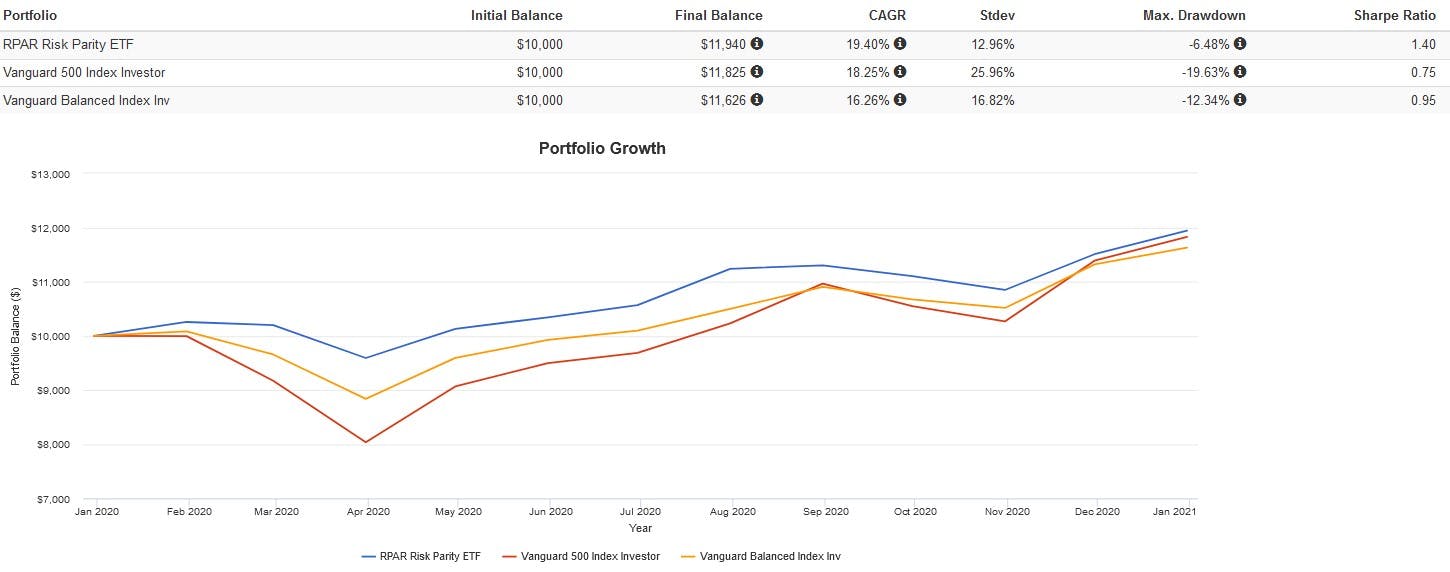
The decision of whether or not to invest in risk parity ETFs depends on your judgment of future market conditions. I don't have a crystal ball, so I can't say. It is worth noting that the conditions in 2022 had occurred very rarely in the past, notably in the late 1970s when Volcker was fighting double-digit inflation with extremely aggressive rate hikes.
However, it's worth noting that these conditions wreak havoc on most diversified portfolios using multiple asset classes. RPAR was hit particularly hard due to its use of leverage. Without the leverage, I expect it would have equaled or beat the 60/40 portfolio. All in all, RPAR is an excellent illustration of the benefits and limitations of diversification.
Please note this article is for information purposes only and does not constitute investment advice.
Latest ETF News
See all ETF newsHow Some ETF Issuers Use Their Own Funds for Cash Management

These Public-Private ETFs Invest in Polymarket and Anduril

There's an ETF for That? Frontier Markets

10-Year Treasury Yield Hits 5%: Which Bond ETFs Offer the Most Direct Exposure?




 Advantages of ETFs over Mutual Funds1/6
Lower Costs
In this guide, we'll explore the advantages of ETFs over mutual funds, giving you valuable insights into why ETFs have gained significant popularity among investors like yourself.
Leveraged ETFs: Unlocking the Potential for Amplified Returns1/6
Understanding Leveraged ETFs
Explore leveraged ETFs: potential for amplified returns & risks. 5 ETFs to consider across equities, commodities & fixed income.
What is a Leveraged ETF?1/6
Introducing Leveraged and Inverse ETFs
In this guide, we'll dive into the world of leveraged ETFs, exploring their definition, mechanics, potential risks, and rewards.
Recent educational content

ETF Trends
ETF Industry KPIs October 5, 2026
This week’s KPI data overview highlights key metrics and trends shaping the ETF landscape.

ETF Trends
ETF Industry KPIs September 28, 2026
This week’s KPI data overview highlights key metrics and trends shaping the ETF landscape.
ETF Trends
ETF Industry KPIs September 22, 2026
This week’s KPI data overview highlights key metrics and trends shaping the ETF landscape.

First Look ETF
First Look ETF: Income, Corporate Arbitrage, and Growth and Value Investing
First Look ETF September 2026: iCapital, Mast Investments and North Square unpack new ETFs targeting monthly income, merger arbitrage and complementary growth and value exposure.

Browse all educational columns



Build and Analyze Your ETF Portfolio Like a Pro
Create your own ETF portfolio in minutes and instantly see allocations, exposures, performance, and risk. Visualize diversification across asset classes, regions, and sectors. Stress-test ideas, compare benchmarks, and refine your strategy with professional-grade analytics.