Global ETF Survey Is Live! 600+ ETF Professionals Weigh In. See Results →



The Ray Dalio All-Weather ETF Portfolio
Here's how to invest like Ray Dalio using ETFs.


Keep up with what matters in ETFs
Get timely ETF insights, market trends, and top ideas straight to your inbox.
Your newsletter subscriptions with us are subject to ETF Central's Privacy Policy and Terms and Conditions.
Everybody talks about "diversification" when it comes to investing, but most people tend to fall short. The average investor buys a stock index fund and pairs it with an aggregate bond fund and calls it a day.
Traditionally, bonds (especially Treasurys) were negatively correlated or at least uncorrelated to stocks. When stocks zigged, they zagged. Thanks to this, and their positive expected returns from coupon payments, bonds were an excellent hedge for equity risk, as per modern portfolio theory. They were able to reduce risk without impacting returns too much.
When stock-bond correlations turn positive in a rising rate, inflationary environment (like in 2022), investors must turn to other assets with a low-to-negative correlation with stocks. This often includes alternatives, like commodities or precious metals. A fully diversified portfolio holds these assets in an allocation that evenly balances out the different sources of risk. This is called "risk parity."
Like what you're reading?
Stay in the loop — get the latest ETF insights: trends, analysis, and expert picks.
The case for an all-weather portfolio
Ray Dalio, founder of the Bridgewater Associates hedge fund, designed his firm's portfolio based on these principles. Dalio observed that different asset classes performed better in various economic scenarios, or "climates." He posited that there were generally four cycles:
- Higher-than-expected inflation
- Higher-than-expected growth
- Lower-than-expected inflation
- Lower-than-expected growth
The point of the all-weather portfolio is to create a fund that chugs along in all market conditions, without the need for timing or predictions. This portfolio is not meant to maximize returns – the goal here is to limit volatility and drawdowns.
Dalio suggested four types of assets that corresponded to his understanding of economic "seasons": stocks, Treasury bonds, commodities, and gold.
The role of stocks
Stocks will drive most of the portfolio's returns during bull markets. Dalio suggested using the total U.S. stock market, but in my opinion, the total world market is preferable as to avoid a repeat of the 2002-2009 "lost decade" for U.S. stocks. Remember, we're trying to maximize diversification here and avoid easily mitigatable risks, like investing in a single country.
The following low-cost index ETFs could work based on your thesis for the U.S. vs worldwide stocks:
The role of bonds
Bonds (Treasurys) provide deflationary crash protection. When a market crash occurs, central banks often drop interest rates to stimulate the economy, which sends bond prices (and especially long-term Treasurys) soaring. This is called the "flight to safety." Bonds also generally lower volatility (in a non-rising rate environment). Dalio suggests a combination of long-term (20+ year) and intermediate term (7-10 year) duration Treasurys to balance interest rate risk and crash protection.
The following low-cost index ETFs could work:
The role of commodities/gold
Commodities provide inflation protection, but in all other market conditions tends to be a poor investment. Commodity funds use futures contracts, which suffer from contango, high costs, and volatility decay. Gold, on the other hand, actually has poor short-term inflation protection thanks to its high volatility but does act as a safe haven for political/socio-economic turmoil. Both have a low to negative correlation with both stocks and bonds, making them decent diversifiers.
The following low-cost index ETFs could work:
- Invesco Optimum Yield Diversified Commodity Strategy No K-1 ETF (PDBC)
- SPDR Gold MiniShares Trust (GLDM)
Constructing the portfolio
Dalio suggested the following allocations:
- 30% stocks
- 15% intermediate bonds
- 40% long-term bonds
- 7.5% commodities
- 7.5% gold
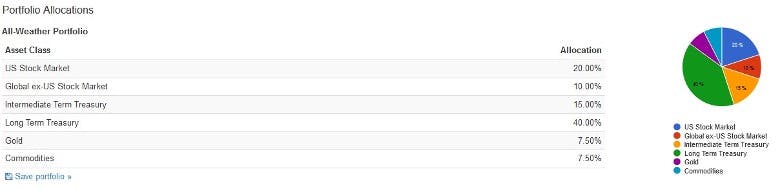
These allocations are not mean-variance optimized or accurate for a true risk parity weighting. Dalio's weights were intended to be a useful rule of thumb for investors that could be easy to implement. I would also be cautious of using backtests to find the "correct" allocations as that is highly subject to over-fitting of data.
That being said, here's how it has performed compared to the S&P 500 since 2007 with annual rebalancing:
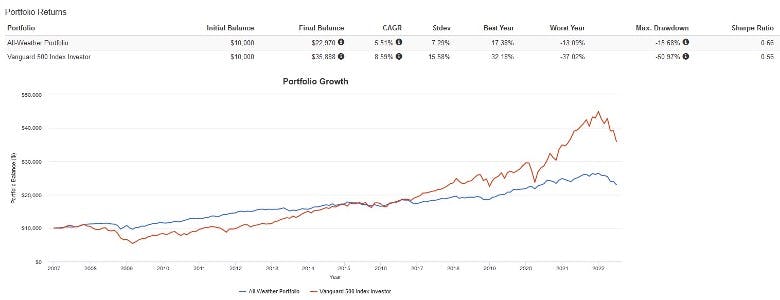
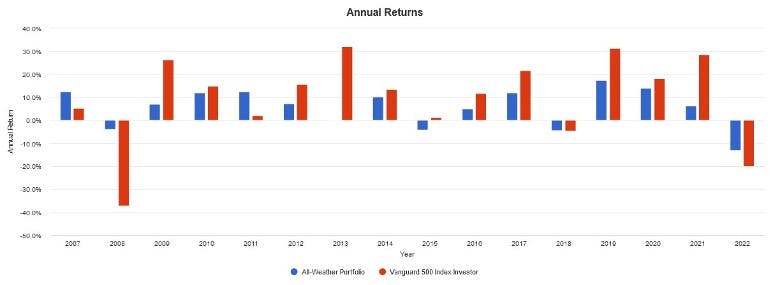
We see far better risk-adjusted returns (Sharpe ratio), with significantly lower volatility and drawdowns. Overall, the sequence of returns was much more predictable, which can be desirable for low-risk investors.
Personally, I would prefer a lower allocation to long-term Treasurys in favour of a higher (40%) stock allocation and the addition of some short-term Treasury Inflation Protected Securities (TIPS). Then again, who am I to argue against Ray Dalio?
Latest ETF News
See all ETF newsBeyond Big Tech: The Increasing Specialization of AI ETFs

There's an ETF for That? Humanoid Robotics and Physical AI

How Some ETF Issuers Use Their Own Funds for Cash Management

These Public-Private ETFs Invest in Polymarket and Anduril

There's an ETF for That? Frontier Markets



 Advantages of ETFs over Mutual Funds1/6
Lower Costs
In this guide, we'll explore the advantages of ETFs over mutual funds, giving you valuable insights into why ETFs have gained significant popularity among investors like yourself.
Leveraged ETFs: Unlocking the Potential for Amplified Returns1/6
Understanding Leveraged ETFs
Explore leveraged ETFs: potential for amplified returns & risks. 5 ETFs to consider across equities, commodities & fixed income.
What is a Leveraged ETF?1/6
Introducing Leveraged and Inverse ETFs
In this guide, we'll dive into the world of leveraged ETFs, exploring their definition, mechanics, potential risks, and rewards.
Recent educational content
First Look ETF
First Look ETF: Income, International, and Cash Flow ETFs
In this season 6 episode of First Look ETF, Stephanie Stanton @etfguide examines the latest ETF marketplace trends with NYSE and guests.


ETF Trends
ETF Industry KPIs October 5, 2026
This week’s KPI data overview highlights key metrics and trends shaping the ETF landscape.

ETF Trends
ETF Industry KPIs September 28, 2026
This week’s KPI data overview highlights key metrics and trends shaping the ETF landscape.
ETF Trends
ETF Industry KPIs September 22, 2026
This week’s KPI data overview highlights key metrics and trends shaping the ETF landscape.