Keep tabs on your favorite ETFs with a personalized weekly tracker. Create a Watchlist now →



Hedging tail risk: ETFs with crash protection
These advanced ETFs use VIX futures or put options to mitigate market downturns.


Keep up with what matters in ETFs
Get timely ETF insights, market trends, and top ideas straight to your inbox.
Your newsletter subscriptions with us are subject to ETF Central's Privacy Policy and Terms and Conditions.
When most investors consider "risk," they usually think about volatility – that is, the up and down movements of an investment around its historical average (standard deviation), or how sensitive it is relative to the overall market (beta). I think this is an incomplete picture of risk.
Most investors, especially beginners should be warier of tail risk. An easy way to understand tail risk is to think about it as the possibility of an extremely unlikely, but catastrophic loss event. A morbid real-life example would be slipping in your bathroom at night, hitting your head, and falling into a vegetative state. A stock market example would be the Black Monday Crash of 1987.
Tail risk can be difficult to quantify for the layperson, yet critical to understanding for investment strategy given its outsized impact on portfolio value. This article will help explain tail risk in an accessible way and give some real-life, concrete examples for mitigating it using ETFs.
Global ETF Survey 2026 is Live!
With 1,790 new products launched by July 2026, choosing is harder than ever. Our Global ETF Survey 2026, built on 620 professional investors and allocators, shows how active, fixed income, options-based and thematic ETFs are reshaping fund selection.
What is tail risk?
Imagine somehow you were able to construct a probability distribution of all the possible future returns/losses an investment (say, the S&P 500) could produce. The end result would look something like the diagram below from PIMCO:
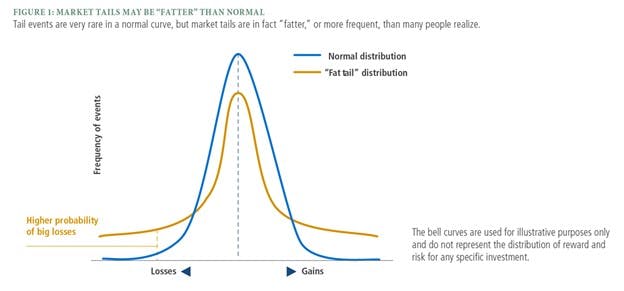
The "arch" in the middle of the distribution for both the blue and yellow lines with the dotted line represent the mean, or average return received by most investors (e.g., a 10% CAGR). We say "most" because the area under this portion of the distribution is the largest.
If we move to the right based on the blue line, we see that the area under the curve gets progressively smaller. This is to illustrate that the probability of experiencing a large gain is less. The same goes if we move to the left of the blue line, with the area under that representing the exponentially decreasing probability of experiencing a massive loss.
These are called "tails," and an investor who experiences one of those big, unlikely losses on the left side has experienced a "tail risk." To get technical, a tail risk occurs when the price of an asset moves three standard deviations left of its historical average. For the S&P 500, a standard deviation is around 15%, so a left tail risk would be a 55% loss.
Now, that’s just the blue line with narrow, or "thin" tails. If we look at the yellow line, we see that the area under each tail is significantly bigger than with the blue line, meaning that the probability of either of those outcomes occurring is higher than normal. These are called "fat tails."
What's important to understand here is that most investors peg the probability of a tail risk as low, when in reality, tails tend to be far fatter than what we expect. This causes most investors to take more risk than is prudent. Moreover, the consequences of a tail risk event are often outsized – think along the lines of losing 50% or more of your portfolio.
Hedging tail risk: VIX futures
The first and most effective way of hedging against a tail risk (like the 2008 market crash) is by using long VIX futures. These are derivative contracts that bet on the future anticipated value of the VIX. I recommend reading this article to understand how they work, but for now, it's sufficient to note that when markets crash, volatility usually spikes and the VIX goes up.
VIX futures are an effective hedge because they have a high negative correlation (around -0.80) with the S&P 500 – they move fairly reliably in the opposite direction. However, they're not a reliable hedge because of two things: mean reversion and contango. The aforementioned article explains this in detail, but it's sufficient to know here that over time, they lose value.
This makes using VIX futures a market-timing exercise, and we all know how bad the average investor (including myself) is at that. If you have a reliable trading strategy however, the following ETFs could work:
- ProShares VIX Short-Term Futures ETF (VIXY): 0.85% expense ratio.
- ProShares VIX Mid-Term Futures ETF (VIXM): 0.85% expense ratio.
Hedging tail risk: Put options
Put options are derivatives that give the buyer the right, but not the obligation, to sell an asset (in this case, the S&P 500) at a certain price, known as the strike before an expiry date. Their exact mechanics are a complex mathematical formula involving a whole lot of variables ("the Greeks"). For now, it’s enough to understand that if the S&P 500 crashes, put options will usually increase in value.
Moreover, put options with strike prices that are out-of-the-money (OTM) possess greater convexity, meaning that the bigger the crash, the better the payout will be. However, put options cost a premium to buy and will generally decay in value over time, a mechanic known as Theta. Think of puts as an insurance policy that you have to renew periodically and that becomes less effective as the expiry date draws near.
Unlike VIX futures, put options can be sustained over the long-term, but with some drag on portfolio performance. The following ETFs use a "ladder" of put options as a market crash hedge:
- Simplify U.S. Equity PLUS Downside Convexity ETF (SPD): 0.53% expense ratio.
- Cambria Tail Risk ETF (TAIL): 0.59% expense ratio.
Please note this article is for information purposes only and does not constitute investment advice.
Latest ETF News
See all ETF newsBeyond Big Tech: The Increasing Specialization of AI ETFs

There's an ETF for That? Humanoid Robotics and Physical AI

How Some ETF Issuers Use Their Own Funds for Cash Management

These Public-Private ETFs Invest in Polymarket and Anduril

There's an ETF for That? Frontier Markets



 Advantages of ETFs over Mutual Funds1/6
Lower Costs
In this guide, we'll explore the advantages of ETFs over mutual funds, giving you valuable insights into why ETFs have gained significant popularity among investors like yourself.
Leveraged ETFs: Unlocking the Potential for Amplified Returns1/6
Understanding Leveraged ETFs
Explore leveraged ETFs: potential for amplified returns & risks. 5 ETFs to consider across equities, commodities & fixed income.
What is a Leveraged ETF?1/6
Introducing Leveraged and Inverse ETFs
In this guide, we'll dive into the world of leveraged ETFs, exploring their definition, mechanics, potential risks, and rewards.
Recent educational content
First Look ETF
First Look ETF: Income, International, and Cash Flow ETFs
In this season 6 episode of First Look ETF, Stephanie Stanton @etfguide examines the latest ETF marketplace trends with NYSE and guests.


ETF Trends
ETF Industry KPIs October 5, 2026
This week’s KPI data overview highlights key metrics and trends shaping the ETF landscape.

ETF Trends
ETF Industry KPIs September 28, 2026
This week’s KPI data overview highlights key metrics and trends shaping the ETF landscape.
ETF Trends
ETF Industry KPIs September 22, 2026
This week’s KPI data overview highlights key metrics and trends shaping the ETF landscape.