Ready-made ETF portfolios built for real investor needs. Explore now →



How to create the classic 60/40 portfolio with ETFs
The 60/40 portfolio is a simple but effective asset allocation model. Let's take a deep dive into its construction.


Keep up with what matters in ETFs
Get timely ETF insights, market trends, and top ideas straight to your inbox.
Your newsletter subscriptions with us are subject to ETF Central's Privacy Policy and Terms and Conditions.
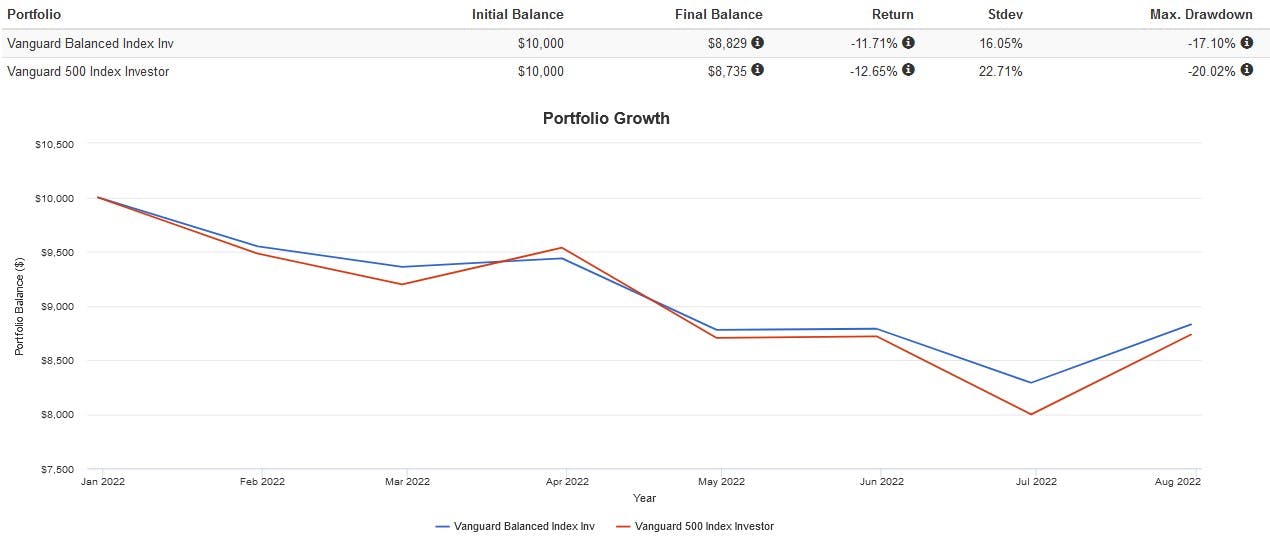
If I had a dollar for every time I heard someone say, "the 60/40 portfolio is dead", I would have enough to recoup the losses my portfolio suffered this year. Still, they're not exactly wrong. Year-to-date, a "balanced" 60/40 portfolio has drawn down nearly as much as a 100% stock one.
Most investors who relied on the 60/40 portfolio as their retirement fund was probably shocked by the high volatility and unrealized losses they’ve endured in 2022. The culprit? A rare combination of high inflation plus interest rate hikes, which tanked bond prices and increased their correlation to stocks. Neither of these bodes well for the diversification value of fixed-income assets.
Still, I think the 60/40 portfolio remains a decent choice for the average investor. It's a simple, easily understood asset allocation that provides a balanced, efficient risk/return profile under most market conditions. It can also be implemented in a variety of ways using low-cost index ETFs. Let's get into it.
Like what you're reading?
Stay in the loop — get the latest ETF insights: trends, analysis, and expert picks.
Diversification and the efficient frontier
Many investors who are 100% invested in stocks do so in order to maximize total returns. However, this approach is rather inefficient, meaning that it takes on disproportionately more risk for less return. I explored this principle in an earlier article on return stacking.
The 60/40 portfolio is rooted in Modern Portfolio Theory (MPT), which states that a diversified portfolio of volatile, uncorrelated assets with positive expected returns can provide an overall better risk-adjusted return (measured by the Sharpe ratio) compared to a single asset. Take a look at the chart below from Early Retirement Now:
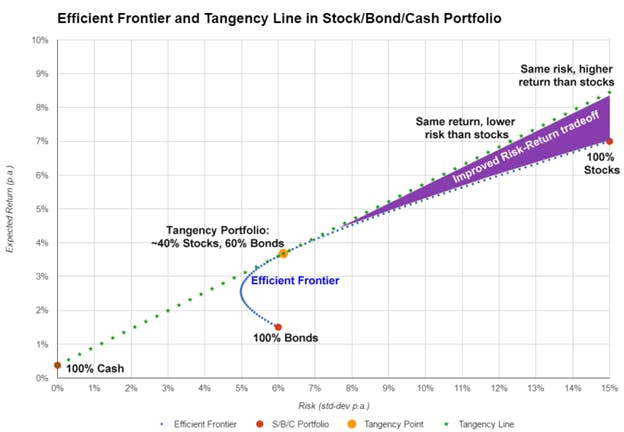
The horizontal (X) axis measures risk (standard deviation), while the vertical (Y) axis measures return (CAGR). The red dots denote single assets (stocks, bonds, or cash), plotted according to their historical risk/return profiles.
The curved line of blue dots represents permutations of various portfolios that mix two or more of the assets together in various allocations. The curved portion of that blue dotted line is known as the efficient frontier, which is composed of portfolios with the historically optimized risk-return profile. That is, this range of portfolios takes on more return for less risk.
The yellow dot is the tangency portfolio. This is the portfolio with the best historical risk/return profile. Here it is a 40/60 portfolio of stocks and bonds, but depending on the timeframe of the data used, it could be anywhere from 50/50 to 60/40.
Risks of the 60/40 portfolio
Now, the effectiveness of the 60/40 portfolio is dependent on a few things, notably the stock-bond relationship. Historically, we had a falling interest rate environment over the last 40 years where bonds and stocks were in a bull market. The few times that stocks fell sharply (2001, 2008, 2020), bonds (especially Treasurys) rallied sharply.
This was not the case during rising rate, inflationary circumstances. In the late 1970s to 1980s when inflation ran rampant and Fed Chairman Paul Volcker hiked rates up to 20%, bonds tumbled along with stocks. The same thing happened in 2022 much to the chagrin of investors holding a 60/40 portfolio.
Implementing the 60/40 portfolio via ETFs
Perhaps the true benefit of the 60/40 portfolio is its simplicity. It can be held long-term with minimal maintenance asides from annual rebalancing and reinvesting dividends. It requires little knowledge other than a basic understanding of how stocks and bonds work, and which funds to select.
When constructing the 60/40 portfolio, investors should aim for two goals: broad diversification, and low fees. These are sources of risk that are within your control and have a huge impact on future returns. This means sticking to inexpensive, broad-market index funds.
If you're a believer in investing globally (like I argued for in this article), you could use the following two Vanguard ETFs:
- Vanguard Total World Stock ETF (VT): 0.07% expense ratio.
- Vanguard Total World Bond ETF (BNDW): 0.06% expense ratio.
If you're only bullish on the U.S. market, you could use the following two Vanguard ETFs:
- Vanguard Total Stock Market ETF (VTI): 0.03% expense ratio.
- Vanguard Total Bond Market ETF (BND): 0.03% expense ratio.
If you want to keep things more concentrated, you could opt for the S&P 500 Index over the total U.S. stock market, and Treasurys over the total bond market. I delved into the pros and cons of each approach in two earlier articles, so head over there if you need a refresher. In any case, you could use the following two Vanguard ETFs:
- Vanguard S&P 500 ETF (VOO): 0.03% expense ratio.
- Vanguard Intermediate-Term Treasury ETF (VGIT): 0.04% expense ratio.
Segments
See all
No specific market segments were tagged
Mentioned ETFs
Further reading

Latest ETF News
See all ETF newsThere’s an ETF for That? Investing Like University Endowments

Could Water ETFs Be the Next AI Bottleneck Trade?

What is a Boomer Candy ETF?

ETF Comparison: NEOS Nasdaq-100 High Income ETF (QQQI) Versus Goldman Sachs Nasdaq-100 Premium Income ETF (GPIQ)




 Advantages of ETFs over Mutual Funds1/6
Lower Costs
In this guide, we'll explore the advantages of ETFs over mutual funds, giving you valuable insights into why ETFs have gained significant popularity among investors like yourself.
Leveraged ETFs: Unlocking the Potential for Amplified Returns1/6
Understanding Leveraged ETFs
Explore leveraged ETFs: potential for amplified returns & risks. 5 ETFs to consider across equities, commodities & fixed income.
What is a Leveraged ETF?1/6
Introducing Leveraged and Inverse ETFs
In this guide, we'll dive into the world of leveraged ETFs, exploring their definition, mechanics, potential risks, and rewards.
Recent educational content

ETF Trends
ETF Industry KPIs September 14, 2026
This week’s KPI data overview highlights key metrics and trends shaping the ETF landscape.

ETF Trends
ETF Industry KPIs September 8, 2026
This week’s KPI data overview highlights key metrics and trends shaping the ETF landscape.
ETF Trends
ETF Industry KPIs August 31, 2026
This week’s KPI data overview highlights key metrics and trends shaping the ETF landscape.
ETF Trends
ETF Industry KPIs August 24, 2026
This week’s KPI data overview highlights key metrics and trends shaping the ETF landscape.
Browse all educational columns




Expert-Built ETF Portfolios, All in One Place
Don’t start from scratch. Discover ready-made ETF portfolios built by professionals to match different goals, timelines, and market views. Use them as inspiration or as a starting point for your own allocation.