Ready-made ETF portfolios built for real investor needs. Explore now →



Does your choice of Bond ETF matter?
Passive investors take note here: Treasurys might be superior to corporate bonds.

Keep up with what matters in ETFs
Get timely ETF insights, market trends, and top ideas straight to your inbox.
Your newsletter subscriptions with us are subject to ETF Central's Privacy Policy and Terms and Conditions.
Passive investors will usually hold a globally diversified portfolio of equities using index funds for their stock allocation. Investors with a lower risk tolerance or a shorter time horizon (e.g. until retirement) should also consider a sensible allocation to fixed-income securities. This generally entails an aggregate U.S. bond universe fund, such as the Vanguard Total Bond Market ETF (BND) or the iShares Core U.S. Aggregate Bond ETF (AGG).
These ETFs offer a blend of U.S. government Treasury bonds, investment grade (BBB and above) corporate debt, and other fixed income like mortgage-backed securities and sometimes municipal bonds. Often, they have an intermediate duration (around 7-9 years), making them moderately sensitive to interest rates. Like their equity index fund counterparts, these aggregate bond funds often come at a low expense ratio, making them suitable long-term holds.
Get data on 14,000+ ETFs
Access Trackinsight's reliable and comprehensive data with 500M+ points on 14,000+ ETFs.
Why aggregate bond funds aren't optimal
This might be a controversial opinion, but I'm not a fan of aggregate bond funds, and in particular, their allocation to corporate bonds. My reasons mainly stem around the inability of corporate bonds to act as a suitable hedge against equity risk. Unlike Treasury bonds (which are "risk-free" in terms of default, being backed by the full faith and credit of the U.S. government), corporate bonds have default risk.
Simply put, this is the off chance that during a liquidity crisis and market crash that the issuer of the corporate bond cannot make good on the debt. Bond funds attempt to mitigate this issue by only holding higher credit quality corporate debt, usually AA, A, or BBB tier bonds. Regardless, this higher risk manifests itself in the higher correlation of corporate bonds with equities compared to Treasurys.
What I mean by that is during crashes, corporate bonds tend to drop in tandem with equities, while Treasury bonds usually exhibit the opposite effect (known as the "flight to safety"). Case in point, check out the max drawdowns suffered by corporate bonds vs Treasurys during the 2008 and 2020 stock market crashes below.
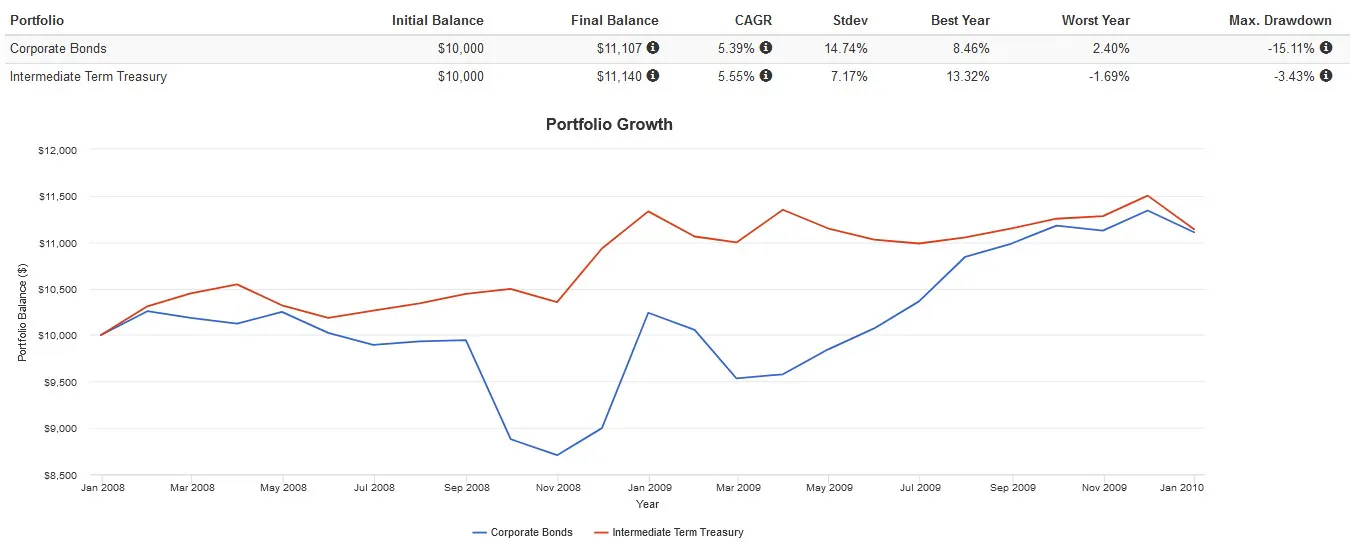
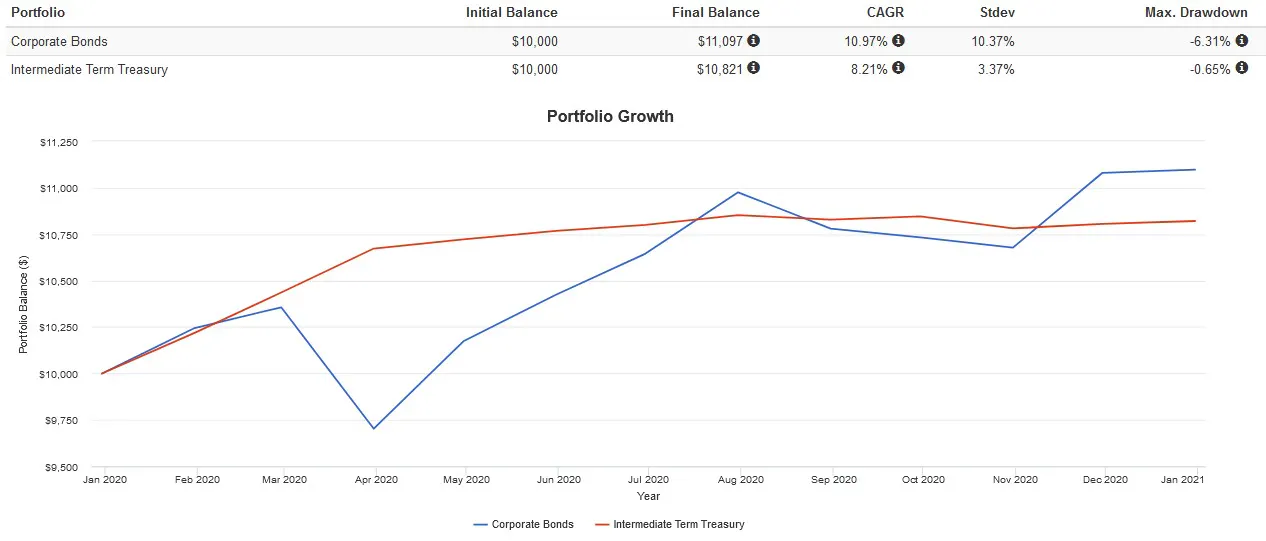
This is precisely the opposite of what I would want my bonds to do. I want my bonds to be negatively correlated with equities during a crash, as to give me the ability to sell them higher and use the proceeds to rebalance into stocks. Corporate bonds simply fail to do this, and aggregate bond funds that allocated 40-50% to corporate bonds are sacrificing protection.
The only time I would consider using corporate bonds is as income for a retirement portfolio in the withdrawal stage. In that case, the higher yield of corporate bonds might be preferable and can augment distributions from dividend stocks and preferred shares.
What bond funds to use then?
To make a long story short – in my opinion, Treasury bonds are the objectively superior portfolio diversifier and hedge against equity risk. When it comes to picking Treasury bond ETFs, investors have several choices, each with its own risk-return profile.
- STRIPS: Stand for Separate Trading of Registered Interest and Principal of Securities bonds. The duration on these assets is usually in excess of 25+ years, making them very sensitive to interest rate changes. During a crash, if rates are dropped, STRIPS may strongly outperform. When rates rise, STRIPS are likely to lose a lot of value. An example would be the Vanguard Extended Duration Treasury ETF (EDV).
- Long-term Treasury: These generally include Treasury bonds with around 15 – 20+ years in duration. They have less interest rate risk than STRIPS, but may perform less strongly during a deflationary crash when rates are cut. An example would be the iShares 20+ Year Treasury Bond ETF (TLT) or Vanguard Long-Term Treasury ETF (VGLT).
- Intermediate-term Treasurys: These generally include Treasury bonds with around 7 – 10 years in duration. They offer a good compromise between interest rate risk and crash protection and tend to be the default holding for many investors. An example would be the iShares 7-10 Year Treasury Bond ETF (IEF) or Vanguard Intermediate-Term Treasury ETF (VGIT).
- Short-term Treasurys: These generally include Treasury bonds with around 1-3 years in duration. They have much lower interest rate risk but tend to not gain as much value during a crash. An example would be the iShares 1-3 Year Treasury Bond ETF (SHY) or Vanguard Short-Term Treasury ETF (VGSH).
- Ultra-short term Treasurys: These generally include Treasury bills less than 1 year duration. This effectively immunizes them from interest rate risk, and they don't move much, if at all, during market crashes. This makes them a good way to store cash safely, albeit with a very low yield. An example would be the iShares 0-3 Month Treasury Bond ETF (SGOV) or the SPDR Bloomberg 1-3 Month T-Bill ETF (BIL).
An even easier hands-off way to hold Treasurys from across the yield curve with an average 7-year duration is via the iShares Core U.S. Treasury Bond ETF (GOVT).
My preferred way of selecting my Treasury bond allocation is to match the duration of the fund(s) to my investment horizon. In my case, I am planning to (hopefully) retire at age 55, which would be just under 30 years away. Hence, I might choose a product like EDV, as I am able to tolerate the high interest rate risk.
In return, I get the strongest hedge against equity risk thanks to its high volatility and low-negative correlation (when rates aren't rising that is). As I get older, I can simply add lower duration Treasury ETFs until the average duration of my fixed-income allocation matches my remaining time horizon.
Latest ETF News
See all ETF news10-Year Treasury Yield Hits 5%: Which Bond ETFs Offer the Most Direct Exposure?

ETF comparison: NEOS S&P 500 High Income ETF (SPYI) Versus Goldman Sachs S&P 500 Premium Income ETF (GPIX)

There’s an ETF for That? Investing Like University Endowments

Could Water ETFs Be the Next AI Bottleneck Trade?

What is a Boomer Candy ETF?



 Advantages of ETFs over Mutual Funds1/6
Lower Costs
In this guide, we'll explore the advantages of ETFs over mutual funds, giving you valuable insights into why ETFs have gained significant popularity among investors like yourself.
Leveraged ETFs: Unlocking the Potential for Amplified Returns1/6
Understanding Leveraged ETFs
Explore leveraged ETFs: potential for amplified returns & risks. 5 ETFs to consider across equities, commodities & fixed income.
What is a Leveraged ETF?1/6
Introducing Leveraged and Inverse ETFs
In this guide, we'll dive into the world of leveraged ETFs, exploring their definition, mechanics, potential risks, and rewards.
Recent educational content

ETF Trends
ETF Industry KPIs September 22, 2026
This week’s KPI data overview highlights key metrics and trends shaping the ETF landscape.


First Look ETF
First Look ETF: Income, Corporate Arbitrage, and Growth and Value Investing
First Look ETF September 2026: iCapital, Mast Investments and North Square unpack new ETFs targeting monthly income, merger arbitrage and complementary growth and value exposure.

ETF Trends
ETF Industry KPIs September 14, 2026
This week’s KPI data overview highlights key metrics and trends shaping the ETF landscape.
ETF Trends
ETF Industry KPIs September 8, 2026
This week’s KPI data overview highlights key metrics and trends shaping the ETF landscape.
Browse all educational columns



Build and Analyze Your ETF Portfolio Like a Pro
Create your own ETF portfolio in minutes and instantly see allocations, exposures, performance, and risk. Visualize diversification across asset classes, regions, and sectors. Stress-test ideas, compare benchmarks, and refine your strategy with professional-grade analytics.