Turn ETF ideas into real portfolios. Try the builder now →



The Bogleheads 3-Fund ETF Portfolio
Here's how to create the ultimate hands-off investment portfolio using passive index ETFs.


Keep up with what matters in ETFs
Get timely ETF insights, market trends, and top ideas straight to your inbox.
Your newsletter subscriptions with us are subject to ETF Central's Privacy Policy and Terms and Conditions.
I'm really not a fan of active management, particularly when it comes to stock picking. While I have a soft spot in my heart for managed futures and hedge funds (for their ability to deliver uncorrelated returns and mitigate risk), the same cannot be said for stock picking.
There is ample evidence to suggest that most stock pickers, whether professionals or retail investors, tend to underperform a simple index fund over time. There are a lot of reasons for why this is so, some economical, some behavioural, but it all boils down to the realization that the market is incredibly efficient and knows much more than you and I.
Investors who accept this reality early can instead focus on matching the market's return via index funds. These are investment instruments that pool various stocks and bonds together in a passive manner. That is, no fund manager is trying to pick and choose which stocks will do well.
One of the most popular ways to invest passively is via a 3-fund portfolio, as advocated for by the "Bogleheads." Bogleheads are followers of Jack Bogle's passive investment philosophy. As the founder and former Chairman of the Vanguard Group (and inventor of the first index fund), Bogle revolutionized passive investing, allowing retail investors to match the market with little cost or effort.
Like what you're reading?
Stay in the loop — get the latest ETF insights: trends, analysis, and expert picks.
Why a 3-fund portfolio?
Jack Bogle famously said: "Don’t look for the needle in the haystack – just buy the haystack!" He meant that investors shouldn't try and pick which stocks, sectors, market caps, or geographies are likely to outperform.
Instead, they should invest in the total market, buying every single stock and bond based on their current market cap and representation, making consistent contributions, and staying the course when time gets rough. Investors who follow this approach are quite literally "investing in the world."
The Boglehead 3-fund portfolio is usually comprised of three different assets:
- A total U.S stock market fund
- A global ex-U.S. stock market fund
- A total U.S. market bond fund (0 – 60% depending on risk tolerance and time horizon)
By buying these three funds, investors accept that they will receive the average return of the global market at all times. This offers extreme diversification – the chance of a particular sector or geography doing poorly is less likely to tank your performance.
As a result, the portfolio offers a good risk-return profile, at the cost of slightly lower total returns. Take a look at the performance of a 60/20/20 U.S. / Global / Bonds Bogleheads 3-fund portfolio compared to the S&P 500 below:
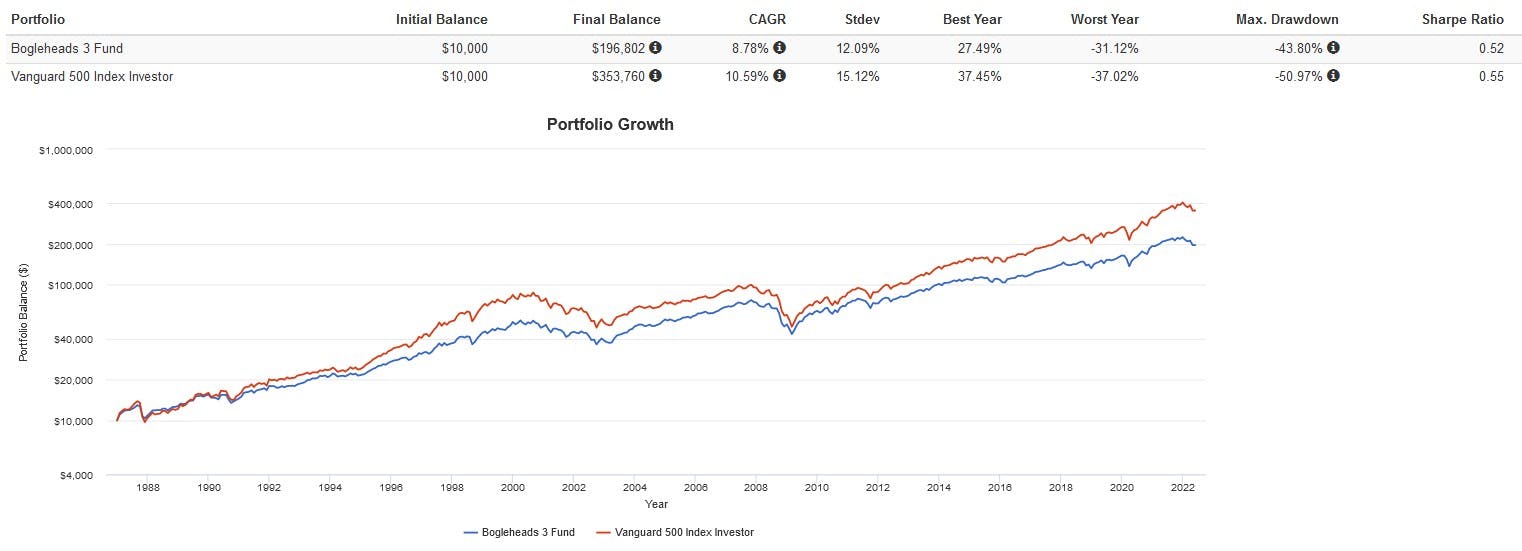
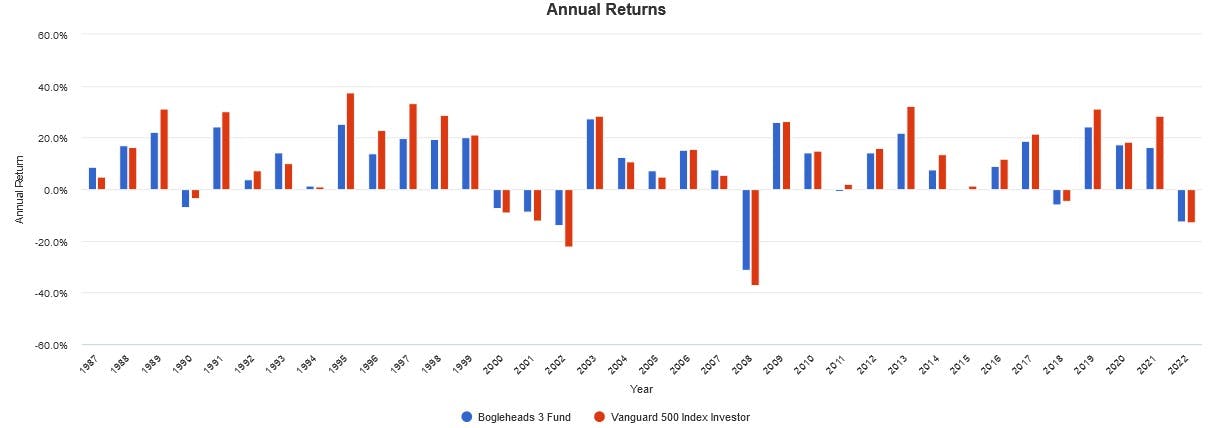
The common mistakes investors make when rejecting the 3-fund portfolio is pointing to the outperformance of U.S. stocks over international stocks and bonds, or a particular sector of stocks (like technology) versus the total stock market. That is a common fallacy – relying on past returns to predict future ones.
We don't know if the U.S. or tech stocks will continue to outperform or not, and historically there have been many periods where international stocks and even bonds outperformed. The Bogleheads way means investing in the total world market according to its current composition, and not just the U.S. This is the best way to mitigate the types of catastrophic risks that could really derail your investment portfolio.
What ETFs to use?
To build the 3-fund portfolio, we have to find the right ETFs that hold our assets of choice. A great way to do this is via ETF Central’s screener, by filtering for equity index and fixed-income EFTs. We're going to use Vanguard ETFs to keep with the spirit of Bogleheads, but iShares ETFs work too (and can often be used as tax-loss harvesting pairs).
Investors can choose to break up their global stock allocation into U.S. and ex-U.S ETFs. Holding international ETFs in a taxable account can allow investors to claim a foreign tax credit. Investors can also further split the international ETFs into developed and emerging market ETFs, but I prefer not to for simplicity and ease of rebalancing.
Vanguard Total Stock Market ETF (VTI)
- Assets under management: $246 billion
- Expense ratio: 0.03%
- Index: CRSP U.S. Total Market Index
- Market cap: Large/mid/small
- Geography: U.S.
- Strategy: Passive index
- Holdings: 4,100
Vanguard Total International Stock ETF (VXUS)
- Assets under management: $246 billion
- Expense ratio: 0.07%
- Index: FTSE Global All Cap Ex U.S. Index
- Market cap: Large/mid/small
- Geography: International developed, international emerging
- Strategy: Passive index
- Holdings: 7,871
For global stocks, investors can also use a one-ticket solution to turn the 3-fund into an even simpler 2-fund portfolio, at the cost of a slightly higher expense ratio:
Vanguard Total World Stock ETF (VT)
- Assets under management: $22 billion
- Expense ratio: 0.07%
- Index: FTSE Global All Cap Index
- Market cap: Large/mid/small
- Geography: U.S., international developed, international emerging
- Strategy: Passive index
- Holdings: 9,488
Finally, investors with a lower risk tolerance or shorter time horizon should consider a bond allocation. Bogle recommended holding the total U.S. bond market, which is comprised of Treasurys and investment-grade corporate bonds averaging an intermediate (7-9 year) duration. This strikes a sweet spot between crash protection and interest rate risk. Investors can also opt to just hold Treasury bonds for a better hedge against equity risk at the cost of lower yields or international bonds, but the Bogleheads way is to just buy the total U.S. bond market.
Vanguard Total Bond Market ETF (BND)
- Assets under management: $80 billion
- Expense ratio: 0.035%
- Index: Bloomberg U.S. Aggregate Bond Index
- Duration: Intermediate (6.7 years)
- Yield to maturity: 3.3%
- Holdings: 10,173
Latest ETF News
See all ETF newsThere’s an ETF for That? Investing Like University Endowments

Could Water ETFs Be the Next AI Bottleneck Trade?

What is a Boomer Candy ETF?

ETF Comparison: NEOS Nasdaq-100 High Income ETF (QQQI) Versus Goldman Sachs Nasdaq-100 Premium Income ETF (GPIQ)




 Advantages of ETFs over Mutual Funds1/6
Lower Costs
In this guide, we'll explore the advantages of ETFs over mutual funds, giving you valuable insights into why ETFs have gained significant popularity among investors like yourself.
Leveraged ETFs: Unlocking the Potential for Amplified Returns1/6
Understanding Leveraged ETFs
Explore leveraged ETFs: potential for amplified returns & risks. 5 ETFs to consider across equities, commodities & fixed income.
What is a Leveraged ETF?1/6
Introducing Leveraged and Inverse ETFs
In this guide, we'll dive into the world of leveraged ETFs, exploring their definition, mechanics, potential risks, and rewards.
Recent educational content

ETF Trends
ETF Industry KPIs September 14, 2026
This week’s KPI data overview highlights key metrics and trends shaping the ETF landscape.

ETF Trends
ETF Industry KPIs September 8, 2026
This week’s KPI data overview highlights key metrics and trends shaping the ETF landscape.
ETF Trends
ETF Industry KPIs August 31, 2026
This week’s KPI data overview highlights key metrics and trends shaping the ETF landscape.
ETF Trends
ETF Industry KPIs August 24, 2026
This week’s KPI data overview highlights key metrics and trends shaping the ETF landscape.
Browse all educational columns



Build and Analyze Your ETF Portfolio Like a Pro
Create your own ETF portfolio in minutes and instantly see allocations, exposures, performance, and risk. Visualize diversification across asset classes, regions, and sectors. Stress-test ideas, compare benchmarks, and refine your strategy with professional-grade analytics.