Global ETF Survey Is Live! 600+ ETF Professionals Weigh In. See Results →



Return stacking using ETFs: A strategy to beat the market?
It sounds complicated and scary, but return stacking is a strategy commonly used by institutional investors.


Keep up with what matters in ETFs
Get timely ETF insights, market trends, and top ideas straight to your inbox.
Your newsletter subscriptions with us are subject to ETF Central's Privacy Policy and Terms and Conditions.
A common complaint I hear from friends and family when I urge them to diversify their portfolios is "allocating 10%, 20%, or 40% to bonds and alternatives decreases my returns". They actually have a point here worth delving into.
For most investors, the easiest and most intuitive (albeit inefficient) way to increase compound annual growth rate (CAGR) is via a high stock allocation. Those familiar with Modern Portfolio Theory know that a 100% stock portfolio is absolutely not on the efficient frontier, but for many, it suffices to get the returns desired, albeit with disproportionately high volatility.
Mixing in bonds (especially Treasurys) and alternatives like commodities and gold improves risk-adjusted returns. That is, we gain more units of return per units of risk taken. This is the beauty of holding a portfolio of non-correlated volatile assets – otherwise known as "diversification".
Global ETF Survey 2026 is Live!
With 1,790 new products launched by July 2026, choosing is harder than ever. Our Global ETF Survey 2026, built on 620 professional investors and allocators, shows how active, fixed income, options-based and thematic ETFs are reshaping fund selection.
Have your lunch, and eat it too?
What if there was a way to gain the benefits of diversification, but also some, if not most of the higher returns associated with a 100% stocks portfolio? The solution here is leverage.
Leverage allows investors to take an efficient portfolio (like a 40/40/20 stocks/bonds/alts) portfolio and ramp it up to either have:
- The same risk, but higher return as per a 100% stock one; or
- The same return, but lower risk as per a 100% stock one.
Consider this backtest of a 1.5x leveraged 60/40 portfolio of the S&P 500 and U.S. intermediate Treasurys (rebalanced quarterly, 5% annual cost of leverage) vs a portfolio of the S&P 500 only:
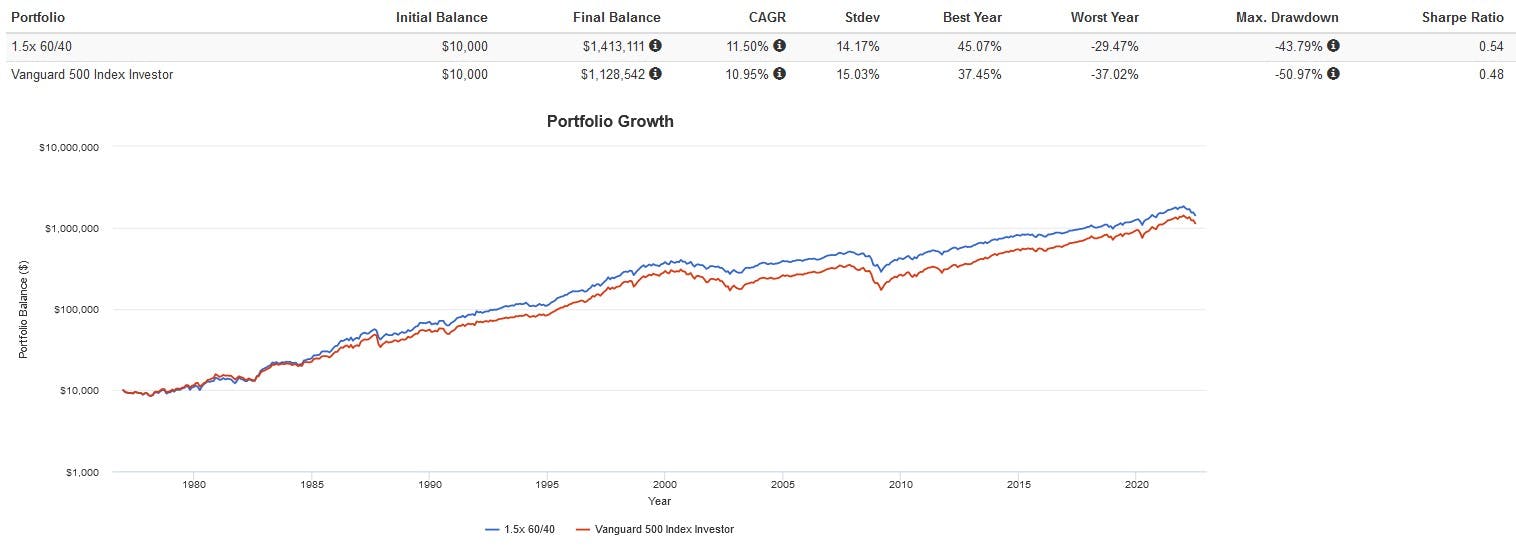
The 1.5x 60/40 had higher CAGR, lower volatility, smaller drawdowns, and a better Sharpe ratio. All we did was take a vanilla 60/40 portfolio and leverage it up a bit to match and beat the performance of 100% stocks.
This is called return stacking – adding uncorrelated volatile assets together, and then applying leverage until you get your desired risk-return profile. This isn't anything new. If you're a pension fund officer, you're probably familiar with this under the guise of "capital efficient investing". A very brave investor on the Bogleheads forum did a 3x leveraged version of this, known as Hedgefundie's Excellent Adventure.
Ways to return stack
So, can we construct a return stacked ETF portfolio? The short answer is yes. Investors can easily purchase a stock, Treasury, and gold ETF in, say, a 40/40/20 proportion. Then, the investor can use portfolio margin to leverage it up, say, 1.5x. This would result in 60/60/30 exposure. However, using margin is subject to changes in borrow rates, and always leaves you open to margin calls.
Investors can also use derivatives like long-dated in-the-money (ITM) call options on ETFs (known as long-term equity appreciation securities, or LEAPS), or index, Treasury, and commodity futures. A discussion of these approaches is beyond the scope of this article, but in general they require sophisticated knowledge and a healthy risk tolerance.
So that leaves ETFs, and the leveraged types at that. Many of these ETFs are daily resetting leverage, in that they only aim to provide 2x, or 3x the daily returns of their underlying index. As disclosed in their prospectus, fact sheet, and marketing materials, they are not intended to be held long-term. They are primarily short-term trading instruments.
The math of how the geometric return works (so-called "volatility decay") can cause their performance to vary wildly if held longer than the daily target, especially if the underlying index is highly volatile or does not have positive expected returns (I suggest giving this paper a read to understand). As well, these funds often have high expense ratios and hidden drags on performance from the cost of borrowing on their underlying swaps.
Return stacked ETFs
However, there are some leveraged ETFs that are intended to be held long-term. The best example I can think of is the Wisdomtree U.S. Efficient Core Fund (NTSX). Every $100 invested in the ETF is allocated as such:
- 90% goes into a portfolio of 500 large-cap U.S. equities.
- 10% is held as cash collateral for intermediate treasury futures providing 6x embedded leverage.
Therefore, the portfolio's notional exposure is 90% stocks, 60% bonds, or 90/60. Note that this is literally just a 60/40 portfolio on 1.5x leverage. Wisdomtree's decision to leverage the bond side using futures is both tax-efficient and avoids the usual issues with daily resetting leverage and volatility decay.
Now investors can just use NTSX on its own to gain access to a 1.5x leveraged 60/40 portfolio, which has historically beaten the S&P 500. Another way to use NTSX is as a 60/40 portfolio, which can be done by holding 67% NTSX, and 33% in cash. Check out this backtest of how this combination compares to other ways of creating a 60/40:
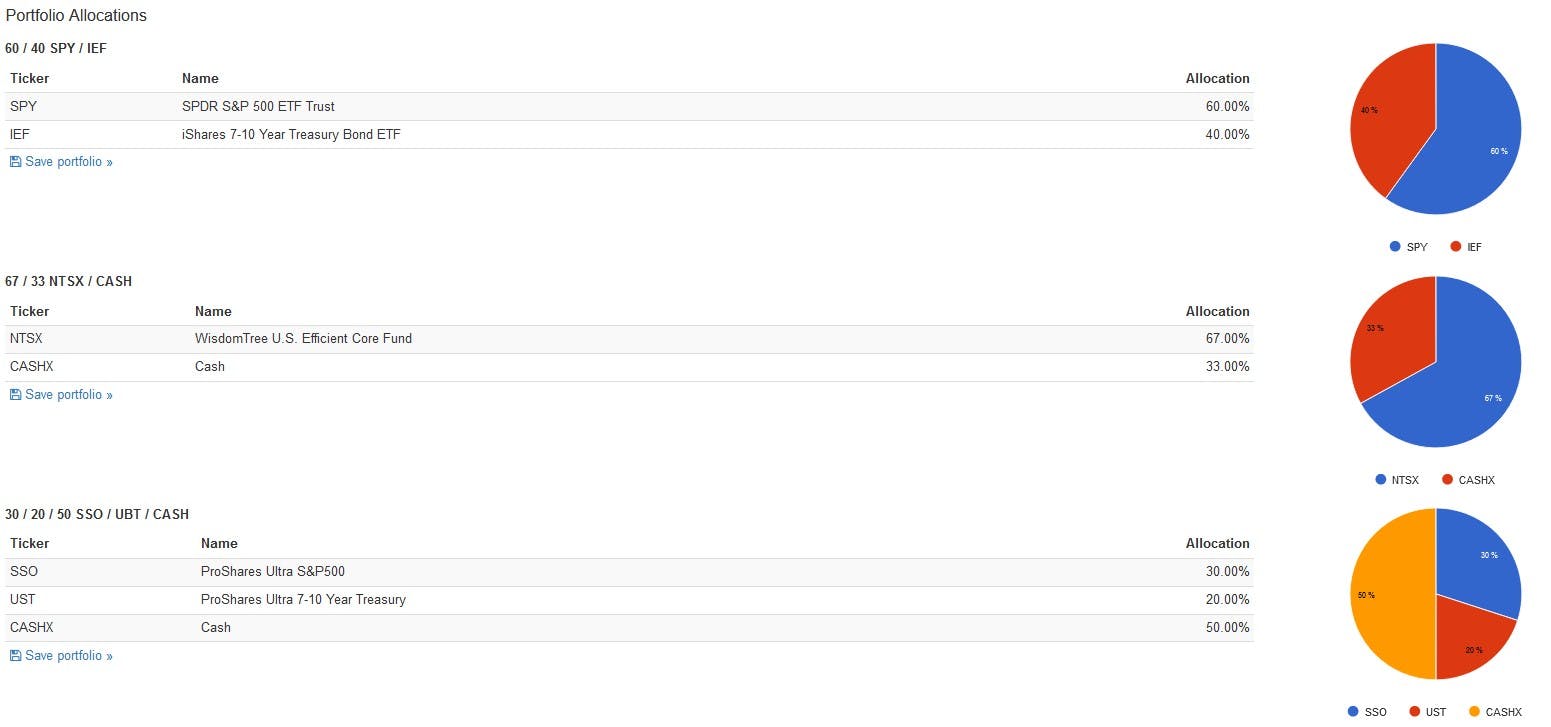
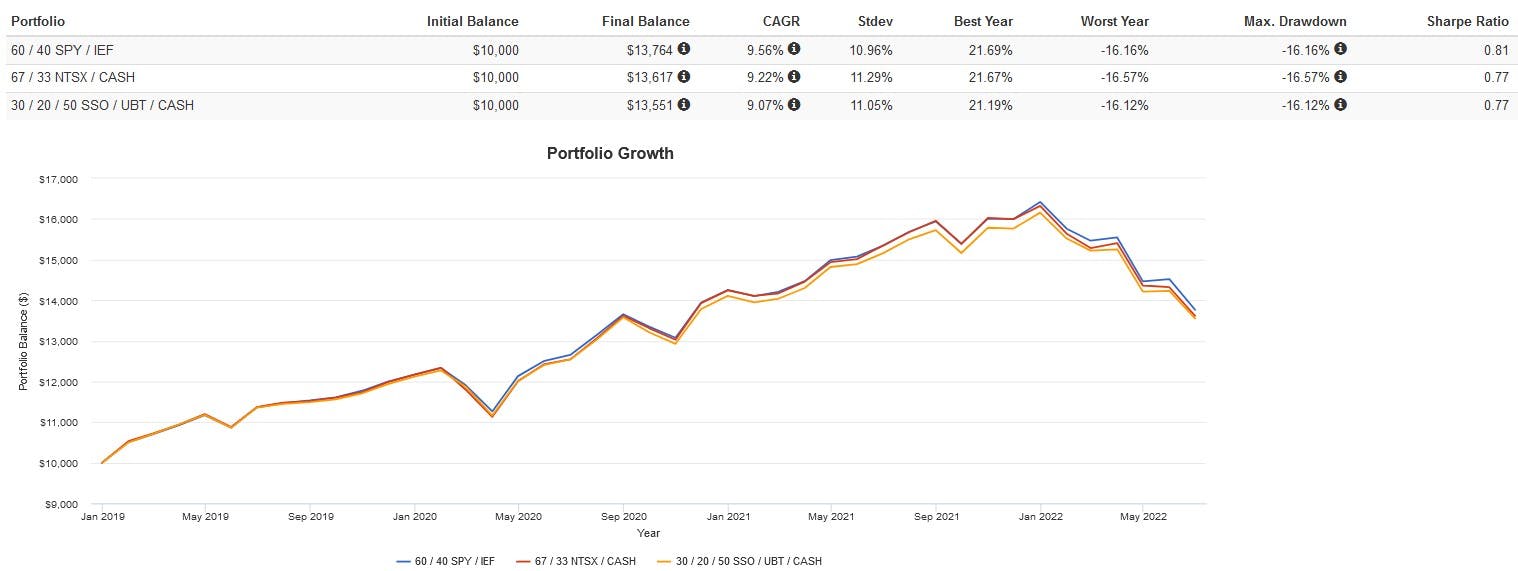
Notice how close the NTSX/cash combination comes to the traditional 60/40. I also reviewed a 60/40 using leveraged ETFs for portfolio #3, in this case a 2x leveraged S&P 500 ETF and a 2x leveraged intermediate treasury ETF, along with cash. It came out to around the same return and risk, but with some drag due to higher expense ratios and volatility decay.
The smartest way (in my opinion) to use NTSX is by holding it as 67% of your portfolio. This way, you get the risk/returns of a traditional 60/40, but with 33% more capital to allocate. A great way to improve risk and returns further is by allocating the 33% to additional non-correlated diversifiers. Personally, I prefer managed futures (systemic trend following ones) and gold, but a broad basket of commodities can work as well.
I'll conclude by warning that this strategy is not risk free. Return stacking depends on correlations, or a lack of. During certain market conditions, correlations can turn positive, with disastrous results. This is why bonds have fallen as much as stocks have so far in 2022, with disastrous results for retirees relying on a "balanced" 60/40 portfolio. This can be mitigated by stacking on more uncorrelated assets, but only to a certain degree.
Latest ETF News
See all ETF newsBeyond Big Tech: The Increasing Specialization of AI ETFs

There's an ETF for That? Humanoid Robotics and Physical AI

How Some ETF Issuers Use Their Own Funds for Cash Management

These Public-Private ETFs Invest in Polymarket and Anduril

There's an ETF for That? Frontier Markets



 Advantages of ETFs over Mutual Funds1/6
Lower Costs
In this guide, we'll explore the advantages of ETFs over mutual funds, giving you valuable insights into why ETFs have gained significant popularity among investors like yourself.
Leveraged ETFs: Unlocking the Potential for Amplified Returns1/6
Understanding Leveraged ETFs
Explore leveraged ETFs: potential for amplified returns & risks. 5 ETFs to consider across equities, commodities & fixed income.
What is a Leveraged ETF?1/6
Introducing Leveraged and Inverse ETFs
In this guide, we'll dive into the world of leveraged ETFs, exploring their definition, mechanics, potential risks, and rewards.
Recent educational content
First Look ETF
First Look ETF: Income, International, and Cash Flow ETFs
In this season 6 episode of First Look ETF, Stephanie Stanton @etfguide examines the latest ETF marketplace trends with NYSE and guests.


ETF Trends
ETF Industry KPIs October 5, 2026
This week’s KPI data overview highlights key metrics and trends shaping the ETF landscape.

ETF Trends
ETF Industry KPIs September 28, 2026
This week’s KPI data overview highlights key metrics and trends shaping the ETF landscape.
ETF Trends
ETF Industry KPIs September 22, 2026
This week’s KPI data overview highlights key metrics and trends shaping the ETF landscape.