Global ETF Survey Is Live! 600+ ETF Professionals Weigh In. See Results →



Managed Futures ETFs: Diversifying investment portfolios
Alternative investments like managed futures are making a resurgence in today's market environment.


Keep up with what matters in ETFs
Get timely ETF insights, market trends, and top ideas straight to your inbox.
Your newsletter subscriptions with us are subject to ETF Central's Privacy Policy and Terms and Conditions.
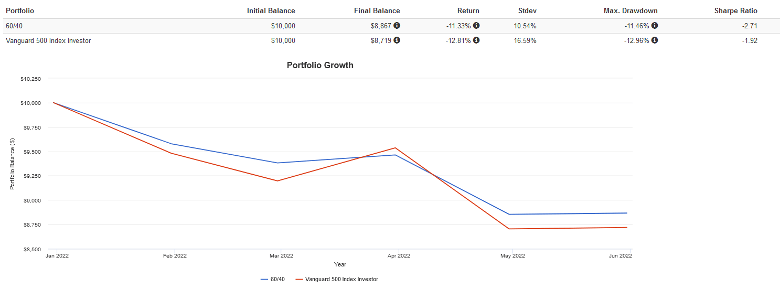
The modern portfolio theory principles of "stocks + bonds = diversification" utterly failed in 2022's rising interest rate and high inflation environment. Year-to-date, a 60/40 portfolio of the S&P 500 and U.S. Treasurys has drawn down worse than a 100% S&P 500 portfolio, as seen below:
The problem here lies with bonds and is twofold:
1. Modified duration: Rising rates spell trouble for fixed-income assets with a higher modified duration (a measurement of bond price sensitivity to interest rate changes), with intermediate and long-term bonds (traditionally used in fixed income allocations) suffering more.
2. Correlation: The historically negative correlation seen between stocks and Treasurys has increased sharply. Monthly correlations between U.S. Treasurys and stocks are now sitting at around 0.18, which severely reduces their diversification benefit.
Global ETF Survey 2026 is Live!
With 1,790 new products launched by July 2026, choosing is harder than ever. Our Global ETF Survey 2026, built on 620 professional investors and allocators, shows how active, fixed income, options-based and thematic ETFs are reshaping fund selection.
The quest for alternatives
Portfolio management in 2022 is now based on finding alternative assets with a low to negative correlation with both stocks and bonds, possess high volatility with a good risk-return profile, and also a positive carry (i.e. they don't decay in value over time). This rules out several traditional alternatives:
- Gold: Decently low monthly correlation with stocks and bonds (0.19 and 0.11 at time of writing), high volatility, but ultimately has flat expected returns (an ounce of gold 100 years later is still an ounce, it may keep its purchasing power, but does not intrinsically produce value).
- Commodities: Decently low/negative correlation with stocks and bonds (0.38 and -0.70 at time of writing) but suffers from contango due to the use of futures contracts and has a negative carry due to storage and roll costs over time.
- VIX Futures: Most negative correlation with stocks and bonds (-0.94 and -0.29 at time of writing) and high volatility, but has severe negative carry and will quickly lose value over time due to mean reversion and contango.
Enter managed futures
Managed futures are a portfolio of futures contracts actively overseen by a team of Commodity Trading Advisors (CTA's). They're designed to offer exposure to multiple asset classes (equities, commodities, fixed-income, currency, etc.) using hedge-fund-like strategies like long/short, market neutral, global macro, and trend-following, to name a few.
The goal of managed futures is to produce uncorrelated or inversely correlated returns with stocks and bonds in order to add further diversification to a portfolio. They also aim to produce positive returns irrespective of market conditions (like hedge funds do). Overall, they tend to outperform in volatile or bear markets but underperform in low volatility bull markets.
I selected two managed futures ETFs using the ETF Central Screener:
- iMGP DBi Managed Futures Strategy ETF: 0.85% expense ratio.
- KFA Mount Lucas Strategy ETF (KMLM): 0.90% expense ratio.
Both ETFs possess a strong negative correlation with both equities and Treasurys and have outperformed the stock and bond markets significantly in 2022. A portfolio with a 20% allocation to managed futures would have lost significantly less this year.


Are managed futures a good idea?
Managed futures are an active strategy. Investing in managed futures ETFs means entrusting your portfolio's performance to a team of CTA's and their skill (or potential lack of) in navigating market conditions. Compare this to a hands-off index or a smart-beta fund that uses a systematic screening criterion. A way to mitigate this is by investing in a managed futures ETF that tracks the performance of multiple hedge funds, like DBMF, which follows the SG CTA Index.
Tracking error is also a concern. Managed futures may have outperformed recently, but in previous years, many of these products had a flat performance. Most investors cannot handle the cognitive dissonance of seeing mediocre performance of their portfolio during a bull run. Some will capitulate and chase performance by selling their managed futures positions and be left without protection during the next market crisis. Using managed futures is an explicit acknowledgement that you're willing to accept lower overall returns for better risk-adjusted returns in the long run.
Finally, fees are high. The average managed futures ETF costs an expense ratio of 0.90%, with some mutual fund variants costing upwards of 1% or more. Compare this to vanilla index funds that cost just 0.03% in some cases. This can significantly eat into your returns in flat years and over long periods of time. Like insurance, you have to size your risk tolerance and decide if the protection and additional diversification are worth paying for.
Segments
See all
No specific market segments were tagged
Mentioned ETFs
Further reading

Latest ETF News
See all ETF newsBeyond Big Tech: The Increasing Specialization of AI ETFs

There's an ETF for That? Humanoid Robotics and Physical AI

How Some ETF Issuers Use Their Own Funds for Cash Management

These Public-Private ETFs Invest in Polymarket and Anduril

There's an ETF for That? Frontier Markets



 Advantages of ETFs over Mutual Funds1/6
Lower Costs
In this guide, we'll explore the advantages of ETFs over mutual funds, giving you valuable insights into why ETFs have gained significant popularity among investors like yourself.
Leveraged ETFs: Unlocking the Potential for Amplified Returns1/6
Understanding Leveraged ETFs
Explore leveraged ETFs: potential for amplified returns & risks. 5 ETFs to consider across equities, commodities & fixed income.
What is a Leveraged ETF?1/6
Introducing Leveraged and Inverse ETFs
In this guide, we'll dive into the world of leveraged ETFs, exploring their definition, mechanics, potential risks, and rewards.
Recent educational content
First Look ETF
First Look ETF: Income, International, and Cash Flow ETFs
In this season 6 episode of First Look ETF, Stephanie Stanton @etfguide examines the latest ETF marketplace trends with NYSE and guests.


ETF Trends
ETF Industry KPIs October 5, 2026
This week’s KPI data overview highlights key metrics and trends shaping the ETF landscape.

ETF Trends
ETF Industry KPIs September 28, 2026
This week’s KPI data overview highlights key metrics and trends shaping the ETF landscape.
ETF Trends
ETF Industry KPIs September 22, 2026
This week’s KPI data overview highlights key metrics and trends shaping the ETF landscape.