ETF model portfolios designed for real investor needs. Discover →



U.S. investors: Total Stock Market or S&P 500?
Here's how to decide which index to buy and hold.


Keep up with what matters in ETFs
Get timely ETF insights, market trends, and top ideas straight to your inbox.
Your newsletter subscriptions with us are subject to ETF Central's Privacy Policy and Terms and Conditions.
I'm a strong advocate for passive investing using index ETFs. Over the long run, this approach beats the majority of not only stock pickers, but also expensive actively managed funds out there. A simple buy-and-hold mentality along with consistent contributions can create lasting generational wealth with little to no effort.
That being said, one question passive investors tend to wrestle with is whether to buy an index fund that tracks just the S&P 500, or the Total U.S. Stock Market. Both can be excellent, low-cost, core portfolio holdings, but how do investors decide which one to pick with so many options out there?
Get data on 14,000+ ETFs
Access Trackinsight's reliable and comprehensive data with 500M+ points on 14,000+ ETFs.
What are the two options for investors?
Most readers are probably very familiar with the S&P 500, a market-capitalization weighted index of the 500 largest publicly traded U.S. companies. Over time, the S&P 500 has evolved into a benchmark for professional fund managers and retail investors to compete against. ETFs tracking the S&P 500 are highly popular, with trillions in assets under management, high liquidity, and minimal bid-ask spreads.
The U.S. stock market doesn't end at just the S&P 500, though. There are still another 3,000+ mid and small-cap stocks floating around. Combining the S&P 500 and these 3000+ other stocks gives us the CRSP US Total Market Index. By weight, around 80% of this is the S&P 500, with around 15% mid-caps and 5% small-caps. The CRSP is still heavily influenced by the S&P 500, given the large overlap of commonly held large-cap stocks between them.
Conveniently, Vanguard offers two low-cost ETFs for tracking these indexes:
- Vanguard S&P 500 ETF (VOO-0.44%): 0.03% expense ratio.
- Vanguard Total Stock Market ETF (VTI-0.49%): 0.03% expense ratio.
What's the difference between the S&P 500 and Total U.S. Stock Market?
Very little actually, unless you want to get very technical and detailed. For the average retail investor, their performance is indistinguishable at first glance. Take a look at the following back tests from 1992 to the present:
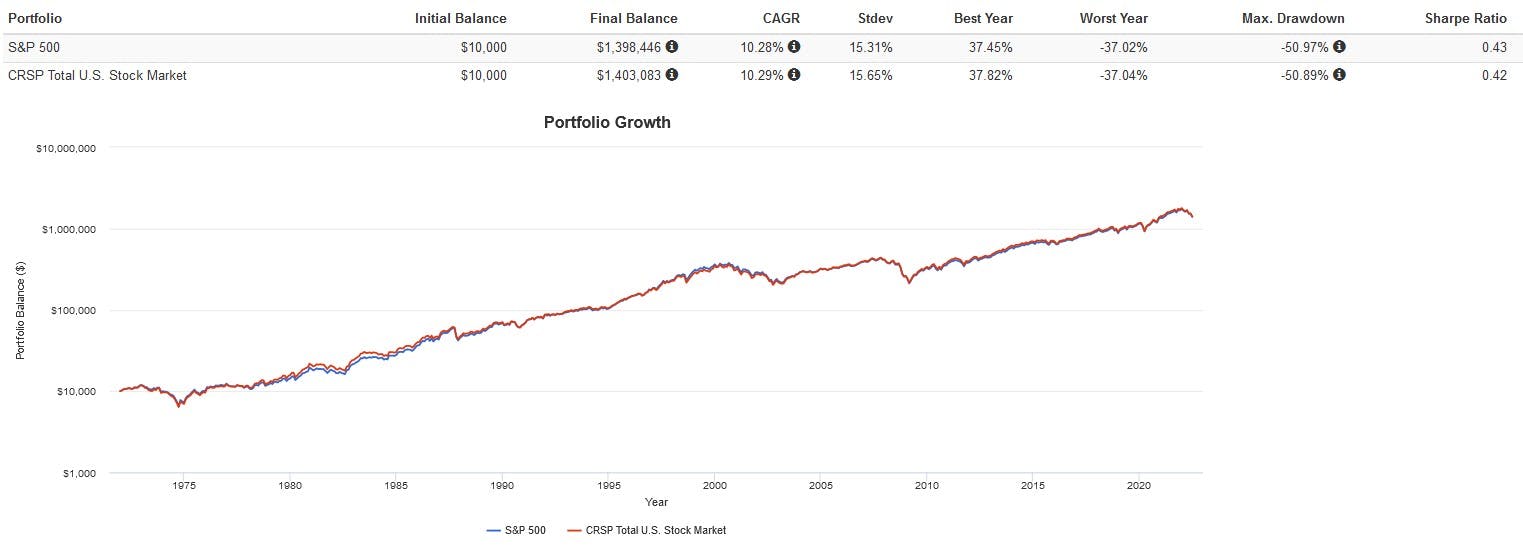
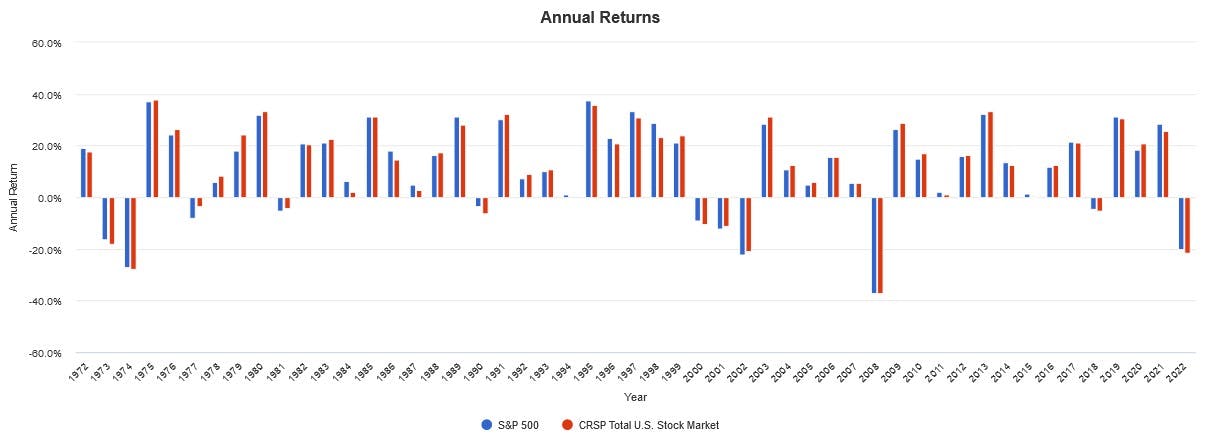
Because VTI holds 80% VOO, the two funds have a very high correlation. As of writing, it's around 0.99 measured monthly over various rolling 5-, 10-, and 20-year periods. The discernable difference here is slightly higher volatility and returns from VTI due to the inclusion of some mid and small-cap stocks. Overall risk-adjusted returns (Sharpe ratio), CAGR, volatility, and drawdowns remain nearly identical. Notice how both indexes take turns outperforming – this is due to the cyclical nature of small vs large-cap stocks.
VOO vs. VTI: which one is ideal?
Honestly, it's a coin toss here. It depends on your outlook for small vs large-cap stocks. Buffett was famously bullish on downtrodden U.S. large cap stocks as a value investor and selected VOO as the investment of choice for his estate. John Bogle favoured VTI, telling investors to "buy the haystack."
Over long periods of time, VTI and VOO will likely perform virtually identically, barring some small intra-year tracking error. The minimal amount of small and mid-caps in VTI is unlikely to differentiate it much from VOO in the long run. From a strict diversification perspective, VTI is broader and holds more stocks, but takes on very slightly higher volatility for a tiny bit more return.
A great alternative is using both as tax-loss harvesting pairs, given their high correlation and similar holdings, yet different underlying indexes. If you're not familiar with tax-loss harvesting, I suggest giving this article a read.
Latest ETF News
See all ETF newsThere’s an ETF for That? Investing Like University Endowments

Could Water ETFs Be the Next AI Bottleneck Trade?

What is a Boomer Candy ETF?

ETF Comparison: NEOS Nasdaq-100 High Income ETF (QQQI) Versus Goldman Sachs Nasdaq-100 Premium Income ETF (GPIQ)




 Advantages of ETFs over Mutual Funds1/6
Lower Costs
In this guide, we'll explore the advantages of ETFs over mutual funds, giving you valuable insights into why ETFs have gained significant popularity among investors like yourself.
Leveraged ETFs: Unlocking the Potential for Amplified Returns1/6
Understanding Leveraged ETFs
Explore leveraged ETFs: potential for amplified returns & risks. 5 ETFs to consider across equities, commodities & fixed income.
What is a Leveraged ETF?1/6
Introducing Leveraged and Inverse ETFs
In this guide, we'll dive into the world of leveraged ETFs, exploring their definition, mechanics, potential risks, and rewards.
Recent educational content
ETF Trends
ETF Industry KPIs September 14, 2026
This week’s KPI data overview highlights key metrics and trends shaping the ETF landscape.

ETF Trends
ETF Industry KPIs September 8, 2026
This week’s KPI data overview highlights key metrics and trends shaping the ETF landscape.
ETF Trends
ETF Industry KPIs August 31, 2026
This week’s KPI data overview highlights key metrics and trends shaping the ETF landscape.
ETF Trends
ETF Industry KPIs August 24, 2026
This week’s KPI data overview highlights key metrics and trends shaping the ETF landscape.
Browse all educational columns



Have you tried our ETF Compare tool?
Compare ETFs like a pro. Analyze fees, performance, exposure & holdings side-by-side.