Keep tabs on your favorite ETFs with a personalized weekly tracker. Create a Watchlist now →



Understanding contango and backwardation in Commodity ETFs
Want to invest in commodity ETFs? Give this article a read first.

Keep up with what matters in ETFs
Get timely ETF insights, market trends, and top ideas straight to your inbox.
Your newsletter subscriptions with us are subject to ETF Central's Privacy Policy and Terms and Conditions.
Inflows to commodity ETFs have increased significantly in 2022, and for a good reason. Commodities are one of the few asset classes in the green this year, thanks to soaring prices in crude oil, natural gas, corn, and even wheat, thanks to the Russian invasion of Ukraine and continued supply chain issues.
Commodities can make for great portfolio diversification thanks to their low correlation to both stocks and bonds. As an asset class, they are resistant to the conditions that cause both stocks and bonds to fall in tandem, namely high inflation coupled with rising interest rates (what we've seen so far in 2022).
That being said, commodities as an investment aren't exactly suitable for novice investors. Earlier this year, I covered some of the tax pitfalls associated with investing in commodity ETFs. In hindsight, I should have addressed today's topic on contango and backwardation first, as these two concepts have the biggest impact on risk and return.
Like what you're reading?
Stay in the loop — get the latest ETF insights: trends, analysis, and expert picks.
What is contango and backwardation?
They sound like fancy Italian dance moves, but make no mistake, contango and backwardation can make or break your commodity investing strategy.
To understand them, we have to break down how most commodity funds are constructed. Commodity funds gain exposure to commodities via futures contracts, which are derivatives consisting of a legal agreement to buy or sell an asset at a predetermined price at a specified date. This makes sense - after all, most investors can’t exactly buy and store barrels of crude oil in their homes.
The thing to note is that futures contracts expire. Commodities ETFs that use futures have to continually sell futures that are about to expire and buy later dated ones, a process called "rolling." This is where the problems begin:
- Contango occurs when the price of a futures contract is above the spot price of the commodity. This creates an additional cost for ETFs holding futures as the fund manager needs to sell the current contract as a loss while purchasing the latter dated one at a premium. This is called "negative roll yield" and can stunt returns.
- Backwardation is essentially the opposite of contango, where spot prices are higher than futures prices. This creates a positive roll yield, which can give commodities funds a boost.
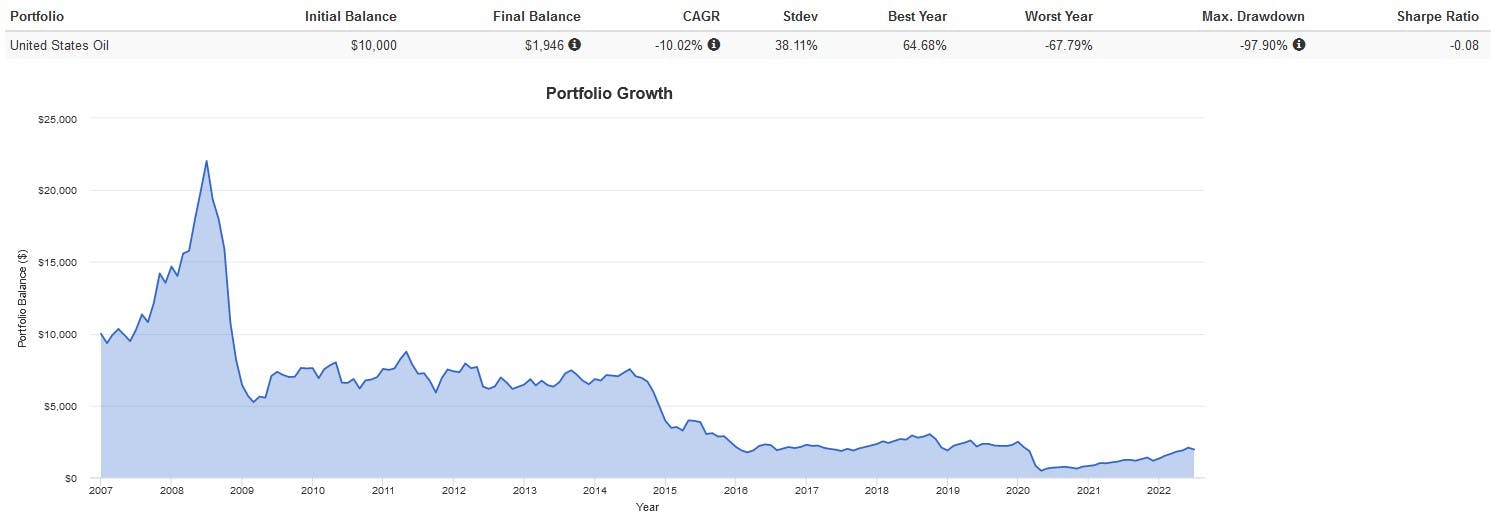
Most of the time, commodity futures are in contango. For example, the popular United States Oil Fund (USO) must roll its July 2022 expiry WTI crude oil futures contracts, by selling them and purchasing those that expire later in August 2022.
Due to this, USO loses money by having to sell the expiring futures contracts for cheap, while being forced to buy further dated futures contracts at a higher price. This causes the share price to decay despite the spot price of oil sometimes rising, as seen here below. For this reason, USO has strongly underperformed the actual price of spot oil.
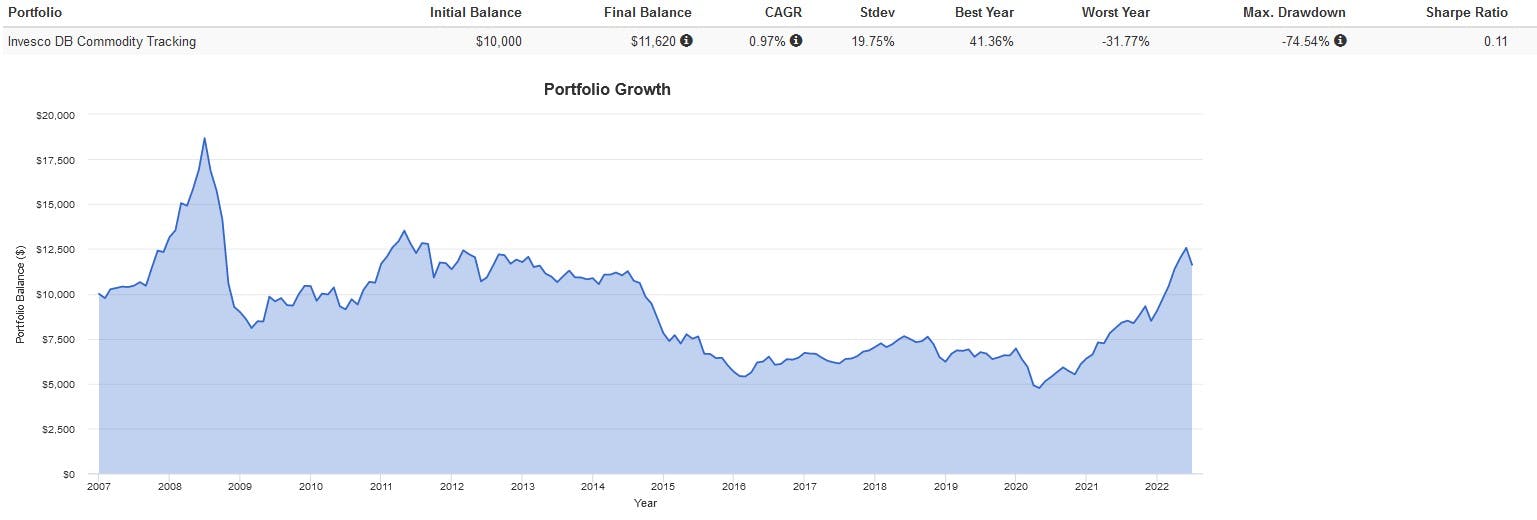
This phenomenon is less acute for ETFs holding a broad basket of commodities like the Invesco DB Commodity Index Tracking Fund ETF (DBC), given that the ETF holds more than just one type of futures contract, which mitigates the risk of the entire ETF being in contango.
Mitigating contango
A common strategy to mitigate the negative effects of contango is by buying commodity ETFs that actually hold the underlying product physically. Unfortunately, this is usually limited to commodities with low storage costs, such as gold, an example being the highly popular SPDR Gold Shares ETF (GLD). Good luck doing this with crude oil or something exotic like soybeans.
Some funds will use futures contracts but roll longer by buying further-dated expiries. This reduces how often the fund needs to roll, which can minimize the effects of contango. However, this can lead to tracking error compared to the spot price as short-term expiring futures tend to be more accurate.
Finally, commodity funds can ladder. Just like a bond ladder is made up of different maturities, a futures ladder holds futures contracts staggered out in date. The fund manager will sell the most expensive ones and buy the cheapest continually, with laddering providing far more flexibility in choosing which contracts to roll. This hedges against contango but can eliminate the benefits of potential backwardation.

Latest ETF News
See all ETF news10-Year Treasury Yield Hits 5%: Which Bond ETFs Offer the Most Direct Exposure?

ETF comparison: NEOS S&P 500 High Income ETF (SPYI) Versus Goldman Sachs S&P 500 Premium Income ETF (GPIX)

There’s an ETF for That? Investing Like University Endowments

Could Water ETFs Be the Next AI Bottleneck Trade?

What is a Boomer Candy ETF?



 Advantages of ETFs over Mutual Funds1/6
Lower Costs
In this guide, we'll explore the advantages of ETFs over mutual funds, giving you valuable insights into why ETFs have gained significant popularity among investors like yourself.
Leveraged ETFs: Unlocking the Potential for Amplified Returns1/6
Understanding Leveraged ETFs
Explore leveraged ETFs: potential for amplified returns & risks. 5 ETFs to consider across equities, commodities & fixed income.
What is a Leveraged ETF?1/6
Introducing Leveraged and Inverse ETFs
In this guide, we'll dive into the world of leveraged ETFs, exploring their definition, mechanics, potential risks, and rewards.
Recent educational content

ETF Trends
ETF Industry KPIs September 22, 2026
This week’s KPI data overview highlights key metrics and trends shaping the ETF landscape.

First Look ETF
First Look ETF: Income, Corporate Arbitrage, and Growth and Value Investing
First Look ETF September 2026: iCapital, Mast Investments and North Square unpack new ETFs targeting monthly income, merger arbitrage and complementary growth and value exposure.

ETF Trends
ETF Industry KPIs September 14, 2026
This week’s KPI data overview highlights key metrics and trends shaping the ETF landscape.
ETF Trends
ETF Industry KPIs September 8, 2026
This week’s KPI data overview highlights key metrics and trends shaping the ETF landscape.
Browse all educational columns



Expert-Built ETF Portfolios, All in One Place
Don’t start from scratch. Discover ready-made ETF portfolios built by professionals to match different goals, timelines, and market views. Use them as inspiration or as a starting point for your own allocation.