Global ETF Survey Is Live! 600+ ETF Professionals Weigh In. See Results →



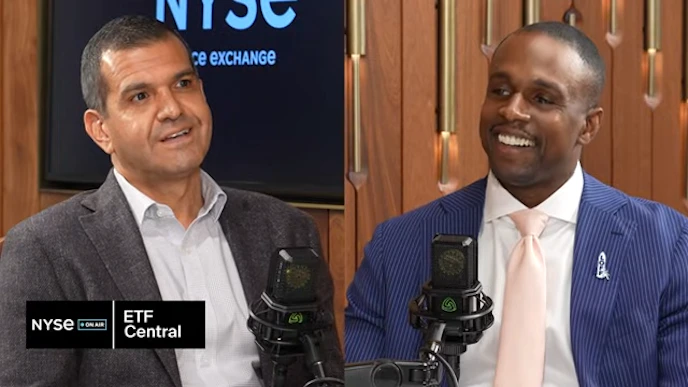
Carlos Diez has spent more than two decades thinking about what separates a compelling investment story from a genuinely strong company.
In this episode of ETF Central, the MarketGrader founder and CEO joins Bilal Little to discuss how technology, data, and disciplined portfolio construction can help investors cut through market noise. Their conversation moves from Diez’s early fascination with business to the evolution of rules-based investing, the changing role of AI, and why staying grounded in fundamentals may matter more than ever in a fast-moving market.
From Colombia to the Stock Market
Carlos Diez’s investing philosophy started long before MarketGrader existed.
Growing up in Colombia, Diez was fascinated by a simple question: who owns the businesses around us? Back then, many of the country’s largest companies were controlled by a relatively small number of families. That stood in sharp contrast to the US model, where public markets allowed ordinary savers to become owners of major businesses.
That idea stuck.
After leaving Colombia as a teenager, finishing high school in Philadelphia and attending Pepperdine University, Diez found himself in the middle of the late 1990s dot-com boom. Friends and soccer teammates were buying stocks because they were rising, often without knowing what the companies actually did.
Sound familiar?
Diez saw the problem clearly. Investors needed a way to understand whether a company was fundamentally strong without earning an accounting degree or spending weekends buried in financial statements.
He graduated in 1999 and founded MarketGrader that December.
Turning Financial Statements Into Something Usable
MarketGrader’s original mission remains surprisingly intact.
The company analyzes publicly traded businesses and translates financial data into ratings that investors can actually use. Roughly a third of the business comes from research and ratings, while the other two-thirds revolves around indexes and portfolios built from those ratings.
MarketGrader launched its first rating system in 2003.
Today, its research spans roughly 41,000 stocks across 93 markets, along with virtually every US-listed equity ETF. Its users include individual investors, advisors, institutions and clients in about 40 countries.
The idea is straightforward: investors may love a company’s story, founder or product, but they should also know whether the numbers hold up.
That means asking unglamorous but useful questions. Are sales growing? Are earnings improving? Are margins healthy? Is management generating attractive returns on invested capital? Is the company borrowing heavily just to keep growth going?
Stories are fun. Cash flow still pays the bills.
Technology Was the Only Way to Scale
Diez did not start MarketGrader because he was chasing an AI theme.
Technology was simply necessary.
Analyzing financial statements for thousands of companies manually would require an army of analysts. Software offered leverage.
MarketGrader built systems to collect, extract, interpret and present financial information at scale.
That mindset eventually made AI a natural extension of what the company was already doing.
Diez describes MarketGrader as either a technology company operating in financial services or an indexing company heavily powered by technology.
Both descriptions work.
More importantly, he sees technology as a leveling tool. A relatively small organization can now build things that once required enormous resources.
Active or Passive? Maybe Both
Diez calls himself an indexer at heart, but he is also a fan of active management.
MarketGrader sits somewhere between the two.
Its indexes actively select companies based on quantitative ratings, but those selections follow transparent rules rather than a portfolio manager’s instincts. Nobody wakes up on Tuesday morning and decides they suddenly love semiconductors.
That removes one of investing’s trickiest variables: human attachment.
Traditional active managers can develop conviction, gut feelings and emotional connections to holdings. MarketGrader instead lets changing financial data determine which companies qualify and how portfolios are rebuilt.
The portfolios are active in what they own, but systematic in how they decide.
A Speed Bump for FOMO
Diez thinks that role matters even more today because markets move faster and narratives spread instantly.
Investors can easily feel they are missing the AI stock, sector or theme of the week. His view is that a disciplined portfolio should act as a speed bump.
The goal is not to prevent investors from taking moonshots. It is to give them a fundamentally grounded core so that every headline does not require a portfolio overhaul.
That philosophy also shapes his view of AI itself.
Diez does not see AI as merely another technology trade. He sees it becoming infrastructure, much like electricity or computers. Companies will eventually stop being asked about their "AI strategy" because using AI will simply become part of doing business.
And AI is not purely digital.
Its expansion requires data centers, power generation, raw materials and physical infrastructure. Diez believes this convergence between the digital and physical economies is fueling a major global capital expenditure cycle, with AI accelerating investment far beyond software and semiconductor companies.
How the Barron’s 400 Works
MarketGrader’s philosophy is perhaps most visible in the Barron’s 400 Index, which underlies the BARRON’S 400 ETF (BFOR).
The relationship with Barron’s dates back to the mid-2000s, when MarketGrader began providing company ratings for Barron’s readers.
That partnership eventually led to an index designed around what Diez calls "GARP plus quality," or growth at a reasonable price combined with measures of financial quality.
MarketGrader uses 24 indicators covering areas such as growth, valuation, profitability, cash flow, leverage and return on invested capital. Those indicators are recalculated daily and combined into a score from zero to 100.
Scores above 60 receive a buy rating. Scores below 50 receive a sell rating.
Historically, only about 15% of US companies in MarketGrader’s universe have earned a buy rating. Globally, that figure is roughly 13%.
The Barron’s 400 selects 400 highly rated US companies and reconstitutes twice a year, in March and September.
Crucially, it is equal weighted. Each company begins at roughly 0.25% of the index.
That prevents mega-cap stocks from swallowing the portfolio simply because their market values have ballooned.
Discipline Over Drama
Diez views the Barron’s 400 as a potential core US equity holding or complement to traditional market-cap-weighted exposure.
Its equal-weighting process also forces discipline. If a holding rises from 0.25% to 1% of the portfolio, the next rebalance can trim it back and redeploy those gains elsewhere. If a fundamentally strong company falls in price, its valuation may become more attractive rather than less.
No guesswork. No emotional debate about whether it is finally time to sell Nvidia.
That sums up MarketGrader’s broader mission: help investors own strong companies using a consistent framework rather than chasing whatever story happens to dominate the market today.
And when asked how he personally wants to be remembered, Diez did not mention indexes, ratings or technology.
He said he hopes people remember how he treated others.
Not a bad reminder for markets either. The tools matter. The process matters. But ultimately, discipline and character tend to compound too.
Please note this article is for information purposes only and does not in any way constitute investment advice. It is essential that you seek advice from a registered financial professional prior to making any investment decision.
Topics
See all
This article does not have a tagged topic
Segments
See all
No specific market segments were tagged