Open Now: The Global ETF Survey Take the Survey →



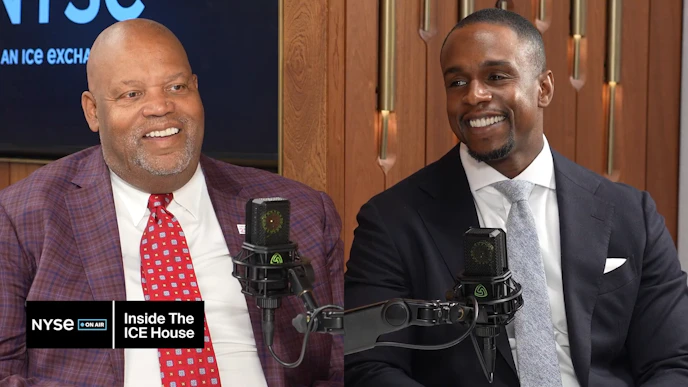
Reggie Browne, principal at GTS Securities and a pioneer of the ETF industry, joins Bilal Little on ETF Central to discuss the evolution of ETFs from their early beginnings to today’s rapidly expanding global marketplace.
Brown reflects on his role as one of the first ETF market makers, explains how GTS helps launch and support ETF products, and outlines the key considerations issuers face when bringing new funds to market.
He also shares his views on ETF innovation, investor education, and the growing role ETFs play in expanding access to investing and wealth creation.
From Stock Exchange Floor to ETF Pioneer
Some careers are planned. Others seem almost inevitable.
For Reginald “Reggie” Browne, the journey into finance started before most people have their first summer job. At just 11 years old, his family encouraged him to invest in stocks rather than simply save money. His grandmother introduced him to investing through public television, and by age 15 he was already working on the floor of the stock exchange.
That early exposure became a career spanning more than four decades. Today, Browne is a principal at GTS Securities, one of the largest ETF market makers in the United States, and has been directly involved in launching thousands of exchange-traded funds.
For him, markets aren't simply a profession. They're part of his identity.
Why the New York Stock Exchange Still Matters
Despite decades of technological change, Browne still views the New York Stock Exchange as one of America's most powerful institutions.
It's more than a trading venue. It represents capitalism, entrepreneurship, capital formation, and the idea that the best ideas can attract investment and grow into something meaningful.
Working there means witnessing a different kind of energy every day. One morning may feature financial executives, while another could include Formula One teams ringing the opening bell or students learning about financial literacy.
That constant mix of business, culture, and history is part of what keeps Wall Street fascinating.
Watching ETFs Grow Up
Browne's ETF story began almost at the industry's birth.
He watched the earliest ETF-like products emerge after the 1987 market crash, when regulators searched for ways to improve market stability. Those early experiments eventually evolved into modern ETFs.
He was also among the earliest full-time market makers for the SPDR S&P 500 ETF (SPY), trading it when daily volume was only about 50,000 shares.
Then something remarkable happened.
Volume exploded, growing from tens of thousands of shares to millions each day.
At that point, Browne realized ETFs weren't simply another product. They were becoming an entirely new way for investors to access markets.
What a Market Maker Actually Does
Most investors never think about who stands on the other side of an ETF trade.
That's where firms like GTS Securities come in.
A market maker provides the initial capital when a new ETF launches, continuously posts buy and sell prices throughout the trading day, and helps ensure investors can always enter or exit positions efficiently.
When investors purchase ETF shares through brokers such as Fidelity or Schwab, they are often interacting indirectly with market makers that maintain liquidity behind the scenes.
The business isn't about making huge profits on every trade.
Instead, it's about pricing securities accurately, managing risk continuously, and earning very small spreads while keeping markets functioning smoothly.
In many ways, market makers are invisible infrastructure.
Building an ETF Is Harder Than It Looks
Launching an ETF today is vastly more complicated than launching one twenty years ago.
Modern ETFs can hold futures, options, structured products, international securities, custom indexes, and numerous other specialized investments.
Before agreeing to support a launch, Browne's team asks a long list of practical questions:
- What exactly is inside the portfolio?
- How will every holding be priced in real time?
- Are there licensing costs for index data?
- What taxes, foreign exchange costs, or trading expenses exist?
- Can the underlying assets actually support investor demand?
If the answers create too much operational complexity or liquidity risk, they may simply decline the opportunity.
Innovation is exciting, but only when markets can support it efficiently.
Distribution Matters as Much as the Investment Idea
One of Browne's biggest lessons for new ETF issuers has nothing to do with portfolio construction.
It's distribution.
Even the best investment strategy won't succeed if nobody knows it exists.
When new asset managers approach GTS, Browne immediately asks about their marketing plan, their target audience, and how they intend to gather assets.
Sometimes exceptional managers attract billions almost immediately because investors already trust their investment process.
Other times, great ideas struggle because the distribution strategy wasn't nearly as strong as the portfolio itself.
Launching an ETF, Browne argues, is as much about building a business as building an investment product.
Innovation Needs Responsibility
The ETF industry has evolved far beyond simple index funds.
Today's products can be incredibly sophisticated, offering leveraged exposure, derivatives, complex options strategies, and specialized trading vehicles.
Browne welcomes innovation, but believes investors need clearer distinctions.
Some ETFs are designed as long-term investment tools.
Others are trading instruments intended for experienced market participants making short-term tactical decisions.
Treating those products as interchangeable can create unnecessary risk.
His view isn't that complex ETFs shouldn't exist. Rather, investors should clearly understand what they own and whether the product matches their objectives.
ETFs Are Becoming Global
Although the U.S. remains the world's largest ETF market, Browne believes the next wave of growth will increasingly come from overseas.
His work already spans markets across Europe, Asia, the Middle East, and Latin America.
Different countries face different regulatory challenges, pension systems, tax structures, and investor behaviors.
Some nations encourage ETF adoption for retirement savings.
Others remain heavily invested in expensive traditional investment products.
Rather than assuming every country will follow America's path, Browne believes successful global expansion requires understanding local regulations and local investor needs.
Fixed Income Is Quietly Being Reinvented
One area Browne finds especially exciting is fixed income.
Bond markets have historically lacked the transparency and efficiency of equity markets.
ETFs are changing that.
Automation, electronic trading, and systematic pricing have reduced trading costs while improving price discovery for corporate bonds.
What once required significant transaction costs can now often be executed much more efficiently.
For investors, that means lower costs, greater transparency, and better access to an asset class that has traditionally been difficult to trade.
Looking Ahead
Beyond markets, Browne remains deeply interested in financial literacy and broader civic participation.
He believes more Americans should have opportunities to build long-term wealth through investing, and he sees ETFs as one of the most effective vehicles for expanding market participation.
He also argues that the country's next chapter should focus on innovation, entrepreneurship, and creating systems that help more households benefit from economic growth.
After spending decades helping build the ETF ecosystem, Browne still sounds remarkably optimistic.
For him, the biggest breakthroughs may not be behind us.
They're just getting started.
Please note this article is for information purposes only and does not in any way constitute investment advice. It is essential that you seek advice from a registered financial professional prior to making any investment decision.
Topics
See all
This article does not have a tagged topic
Segments
See all
No specific market segments were tagged
Mentioned ETFs
No specific ETFs were tagged



Active Trader Report: Use of Leveraged & Inverse ETFs Way Up
Direxion partnered with Compound Insights and Vanda to explore what’s driving the evolution of active trading — and how active traders are using leveraged and inverse funds across equities, single stocks, commodities, and volatility.