Open Now: The Global ETF Survey Take the Survey →



The 4 most common portfolio mistakes made by ETF investors
ETF investors should be aware of these common portfolio mistakes and how to avoid them.


Keep up with what matters in ETFs
Get timely ETF insights, market trends, and top ideas straight to your inbox.
Your newsletter subscriptions with us are subject to ETF Central's Privacy Policy and Terms and Conditions.
ETF investors tend to outperform stock pickers and day-traders, but we're not perfect. At one point or another, we've probably made a mistake or two with our portfolios.
While some can be harmless, others can be annoying, or downright harmful to your portfolio's long-term risk-return profile. Case in point, consider investors who held the Hedgefundie 3x leveraged ETF portfolio this year. Ouch.
I spoke with Darin Tuttle, Chartered Financial Analyst and Chief Investment Officer of Tuttle Ventures LLC to discuss the four most common mistakes made by ETF investors. Darin's original points pertained to portfolio management as a whole, but we've adapted it for ETF investors.
- The Fund Frankenstein
- The Duration Dumpster
- The Focused FAANMG Flop
- The Lotto Ticket Graveyard
The ETF Industry Is Evolving Fast
From AI infrastructure to active strategies, the ETF landscape is shifting. Share your perspective in the 7th Annual Global ETF Survey and get exclusive early access to the final report.
The Fund Frankenstein
Legend has it that Dr. Henry Frankenstein attempted to create artificial life by assembling a creature from cadaver parts. It turns out that some investors take the same approach with their portfolios.
According to Tuttle, the Frankenstein portfolio typically has 25-30 seemingly randomly selected ETFs pieced together in odd-sized allocations. There's no consideration for rebalancing, tax efficiency, overall portfolio metrics, or broad investment strategy.
Tuttle says that this mistake is most common with investors who either do-it-themselves with no research or choose an advisor who has never crafted a proper long-term plan. In the latter case, the client essentially falls victim to an advisor’s “modern experiments” with their money as the “lab rat.”
A healthy dose of chasing "hot" asset classes, short-term trends, and shiny new funds causes this. Are managed futures doing well this year? Let's add a random 3% allocation. Growth stocks outperforming? Throw in a growth ETF even though it overlaps with half your existing holdings.
The end result is "a walking zombie" according to Tuttle that offers no advantages compared to a vanilla 60/40 portfolio and is likely to underperform a simple index fund.
The Duration Dumpster
Tuttle says the "duration dumpster" is a common mistake for older investors who held an outsized allocation to longer maturity fixed income assets in 2022.
Bonds experienced a 40-year bull market as interest rates declined and declined. During this time, long-duration bonds provided an excellent hedge against equity risk as their price increased and correlation with equities stayed negative, especially when rates dropped during bad market crashes.
According to Tuttle, this led to the "duration dumpster" collecting an extended modified duration of 7+ years in an effort to produce higher yields in a low interest rate environment. As a result, most investors heavily allocated to intermediate and long-duration fixed income.
However, these investors apparently forgot that duration is a measure of the sensitivity of the price of a bond to a change in interest rates. As rates go up, yields also go up, causing the price of a bond to go down, with longer duration bonds suffering extra hard.
The result? Supposedly "balanced" 60/40 portfolios drawing down nearly as much as 100% stock ones as their heavy allocation towards long duration bonds tanked. Interest rate risk is very real folks.
The Focused FAANMG Flop
Tuttle says this portfolio mistake is most common among Gen Z and Millennial investors with an above average risk tolerance and a growth-oriented, equity heavy portfolio.
The "Focused FAANMG Flop" is common among investors who go all in on a handful of ETFs dominated by large-cap, U.S. technology sector growth stocks (think Facebook, Apple, Amazon, Netflix, Microsoft, Google, Tesla, etc.).
Some of these ETFs like the Invesco QQQ Trust (QQQ) have 51% of their weight concentrated in the top 10 holdings. This is not diversified at all. The result is a high beta (a measure of sensitivity relative to the market) and a high standard deviation (volatility).
As a result, these portfolios performed great until 2021, when the cost of capital was cheap, and the tech bull run seemed unstoppable. What happened in 2022? A literal rug-pull due to rising interest rates and skyrocketing inflation.
As Tuttle put it, over-allocating to mega-caps in a single sector to chase returns on already lofty valuations will leave you hurting during the inevitable ensuing sell-off.
The Lotto Ticket Graveyard
According to Tuttle, this portfolio mistake is the result of undisciplined, impatient investors falling victim to chasing pipedreams, moonshots, and get-rich-quick stories.
The "Lotto Ticket Graveyard" is characterized by heavy allocations towards extremely speculative ETFs dabbling in anything from cryptocurrency, leveraged ETFs, meme stocks, marijuana, small-cap biotech, or unprofitable "disruptive" technology companies.
The potential for returns here comes mostly from short-term volatility, speculation, and buying frenzies says Tuttle. There's little in terms of true fundamentals like earnings or cashflows which support real, sustainable long-term growth.
The result is a short period of high returns followed by reversion to the mean and bag holding. Most of these investors will fail to take profits at the top, opting instead to "diamond hand" their unrealized loss.
Please note this article is for information purposes only and does not constitute investment advice.
Latest ETF News
See all ETF newsThe Two Best Types of Fixed-Income ETFs For Managing Cash

ETF Comparison: Roundhill Generative AI & Technology ETF Versus iShares A.I. Innovation and Tech Active ETF

Crypto Income ETFs: Futures, Options, or Staking?

There’s an ETF for That? Air Conditioning Stocks




 Advantages of ETFs over Mutual Funds1/6
Lower Costs
In this guide, we'll explore the advantages of ETFs over mutual funds, giving you valuable insights into why ETFs have gained significant popularity among investors like yourself.
Leveraged ETFs: Unlocking the Potential for Amplified Returns1/6
Understanding Leveraged ETFs
Explore leveraged ETFs: potential for amplified returns & risks. 5 ETFs to consider across equities, commodities & fixed income.
What is a Leveraged ETF?1/6
Introducing Leveraged and Inverse ETFs
In this guide, we'll dive into the world of leveraged ETFs, exploring their definition, mechanics, potential risks, and rewards.
Recent educational content

ETF Trends
ETF Industry KPIs July 20, 2026
This week’s KPI data overview highlights key metrics and trends shaping the ETF landscape.

ETF Trends
ETF Industry KPIs July 13, 2026
This week’s KPI data overview highlights key metrics and trends shaping the ETF landscape.
First Look ETF
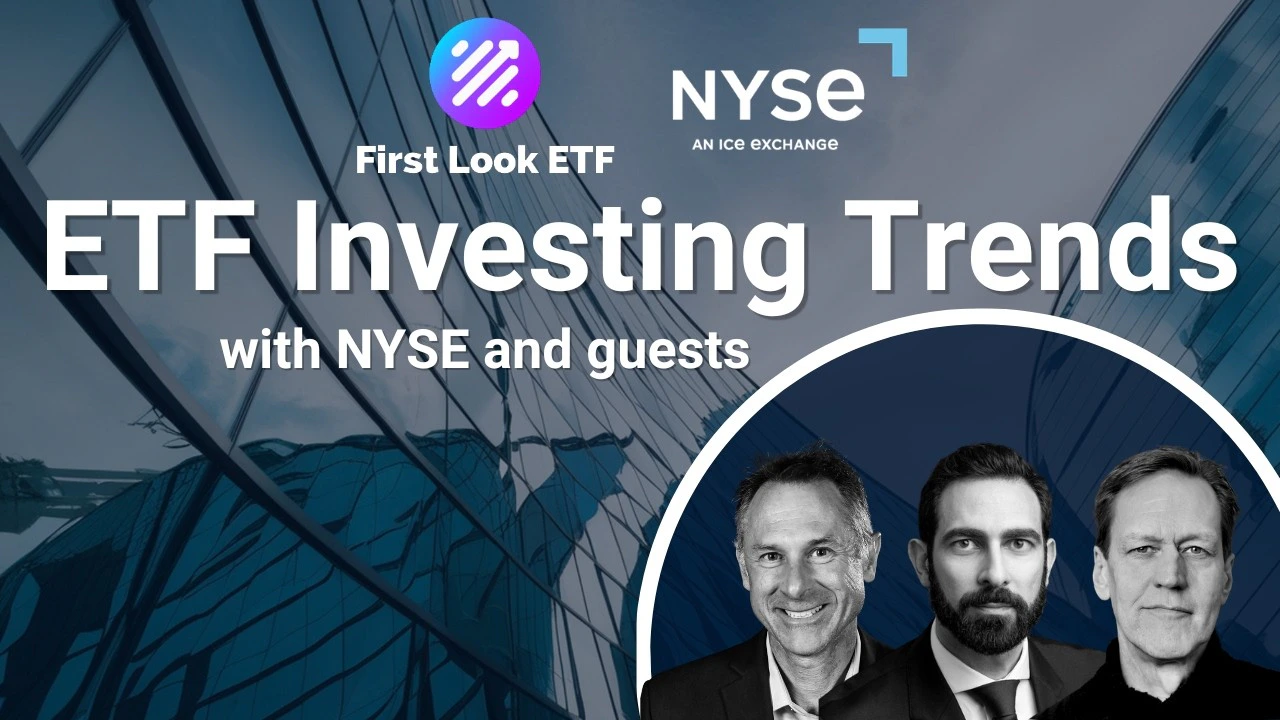
First Look ETF: Cash Deployment, Bond, and Hedged ETFs
In this season 6 episode of First Look ETF, Stephanie Stanton examines the latest ETF marketplace trends with NYSE and guests.

ETF Trends
ETF Industry KPIs July 6, 2026
This week’s KPI data overview highlights key metrics and trends shaping the ETF landscape.
Browse all educational columns



Build and Analyze Your ETF Portfolio Like a Pro
Create your own ETF portfolio in minutes and instantly see allocations, exposures, performance, and risk. Visualize diversification across asset classes, regions, and sectors. Stress-test ideas, compare benchmarks, and refine your strategy with professional-grade analytics.