Ready-made ETF portfolios built for real investor needs. Explore now →



Bitcoin ETFs: What are the current options for U.S. investors?
These funds offer alternative ways of gaining cryptocurrency exposure.


Keep up with what matters in ETFs
Get timely ETF insights, market trends, and top ideas straight to your inbox.
Your newsletter subscriptions with us are subject to ETF Central's Privacy Policy and Terms and Conditions.
The launch of a U.S. spot-based (physically backed) Bitcoin ETF continues to elude fund managers. Recently, the Securities & Exchange Commission (SEC) shot down Greyscale's application to convert their close-ended trust (GTBC) to an open-ended ETF, with a lawsuit now pending.
For now, U.S. investors seeking spot Bitcoin exposure have to rely on close-ended trusts, which have numerous drawbacks. Chief among them is the potential for funds to trade at a discount or premium relative to their net asset value (NAV). For example, GTBC is currently trading at a -35% discount to NAV.
The open-ended creation/redemption process of a spot Bitcoin ETF would have largely resolved this. In lieu of this, investors seeking Bitcoin exposure via ETFs have to rely on proxies. This usually takes one of two forms: Bitcoin futures, or Bitcoin miner stocks. Let's take a look at how each approach works.
Global ETF Survey 2026 is Live!
With 1,790 new products launched by July 2026, choosing is harder than ever. Our Global ETF Survey 2026, built on 620 professional investors and allocators, shows how active, fixed income, options-based and thematic ETFs are reshaping fund selection.
Bitcoin futures ETFs
Bitcoin has developed a substantial secondary derivatives market. One of the most popular instruments traded are Bitcoin futures, which are agreements between two parties to buy or sell Bitcoin at a pre-determined price and date. They can be used to speculate or hedge risk.
These futures therefore offer exposure to Bitcoin, but not the spot price. As I explored in an earlier article on commodity futures ETFs, contango and backwardation can create tracking error for these funds. When volatility gets high, Bitcoin futures can diverge from the spot price of Bitcoin significantly.
That being said, the current products on the market have done an admirable job minimizing tracking error and the negative effects of contango. For instance, the ProShares Bitcoin Strategy ETF (BITO) has tracked the spot price of Bitcoin very well year-to-date.
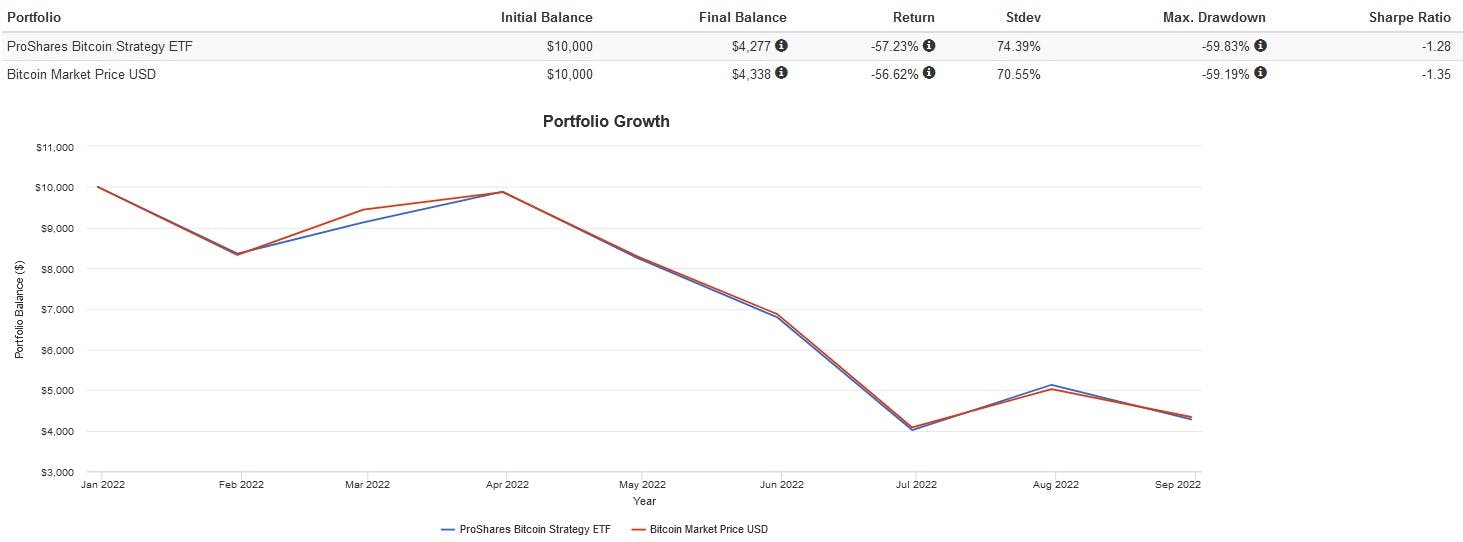
My theory is that given how easy and low-cost it is to store Bitcoin offline in cold wallets, contango does not occur as often, compared to expensive to store commodities like crude oil or soybeans. That being said, these funds are still expensive – BITO costs an expense ratio of 0.95%.
Nonetheless, it appears that Bitcoin futures ETFs can be a reliable way of gaining Bitcoin exposure in a traditional brokerage account. This saves investors the need to transact on a cryptocurrency exchange and self-custody their Bitcoin. However, it does prevent you from trading on a 24/7 basis.
Bitcoin miner ETFs
Investors can also gain Bitcoin exposure by holding the shares of publicly traded Bitcoin miners. This is very much akin to buying gold miner stocks as a substitute for gold bullion. A readily accessible way of buying Bitcoin miner stocks is via a thematic ETF that holds a portfolio of them.
An example here is the Global X BlockChain ETF (BKCH), which holds 24 stocks involved in blockchain technology. This ETF is not a pure-play Bitcoin miner ETF, given that it also holds companies involved in digital asset transactions, decentralized applications, hardware, and digital asset integration.
Nonetheless, it seems to have done its job of tracking the Bitcoin spot price fairly well. Year-to-date, BKCH has a 0.90 correlation with the Bitcoin spot price. However, it also has a higher correlation with equities at 0.86 versus 0.77 for Bitcoin. This is to be expected given that BKCH is comprised of stocks.
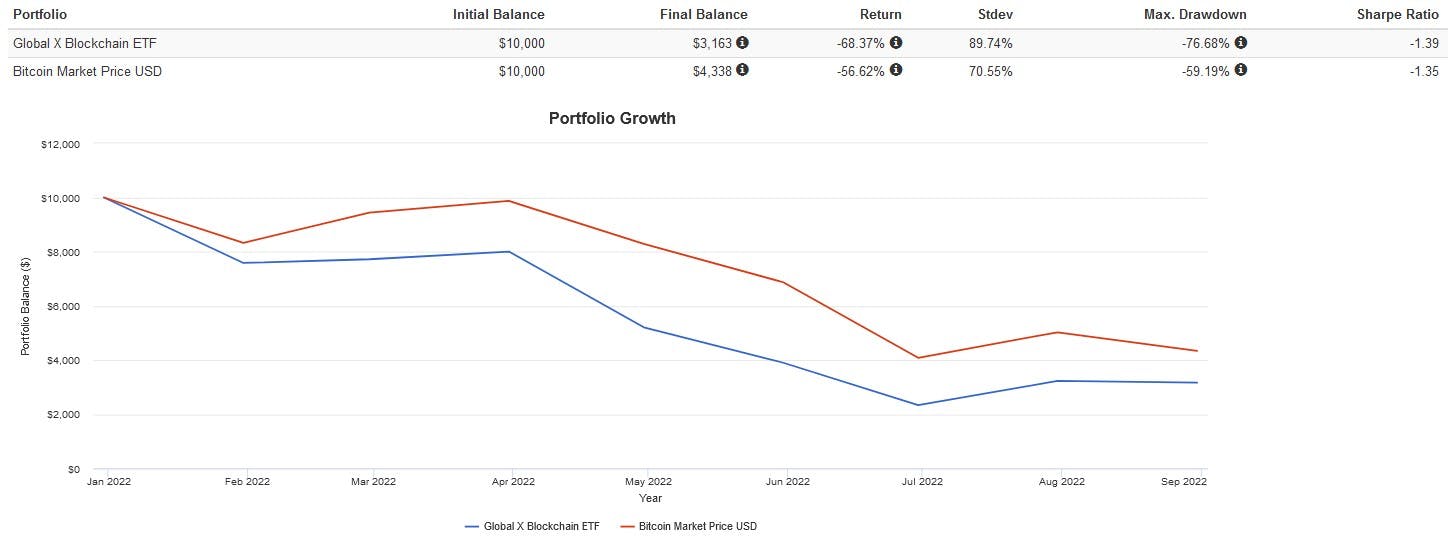
Global X also offers the Blockchain & Bitcoin Strategy ETF (BITS), which combines BKCH at 50% of its holdings with a Bitcoin future overlay. This is a hybrid approach that may appeal to investors seeking the best of both worlds. Compared to BITO, BITS costs a lower expense ratio of 0.65%.
Please note this article is for information purposes only and does not constitute investment advice.
Latest ETF News
See all ETF newsThere's an ETF for That? Humanoid Robotics and Physical AI

How Some ETF Issuers Use Their Own Funds for Cash Management

These Public-Private ETFs Invest in Polymarket and Anduril

There's an ETF for That? Frontier Markets




 Advantages of ETFs over Mutual Funds1/6
Lower Costs
In this guide, we'll explore the advantages of ETFs over mutual funds, giving you valuable insights into why ETFs have gained significant popularity among investors like yourself.
Leveraged ETFs: Unlocking the Potential for Amplified Returns1/6
Understanding Leveraged ETFs
Explore leveraged ETFs: potential for amplified returns & risks. 5 ETFs to consider across equities, commodities & fixed income.
What is a Leveraged ETF?1/6
Introducing Leveraged and Inverse ETFs
In this guide, we'll dive into the world of leveraged ETFs, exploring their definition, mechanics, potential risks, and rewards.
Recent educational content

ETF Trends
ETF Industry KPIs October 5, 2026
This week’s KPI data overview highlights key metrics and trends shaping the ETF landscape.

ETF Trends
ETF Industry KPIs September 28, 2026
This week’s KPI data overview highlights key metrics and trends shaping the ETF landscape.
ETF Trends
ETF Industry KPIs September 22, 2026
This week’s KPI data overview highlights key metrics and trends shaping the ETF landscape.
First Look ETF
First Look ETF: Income, Corporate Arbitrage, and Growth and Value Investing
First Look ETF September 2026: iCapital, Mast Investments and North Square unpack new ETFs targeting monthly income, merger arbitrage and complementary growth and value exposure.

Browse all educational columns



ETFs’ Next Act: From Access to Selection
With 1,790 new products launched by July 2026, choosing is harder than ever. Our Global ETF Survey 2026, built on 620 professional investors and allocators, shows how active, fixed income, options-based and thematic ETFs are reshaping fund selection.