Open Now: The Global ETF Survey Take the Survey →



How to become a growth investor using ETFs
These ETFs are great for capturing growth stock exposure at a low price.


Keep up with what matters in ETFs
Get timely ETF insights, market trends, and top ideas straight to your inbox.
Your newsletter subscriptions with us are subject to ETF Central's Privacy Policy and Terms and Conditions.
Growth stocks have been on a tear in recent years. These are generally the stocks of companies expected by the market to increase their revenues and earnings faster on average. During low-interest-rate environments, growth stocks enjoy easy access to capital, which allows them to scale up rapidly. Commonly, growth stocks tend to be from the technology and communications sectors, with notable examples such as Amazon (AMZN, Alphabet (GOOG), Tesla (TSLA), and NVIDIA (NVDA).
Growth stocks are often characterized by high spending in research & development and sales & marketing. As such, they tend to reinvest retained earnings into capital-intensive projects to further grow the company. Compared to blue-chip or value stocks, growth stocks generally do not pay dividends. In terms of financial metrics, they are often characterized by high valuations (price to equity, price to book, price to sales, price to free cash flow) and a 15 percent or higher return on equity (ROE).
The ETF Industry Is Evolving Fast
From AI infrastructure to active strategies, the ETF landscape is shifting. Share your perspective in the 7th Annual Global ETF Survey and get exclusive early access to the final report.
How has growth investing historically performed?
Growth stock outperformance comes in bursts. As mentioned earlier, they tend to outperform when inflation and interest rates are low. When the opposite is true (like in 2022 so far), they tend to underperform the market. Overall, growth stocks are more volatile, with a higher standard deviation and max drawdown. Investors could reap strong gains after a sustained bull market (like from 2017 – 2021) but will suffer deeper drawdowns during bear markets (like the 2001 Dot-Com bubble).
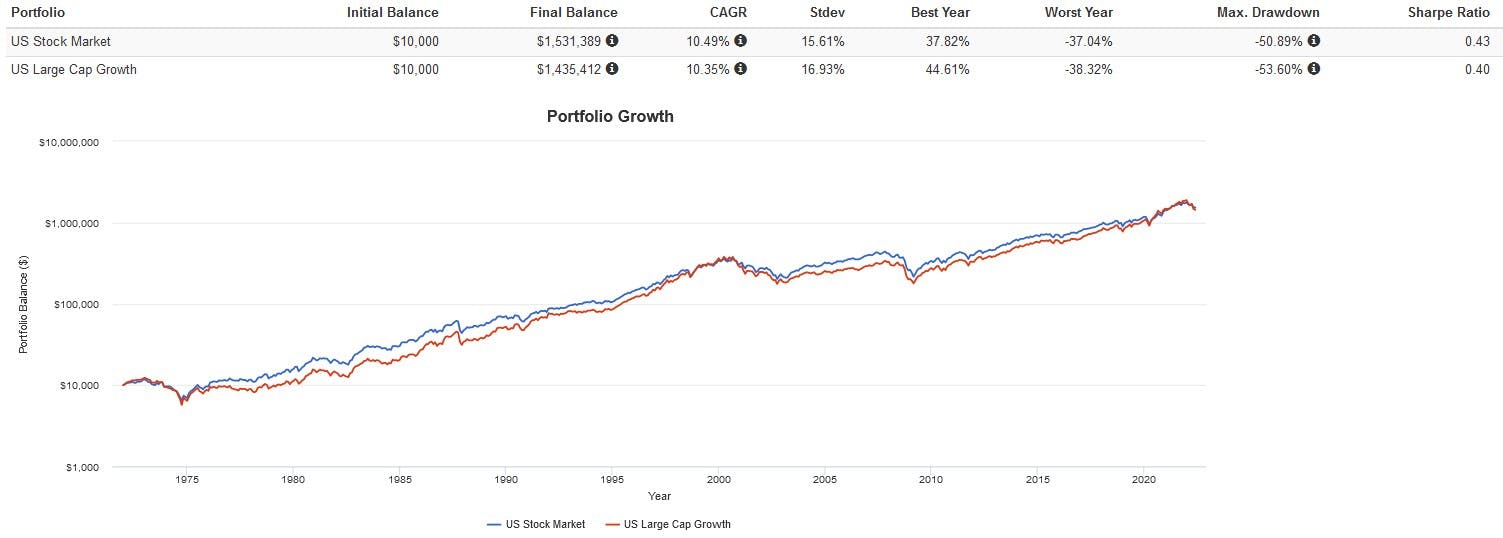
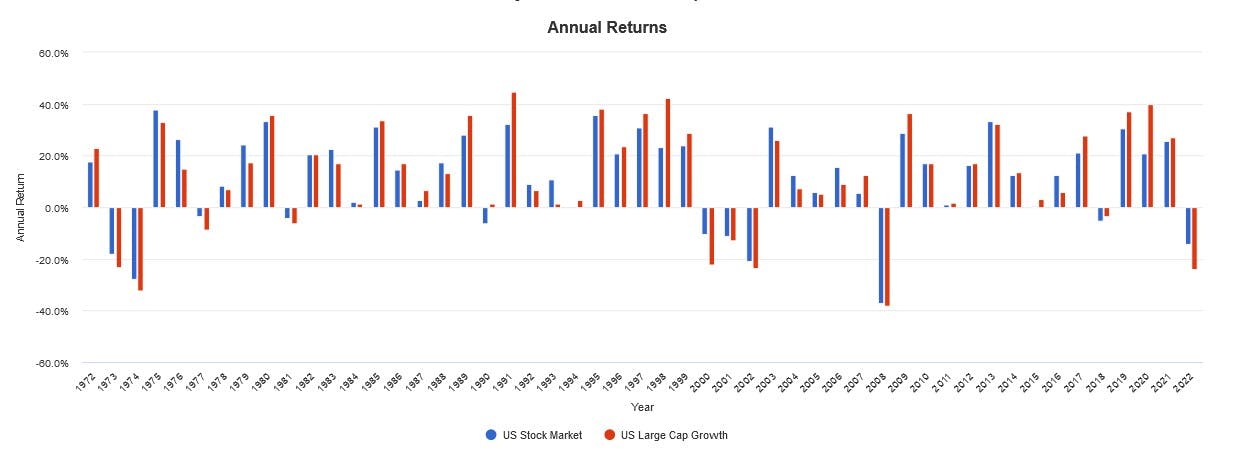
The common mistake new growth investors make is chasing performance. That is, they buy in during the run-up and double down at the peak. While this could work as a momentum strategy based on technical indicators, it is not ideal for a buy-and-hold approach. The old saying goes, "it is easy to be a genius in a bull market." When the investment environment changes, growth stocks can suffer heavily.
Many investors who bought pandemic-era growth stocks like Zoom (ZM), Palantir (PLTR), Shopify (SHOP), Coinbase (COIN), and Robinhood (HOOD) at the all-time highs are now down 80% or more on their investment in some cases. Beyond looking at financial metrics, the best way to successfully implement a growth investing strategy is to be mindful of investing biases and have a long-term perspective.
Growth ETFs you could add to your portfolio
An easy way to tilt your portfolio to growth stocks is via an exchange-traded fund (ETF) that tracks a basket of them. Various ETFs offer different types of exposures to various subsets of growth stocks, such as U.S. only, international developed, international emerging, mega, large, mid, or small-cap. In return for an expense ratio, investors gain instant access to a managed portfolio that rebalances itself regularly, allowing them to stay hands-off and passive.
I used ETF Central’s screener to find a list of growth ETFs and described them based on their strategy, holdings, market cap, geography, and expense ratio. Many of these ETFs tend to be heavily weighted towards the technology and communication sectors and are in no way considered "cheap." Their valuation metrics tend to be quite expensive, even after the recent bear market.
Keep in mind that a growth-stock tilt is inherently a form of active management, even if passive index ETFs are used. By overweighting growth stocks, investors are consciously betting on that segment of the market outperforming. Before investing, ensure you have thought out your investment thesis and risk tolerance carefully.
Vanguard Growth ETF (VUG)
- Assets under management: $67 billion
- Expense ratio: 0.04%
- Index: CRSP US Large Cap Growth Index
- Market cap: Large
- Geography: U.S.
- Strategy: Passive index
- Holdings: 266
Vanguard Mega Cap Growth ETF (MGK)
- Assets under management: $10 billion
- Expense ratio: 0.07%
- Index: CRSP US Mega Cap Index
- Market cap: Mega
- Geography: U.S.
- Strategy: Passive index
- Holdings: 104
Invesco QQQ ETF (QQQ)
- Assets under management: $154 billion
- Expense ratio: 0.20%
- Index: NASDAQ 100 Index
- Market cap: Large
- Geography: U.S.
- Strategy: Passive index
- Holdings: 102
iShares S&P 500 Growth ETF (IVW)
- Assets under management: $154 billion
- Expense ratio: 0.18%
- Index: S&P 500 Growth Total Return Index
- Market cap: Large
- Geography: U.S.
- Strategy: Passive index
- Holdings: 241
iShares MSCI EAFE Growth ETF (EFG)
- Assets under management: $8 billion
- Expense ratio: 0.35%
- Index: MSCI EAFE Growth Net Total Return Index
- Market cap: Large/Mid
- Geography: International developed
- Strategy: Passive index
- Holdings: 439
ARK Innovation ETF (ARKK)
- Assets under management: $8 billion
- Expense ratio: 0.75%
- Index: N/A
- Market cap: Large/Mid
- Geography: U.S.
- Strategy: Actively managed
- Holdings: 35
Mentioned ETFs
Further reading

Latest ETF News
See all ETF newsAvoid S&P 500 Concentration Risk with These Two ETFs

How Investors can Maximize Tax Efficiency with Income ETFs

Trump Accounts: Here's Which ETFs You Can Invest In

The Two Best Types of Fixed-Income ETFs For Managing Cash




 Advantages of ETFs over Mutual Funds1/6
Lower Costs
In this guide, we'll explore the advantages of ETFs over mutual funds, giving you valuable insights into why ETFs have gained significant popularity among investors like yourself.
Leveraged ETFs: Unlocking the Potential for Amplified Returns1/6
Understanding Leveraged ETFs
Explore leveraged ETFs: potential for amplified returns & risks. 5 ETFs to consider across equities, commodities & fixed income.
What is a Leveraged ETF?1/6
Introducing Leveraged and Inverse ETFs
In this guide, we'll dive into the world of leveraged ETFs, exploring their definition, mechanics, potential risks, and rewards.
Recent educational content

ETF Trends
ETF Industry KPIs July 20, 2026
This week’s KPI data overview highlights key metrics and trends shaping the ETF landscape.

ETF Trends
ETF Industry KPIs July 13, 2026
This week’s KPI data overview highlights key metrics and trends shaping the ETF landscape.

First Look ETF
First Look ETF: Cash Deployment, Bond, and Hedged ETFs
In this season 6 episode of First Look ETF, Stephanie Stanton examines the latest ETF marketplace trends with NYSE and guests.

ETF Trends
ETF Industry KPIs July 6, 2026
This week’s KPI data overview highlights key metrics and trends shaping the ETF landscape.
Browse all educational columns



The ETF Industry Is Evolving Fast
From AI infrastructure to active strategies, the ETF landscape is shifting. Share your perspective in the 7th Annual Global ETF Survey and get exclusive early access to the final report.