ETF model portfolios designed for real investor needs. Discover →



Hedgefundie's Excellent Adventure: A 3x leveraged ETF portfolio
This strategy is highly risky and not for the faint of heart.


Keep up with what matters in ETFs
Get timely ETF insights, market trends, and top ideas straight to your inbox.
Your newsletter subscriptions with us are subject to ETF Central's Privacy Policy and Terms and Conditions.
The Bogleheads forum is the last place someone would look to find a highly risky, "swing-for-the-fences" investment strategy. As adherents of Vanguard founder John Bogle's passive investing philosophy, the average Boglehead prefers to hold a diversified 3-fund portfolio of low-cost index ETFs.
So, you can imagine my surprise when I stumbled upon "Hedgefundie's Excellent Adventure," a massive forum thread where a member ("Hedgefundie") described in length his strategy of using a 3x leveraged S&P 500 fund and a 3x leveraged long-term Treasury fund to beat the market and retire a millionaire.
The thread is fascinating, and I encourage readers to give parts 1 and 2 a detailed read. There's a lot of insightful analysis and knowledgeable debate that you don't usually see in online discussions about investing. However, if you just want the SparkNotes version, keep on reading here!
Global ETF Survey 2026 is Live!
With 1,790 new products launched by July 2026, choosing is harder than ever. Our Global ETF Survey 2026, built on 620 professional investors and allocators, shows how active, fixed income, options-based and thematic ETFs are reshaping fund selection.
How the Hedgefundie Adventure works
The Hedgefundie portfolio (hereby called "HFEA") is basically a leveraged variant of the good old-fashioned 60/40 portfolio of stocks and bonds.
Recall from my previous article on the 60/40 that this allocation has historically provided a great balance of risk and return. I also wrote an article on "return stacking" that described how the modest use of leverage could enhance the returns of a diversified portfolio without taking on excessive risk.
HFEA does not use modest leverage. The strategy started off with a pretty innocent premise: Hold an S&P 500 index fund and a long-term Treasury fund in risk-parity weightings, where each asset contributes roughly the same amount towards the portfolio's overall risk. This was around 40/60 stocks/bonds.
Here's the crazy part: leveraging it up 3x. This gives a notional exposure of 120% stocks, and 180% long-term Treasurys. Interestingly, Hedgefundie chose to use leveraged ETFs, in particular the ProShares UltraPro S&P500 ETF (
Neither of these ETFs is designed to be held long-term. Their leverage targets are only intended to be accurate for a single day. Holding them long-term subjects the investor to volatility drags (which this paper explains well) plus high expense ratios and the cost of borrowing on the underlying swaps. This makes their long-term returns differ from the intended 3x target.
Nonetheless, it appears that leveraged ETFs can be held long-term (although this is highly inadvisable and subject to extreme tail risks). Essentially, Hedgefundie was relying on the following to hold true:
- The 3x leveraged S&P 500 ETF (UPRO+0.88%) would drive strong returns during bull markets
- If the market crashed, the 3x leveraged long-term Treasury ETF (TMF+2.41%) would spike in price as a result of the "flight to quality" phenomenon, especially when interest rates drop.
- UPRO's daily resetting leverage would prevent fund liquidation as long as the underlying S&P 500 index did not crash over 33% in a single day (technically impossible due to circuit breakers).
The portfolio is rebalanced quarterly on the first trading day. Other people tried market-timing models using simple moving averages and rebalancing bands, but none backtested well as simple quarterly rebalancing. Hedgefundie eventually switched from a 40/60 to a 55/45 allocation, or 165% S&P 500, 135% long-term Treasurys. The rationale behind this was more muted expectations for TMF after a 40-year bond bull market and low-interest rates.
Hedgefundie historical performance
Keep in mind that the following backtests are hypothetical in nature, does not reflect actual investment results and is not a guarantee of future results. The hypothetical returns do not reflect trading costs, transaction fees, commissions, or actual taxes due on investment returns.

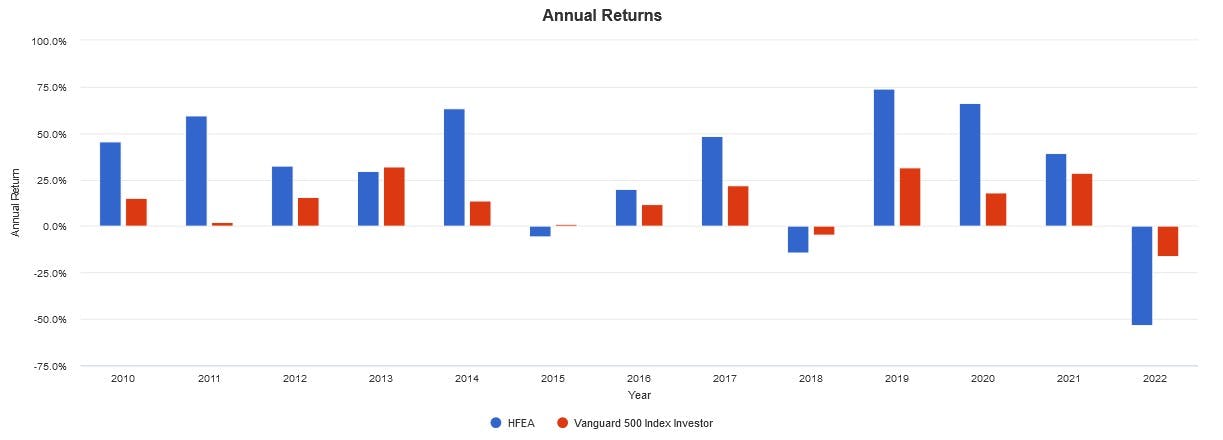
HFEA worked great thanks to the stock and bond bull market of the past decade. It even survived the 2020 March COVID-19 crash unscathed as long-term Treasurys soared sharply when stocks sold off. An investor in HFEA who rebalanced on schedule would have avoided massive losses, and then made a handsome profit during the V-shaped recovery.
The main weakness of this strategy is a period of rapidly rising interest rates coupled with persistently high inflation. In this case, stock-bond correlations turn positive (historically, it's been at -0.30) and bond prices fall. This severely reduces TMF's potential as crash insurance and causes it to lose value, thus not only leaving HFEA without protection, but also creating a drag on returns.
Hedgefundie himself explicitly noted this and felt that the risk was remote. Unfortunately, he was proven wrong, as these conditions occurred in 2022. The results have been highly detrimental to the HFEA strategy, leading to big losses – a -53% drawdown year-to-date, while the S&P 500 only lost -16%. This is a massive loss difficult for even the most risk-tolerant of investors to endure.
The final word on Hedgefundie
I hope Hedgefundie is doing well despite the unrealized losses. While extreme, his strategy is theoretically sound – leveraging up a portfolio of uncorrelated assets with positive expected returns. However, every strategy has a weakness, and it looks like HFEA finally met its nemesis in 2022.
Can HFEA be improved? Possibly. Personally, I would tone down the leverage to 2x maximum, and perhaps add in a gold allocation along with some managed futures in case both stocks and bonds fall. Overall returns would decrease, but risk-adjusted ones might improve, and drawdowns might lessen.
One thing is for certain though – the HFEA strategy is not advisable for the average retail investor. Most investors can't even tolerate the volatility of a regular 100% stock portfolio without panic selling. Applying leverage using exotic ETFs intended for short-term holdings only is even riskier.
Please note this article is for information purposes only and does not constitute investment advice.
Mentioned ETFs
Further reading

Latest ETF News
See all ETF newsThere's an ETF for That? Humanoid Robotics and Physical AI

How Some ETF Issuers Use Their Own Funds for Cash Management

These Public-Private ETFs Invest in Polymarket and Anduril

There's an ETF for That? Frontier Markets




 Advantages of ETFs over Mutual Funds1/6
Lower Costs
In this guide, we'll explore the advantages of ETFs over mutual funds, giving you valuable insights into why ETFs have gained significant popularity among investors like yourself.
Leveraged ETFs: Unlocking the Potential for Amplified Returns1/6
Understanding Leveraged ETFs
Explore leveraged ETFs: potential for amplified returns & risks. 5 ETFs to consider across equities, commodities & fixed income.
What is a Leveraged ETF?1/6
Introducing Leveraged and Inverse ETFs
In this guide, we'll dive into the world of leveraged ETFs, exploring their definition, mechanics, potential risks, and rewards.
Recent educational content

First Look ETF
First Look ETF: Income, International, and Cash Flow ETFs
In this season 6 episode of First Look ETF, Stephanie Stanton @etfguide examines the latest ETF marketplace trends with NYSE and guests.


ETF Trends
ETF Industry KPIs October 5, 2026
This week’s KPI data overview highlights key metrics and trends shaping the ETF landscape.

ETF Trends
ETF Industry KPIs September 28, 2026
This week’s KPI data overview highlights key metrics and trends shaping the ETF landscape.
ETF Trends
ETF Industry KPIs September 22, 2026
This week’s KPI data overview highlights key metrics and trends shaping the ETF landscape.
Browse all educational columns



ETFs’ Next Act: From Access to Selection
With 1,790 new products launched by July 2026, choosing is harder than ever. Our Global ETF Survey 2026, built on 620 professional investors and allocators, shows how active, fixed income, options-based and thematic ETFs are reshaping fund selection.