Global ETF Survey Is Live! 600+ ETF Professionals Weigh In. See Results →



ETF Comparison: iShares Core Dividend Growth ETF (DGRO) Versus ProShares S&P 500 Dividend Aristocrats ETF (NOBL)
Dividend growth ETFs are not all created equal. Explore how DGRO and NOBL differ in methodology and performance, and what that means for your dividend strategy.


Keep up with what matters in ETFs
Get timely ETF insights, market trends, and top ideas straight to your inbox.
Your newsletter subscriptions with us are subject to ETF Central's Privacy Policy and Terms and Conditions.
In part three of our ultimate guide to dividend investing, we looked at how dividend growth ETFs offer an accessible route to capturing the quality factor, often inadvertently.
However, it's crucial to recognize that the methodologies behind these ETFs can vary significantly, affecting their performance and suitability for investors.
To demonstrate these differences and underscore the importance of examining the mechanics of each ETF, today we're comparing two popular options: the iShares Core Dividend Growth ETF
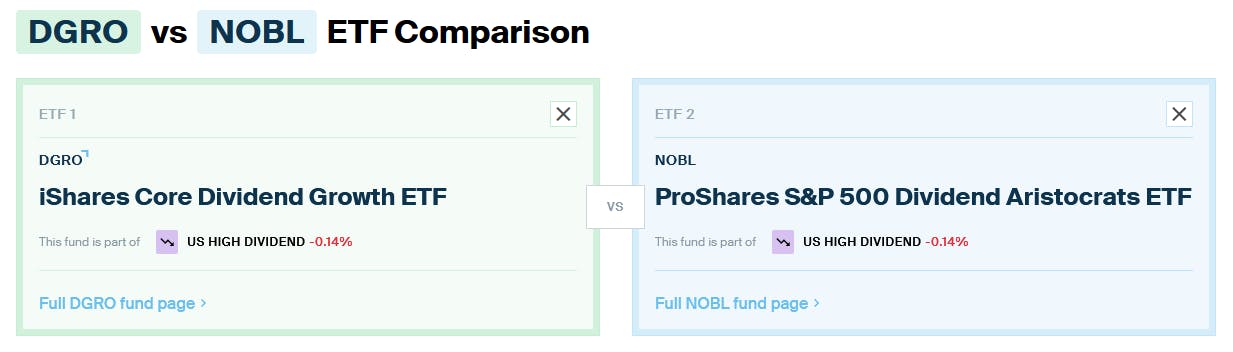
Let's dive into the specifics and see how DGRO and NOBL stack up against each other using insights from the ETF Central comparison tool.
Global ETF Survey 2026 is Live!
With 1,790 new products launched by July 2026, choosing is harder than ever. Our Global ETF Survey 2026, built on 620 professional investors and allocators, shows how active, fixed income, options-based and thematic ETFs are reshaping fund selection.
DGRO vs NOBL: Total cost of ownership
When it comes to total cost of ownership, DGRO clearly takes the lead. As part of the iShares "Core" lineup, it boasts a low expense ratio of just 0.08%. This is notably cost-effective, especially when compared to its counterpart.
On the flip side, NOBL carries a considerably higher expense ratio of 0.35%. This places it on par with actively managed funds like the JPMorgan Equity Premium Income ETF
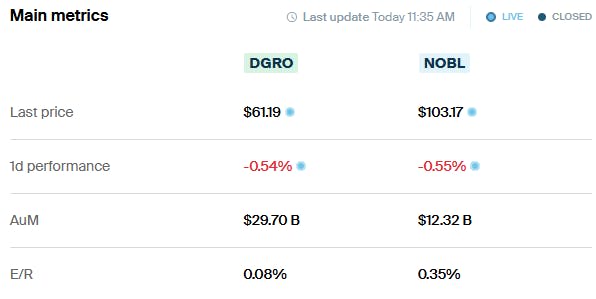
In terms of annual costs on a $10,000 investment, you're looking at just $8 for DGRO compared to $35 for NOBL—over four times the cost.
Despite NOBL's higher fee, it does edge out slightly in terms of liquidity, with a 30-day median bid-ask spread of 0.018%, compared to 0.027% for DGRO. However, this small difference in liquidity is generally inconsequential for most investors.
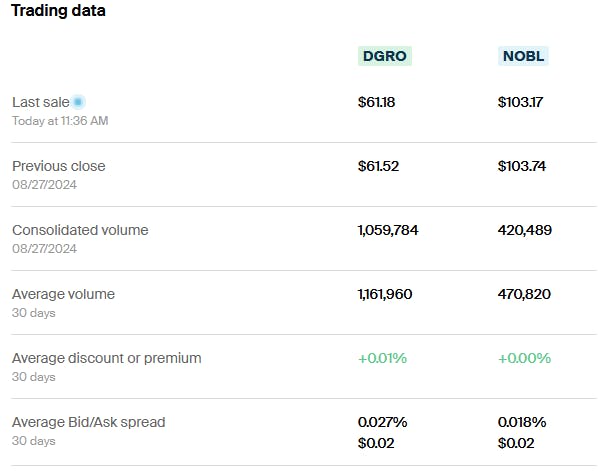
Overall, from a total cost of ownership perspective, DGRO is the more economical choice by a significant margin. It's one of the cheapest dividend growth ETFs out there.
DGRO vs NOBL: Methodology and holdings
DGRO
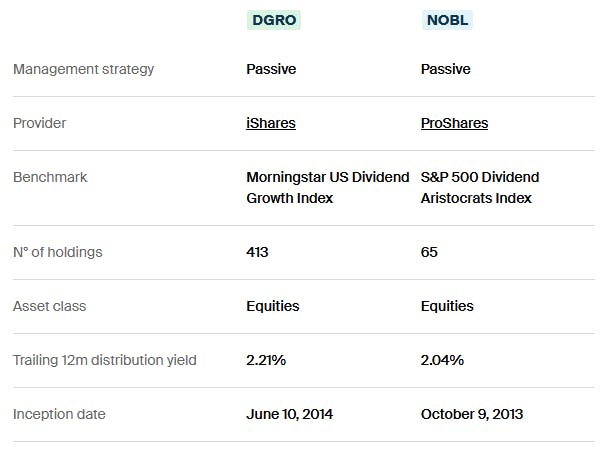
DGRO's selection methodology is detailed. It includes stocks that have increased dividends for at least five consecutive years and maintain a payout ratio under 75%, alongside a positive earnings forecast.
Additionally, it excludes REITs and the highest 10% of stocks by dividend yield within its selection universe. The ETF then weights its holdings based on the total dollar value of the dividends paid, not the yield, with a cap of 3% per holding to maintain diversification.
On the other hand, NOBL's approach is more straightforward. It selects stocks from the S&P 500 that have raised their dividends for 25+ consecutive years and applies an equal-weight strategy to each.
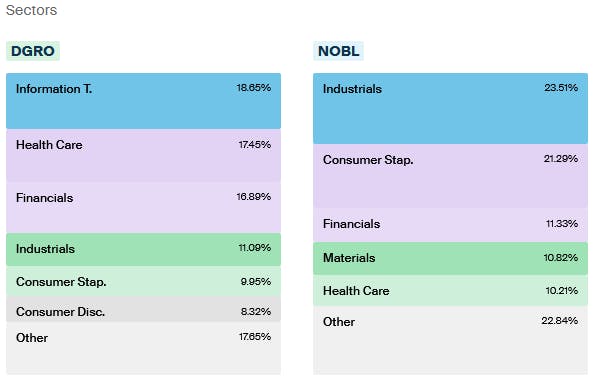
Sector exposure varies between the two: DGRO
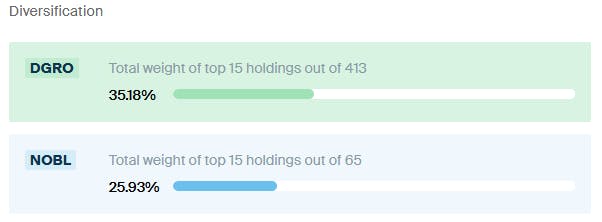
In terms of portfolio concentration, DGRO's top 15 holdings represent 35.18% of its total assets, moderated by the 3% cap per stock at each rebalance. NOBL, with its equal weighting, sees its top 15 holdings make up 25.93% of the portfolio, influenced mainly by performance dynamics post-rebalance.

DGRO vs NOBL: Risk and return
Over the last three years, one year, and year-to-date (YTD) periods, DGRO
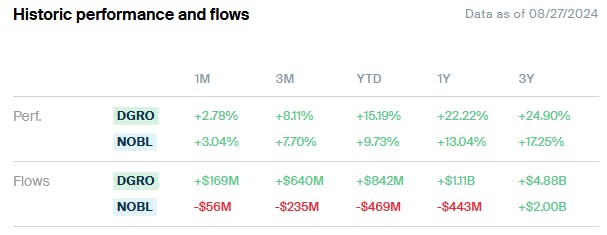
In terms of long-term performance, DGRO has also led with a compound annual growth rate (CAGR) of 11.92% compared to NOBL's 10.66% and has posted a slightly higher Sharpe ratio of 0.58 versus 0.52 for NOBL.
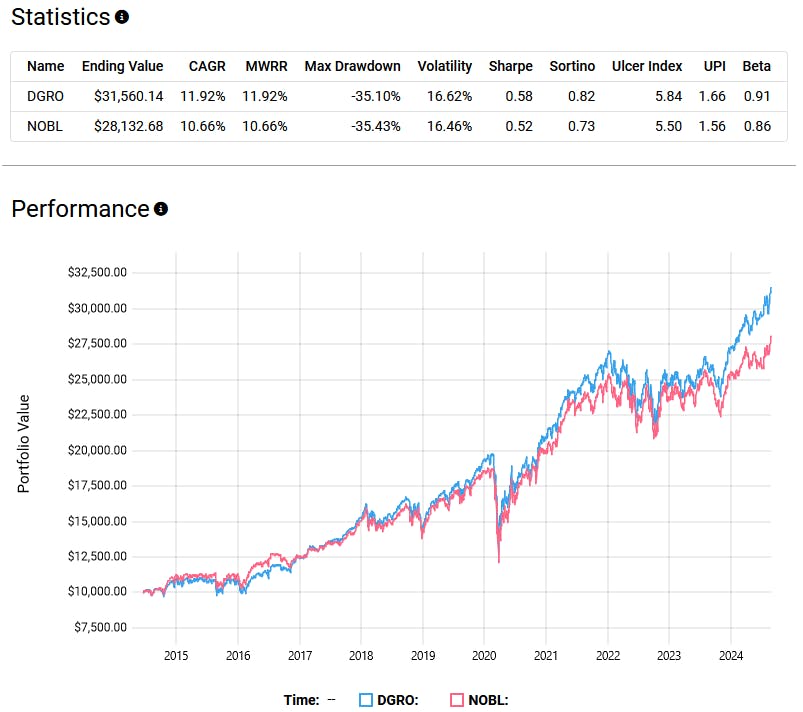
Despite NOBL's focus on dividend aristocrats—companies with 25+ years of consecutive dividend growth—the ETF has not demonstrated significantly better risk metrics. Both DGRO
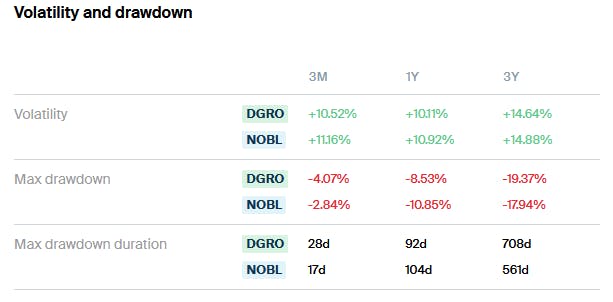
Personally, I prefer DGRO
Its higher expense ratio of 0.35% also constitutes a substantial drag on performance. Moreover, the equal-weighting approach in a dividend-focused ETF seems arbitrary and not necessarily optimal for this investment style.
Conversely, DGRO employs a more forward-looking approach by incorporating quality metrics such as consensus earnings forecasts and payout ratios, effectively screening out yield traps.
It also weights holdings based on the total dollar value of dividends paid, rather than yield alone, which I believe is a more rational approach to dividend investing. Finally, all these benefits come at a much lower expense ratio of 0.08%.
Please note this article is for information purposes only and does not in any way constitute investment advice. It is essential that you seek advice from a registered financial professional prior to making any investment decision.
Latest ETF News
See all ETF newsBeyond Big Tech: The Increasing Specialization of AI ETFs

There's an ETF for That? Humanoid Robotics and Physical AI

How Some ETF Issuers Use Their Own Funds for Cash Management

These Public-Private ETFs Invest in Polymarket and Anduril

There's an ETF for That? Frontier Markets



 Advantages of ETFs over Mutual Funds1/6
Lower Costs
In this guide, we'll explore the advantages of ETFs over mutual funds, giving you valuable insights into why ETFs have gained significant popularity among investors like yourself.
Leveraged ETFs: Unlocking the Potential for Amplified Returns1/6
Understanding Leveraged ETFs
Explore leveraged ETFs: potential for amplified returns & risks. 5 ETFs to consider across equities, commodities & fixed income.
What is a Leveraged ETF?1/6
Introducing Leveraged and Inverse ETFs
In this guide, we'll dive into the world of leveraged ETFs, exploring their definition, mechanics, potential risks, and rewards.
Recent educational content

First Look ETF
First Look ETF: Income, International, and Cash Flow ETFs
In this season 6 episode of First Look ETF, Stephanie Stanton @etfguide examines the latest ETF marketplace trends with NYSE and guests.


ETF Trends
ETF Industry KPIs October 5, 2026
This week’s KPI data overview highlights key metrics and trends shaping the ETF landscape.

ETF Trends
ETF Industry KPIs September 28, 2026
This week’s KPI data overview highlights key metrics and trends shaping the ETF landscape.
ETF Trends
ETF Industry KPIs September 22, 2026
This week’s KPI data overview highlights key metrics and trends shaping the ETF landscape.