Create, analyze, optimize your ETF portfolio. Start now →



ETF Central's Ultimate Guide to Dividend Investing, Part 3: Dividend Growth ETFs
This article is the third part of ETF Central's 6-part series on how ETFs use various dividend-based strategies.


Keep up with what matters in ETFs
Get timely ETF insights, market trends, and top ideas straight to your inbox.
Your newsletter subscriptions with us are subject to ETF Central's Privacy Policy and Terms and Conditions.
We ended part 2 of our dividend ETF series, which covered high-yield dividend ETFs, with this quote from a 2017 Vanguard whitepaper:
"The performance of these [dividend] strategies has been time-period dependent and largely explained by their exposure to a handful of equity factors: value and lower volatility for high-dividend-yielding equities and lower volatility and quality for dividend growth equities."
This brings us to part 3 today, which covers the opposite of high-yield dividend ETFs—dividend growth ETFs. Instead of focusing on high present yields, these ETFs target equities that have historically grown dividends, either at a higher year-over-year rate or, more commonly, for a number of consecutive years.
As usual, we'll go over some key concepts when it comes to dividend growth investing and highlight a few standout ETF examples to illustrate these points.
Like what you're reading?
Stay in the loop — get the latest ETF insights: trends, analysis, and expert picks.
Why dividend growth?
Like anything money-related, dividends are susceptible to the invisible killer of value—inflation. Inflation erodes the purchasing power of money over time, meaning that the same amount of money buys fewer goods and services in the future than it does today.
This erosion applies to dividends as well. If a company's dividends do not grow at least as much as inflation, the real value of those dividends decreases over time.
For instance, if inflation is running at 2% per year, a company needs to increase its dividend by at least 2% annually to maintain the purchasing power of those dividend payments.
Without this growth, the dividends' ability to support your financial goals—whether that's providing income in retirement or reinvesting for future growth—diminishes.
This growth is even more critical if you're reinvesting those steadily growing dividends. Reinvesting dividends means using the dividend payments to purchase additional shares of the company. As time goes on and the company continues to grow its dividends, those reinvested dividends buy more shares.
Those new shares, in turn, produce more dividends, creating a powerful compounding effect. The snowball keeps rolling and growing, leading to an increasingly larger stream of income over time.
How do ETFs target dividend growth?
The most common and straightforward way ETFs target dividend growth is by setting criteria for how many years historically an eligible holding must have consecutively increased dividends. This approach ensures that the selected companies have a proven track record of returning value to shareholders.
For example, the S&P U.S. Dividend Growers Index, tracked by the Vanguard Dividend Appreciation ETF
Similarly, the iShares Core Dividend Growth ETF
The beauty of this criteria is that it can be easily complemented by other screeners, whether for high dividend yield or dividend quality. These hybrid dividend ETF strategies will be discussed in a future article in this series.
But back to dividend growth—you may have heard of names like "dividend aristocrats" and "dividend kings" used for stocks with even higher streaks of unbroken dividend growth.
For example, the ProShares S&P 500 Dividend Aristocrats ETF
Taking this even further, the Roundhill S&P Dividend Monarchs ETF
The benefits of dividend growth ETFs
The yields on dividend growth ETFs aren't going to excite income investors. While these ETFs usually offer higher yields than broad market index benchmarks like the S&P 500, they don't reach the 3-5% yields seen with high-yield dividend ETFs.
So, why own these ETFs? As Vanguard found, they are a great way to target quality stocks inexpensively, albeit with a focus on just the dividend-paying ones (sorry, Berkshire!).
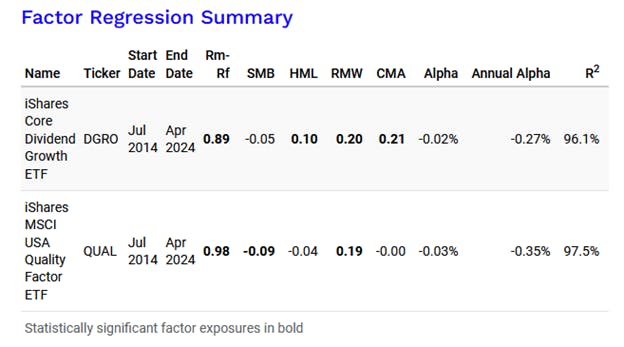
We can break down the source of a company's "quality" into two Fama-French factors. Just like how high-yield dividend ETFs can provide exposure to the value (high minus low, or HML) factor, dividend growth ETFs can provide exposure to:
- Profitability (RMW, or robust minus weak): This factor measures the performance of stocks with robust (high) profitability versus those with weak (low) profitability. Dividend growth companies tend to have strong and consistent earnings, which support their ability to increase dividends over time.
- Investment (CMA, or conservative minus aggressive): This factor evaluates the return differences between companies that invest conservatively and those that invest aggressively. Dividend growth companies typically follow a conservative investment strategy, focusing on steady, sustainable growth rather than aggressive expansion.
Dividend growth companies often have above-average exposure to these two factors due to their traits. They generally exhibit strong and stable earnings (profitability) and prefer steady, measured investment approaches (conservative investment), which aligns well with the characteristics sought by investors targeting quality.
A factor regression analysis illustrates this concept. As seen below, even though it is not an explicit quality factor ETF, DGRO has historically provided higher loadings to both the profitability and investment factors compared to the brand-name iShares MSCI USA Quality Factor ETF
This being said, dividend growth ETFs indirectly target quality. But you can also directly target dividend quality, which focuses more on how sustainable the dividend is versus how long it has grown historically. For this, stay tuned for Part 4 of this series soon.
Please note this article is for information purposes only and does not in any way constitute investment advice. It is essential that you seek advice from a registered financial professional prior to making any investment decision.

Latest ETF News
See all ETF newsCould Water ETFs Be the Next AI Bottleneck Trade?

What is a Boomer Candy ETF?

ETF Comparison: NEOS Nasdaq-100 High Income ETF (QQQI) Versus Goldman Sachs Nasdaq-100 Premium Income ETF (GPIQ)





 Advantages of ETFs over Mutual Funds1/6
Lower Costs
In this guide, we'll explore the advantages of ETFs over mutual funds, giving you valuable insights into why ETFs have gained significant popularity among investors like yourself.
Leveraged ETFs: Unlocking the Potential for Amplified Returns1/6
Understanding Leveraged ETFs
Explore leveraged ETFs: potential for amplified returns & risks. 5 ETFs to consider across equities, commodities & fixed income.
What is a Leveraged ETF?1/6
Introducing Leveraged and Inverse ETFs
In this guide, we'll dive into the world of leveraged ETFs, exploring their definition, mechanics, potential risks, and rewards.
Recent educational content

ETF Trends
ETF Industry KPIs September 8, 2026
This week’s KPI data overview highlights key metrics and trends shaping the ETF landscape.

ETF Trends
ETF Industry KPIs August 31, 2026
This week’s KPI data overview highlights key metrics and trends shaping the ETF landscape.
ETF Trends
ETF Industry KPIs August 24, 2026
This week’s KPI data overview highlights key metrics and trends shaping the ETF landscape.
What’sTheFund
What's the Fund | Ocean Park Diversified Income ETF (DUKZ)
James St Aubin, Chief Investment Officer at Ocean Park Asset Management, discuss the DUKZ ETF, exposing investors to the whole spectrum of asset classes in the fixed income markets, through their rules-based process.

Browse all educational columns



Expert-Built ETF Portfolios, All in One Place
Don’t start from scratch. Discover ready-made ETF portfolios built by professionals to match different goals, timelines, and market views. Use them as inspiration or as a starting point for your own allocation.