From idea to ETF portfolio in minutes. Build yours now →



ETF Central's Ultimate Guide to Dividend Investing, Part 2: High-Yield Dividend ETFs
This article is the second part of ETF Central's 6-part series on how ETFs use various dividend-based strategies.


Keep up with what matters in ETFs
Get timely ETF insights, market trends, and top ideas straight to your inbox.
Your newsletter subscriptions with us are subject to ETF Central's Privacy Policy and Terms and Conditions.
Our guide on the different major types of dividend ETFs kicks off with a look at one of the simplest yet popular: high-yield dividend ETFs.
Their name says it all—these are ETFs that hold dividend stocks which pay a high yield above and beyond their non-dividend focused benchmarks and counterparts.
Here's an overview of the reasons why investors may adopt this strategy, and highlights a few notable high-yield dividend ETFs that illustrate the concepts discussed
Get data on 14,000+ ETFs
Access Trackinsight's reliable and comprehensive data with 500M+ points on 14,000+ ETFs.
High yield dividend ETFs can provide income
Prior to 2022, when interest rates began to rise steadily and aggressively to the 5.25 - 5.5% range we see today, investors had to look outside of Treasury bills for income. When interest rates were much lower, high-yield dividend strategies were particularly attractive, with some paying above 4%.
These ETFs commonly work by tracking a dividend-focused benchmark index. For example, the SPDR Portfolio S&P 500 High Dividend ETF
However, you'll find significant variations between ETFs. One common distinction is based on the hurdle rate set to qualify a potential holding as "high yield" or not. For example, SPYD picks the top 80 highest-yielding stocks in the S&P 500, but the Vanguard High Dividend Yield ETF
Weighting strategies can also differ. SPYD weights its 80 stocks equally, but a fundamentally weighted dividend ETF like the WisdomTree U.S. High Dividend Fund
Sector differences are another important aspect to consider. Typically, high-yield dividend ETFs will have a higher weighting towards industries like financials, consumer staples, utilities, and energy, whereas sectors like technology and consumer discretionary may be underweighted. Additionally, depending on the index, real estate investment trusts (REITs) may be excluded altogether.
Regardless of these differences, the key takeaway is that virtually all ETFs in the high-yield category will pay income greater than a broad market index benchmark of the same geography. This makes them a valuable tool for investors seeking higher income from their investments.
High-yield dividend ETFs can target value stocks
Another unintended, albeit effective, use for high-yield dividend ETFs is as a low-cost proxy or substitute for value factor ETFs.
In the context of investment strategies, the value factor—defined by the Fama-French three-factor model—systematically identifies stocks that trade for less than their intrinsic values based on price-to-book ratios.
To understand why high dividend yields can serve as a preliminary value screen, it's essential to grasp how yield is calculated – by dividing a company's annual dividend by its share price.
Therefore, a high dividend yield can indicate a lower share price relative to the dividend paid, which can reliably point to a stock being undervalued or out of favor, all else being equal.
This is a reason why the "Dogs of the Dow" strategy, which involves picking the top 10 highest-yielding blue-chip Dow stocks each year, has performed decently over time.
For example, as seen below, a factor regression of VYM and the Vanguard Value ETF
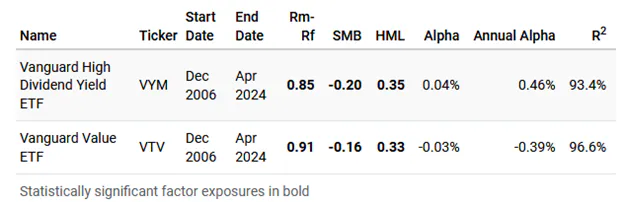
In a 2017 whitepaper, Vanguard confirmed this relationship, noting: "The performance of these [dividend] strategies has been time-period dependent and largely explained by their exposure to a handful of equity factors: value and lower volatility for high-dividend-yielding equities and lower volatility and quality for dividend growth equities."
This concludes our article on high-yield dividend ETFs and segues neatly into our next, upcoming article on dividend growth ETFs.
Please note this article is for information purposes only and does not in any way constitute investment advice. It is essential that you seek advice from a registered financial professional prior to making any investment decision.

Latest ETF News
See all ETF newsThese Public-Private ETFs Invest in Polymarket and Anduril

There's an ETF for That? Frontier Markets

10-Year Treasury Yield Hits 5%: Which Bond ETFs Offer the Most Direct Exposure?

ETF comparison: NEOS S&P 500 High Income ETF (SPYI) Versus Goldman Sachs S&P 500 Premium Income ETF (GPIX)




 Advantages of ETFs over Mutual Funds1/6
Lower Costs
In this guide, we'll explore the advantages of ETFs over mutual funds, giving you valuable insights into why ETFs have gained significant popularity among investors like yourself.
Leveraged ETFs: Unlocking the Potential for Amplified Returns1/6
Understanding Leveraged ETFs
Explore leveraged ETFs: potential for amplified returns & risks. 5 ETFs to consider across equities, commodities & fixed income.
What is a Leveraged ETF?1/6
Introducing Leveraged and Inverse ETFs
In this guide, we'll dive into the world of leveraged ETFs, exploring their definition, mechanics, potential risks, and rewards.
Recent educational content

ETF Trends
ETF Industry KPIs September 28, 2026
This week’s KPI data overview highlights key metrics and trends shaping the ETF landscape.

ETF Trends
ETF Industry KPIs September 22, 2026
This week’s KPI data overview highlights key metrics and trends shaping the ETF landscape.
First Look ETF
First Look ETF: Income, Corporate Arbitrage, and Growth and Value Investing
First Look ETF September 2026: iCapital, Mast Investments and North Square unpack new ETFs targeting monthly income, merger arbitrage and complementary growth and value exposure.

ETF Trends
ETF Industry KPIs September 14, 2026
This week’s KPI data overview highlights key metrics and trends shaping the ETF landscape.
Browse all educational columns



Expert-Built ETF Portfolios, All in One Place
Don’t start from scratch. Discover ready-made ETF portfolios built by professionals to match different goals, timelines, and market views. Use them as inspiration or as a starting point for your own allocation.