Open Now: The Global ETF Survey Take the Survey →



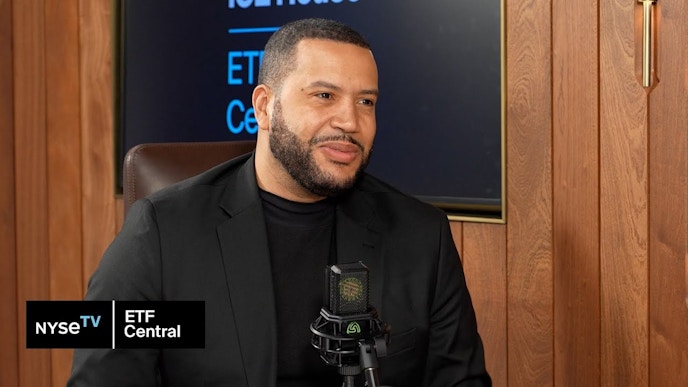
Bilal Little, Director of Exchange-Traded Funds at the NYSE and host of the ETF Central podcast, sits down with Armando Pantoja, fintech entrepreneur and financial futurist, to talk about how AI, energy, and crypto are transforming the investing landscape—and why ETFs are becoming the smartest way to tap into tomorrow's biggest trends.
From Code to Crypto: The Origin of a Financial Futurist
Armando Pantoja didn’t start out as a millionaire or a media personality. In fact, he barely made it through high school.
But everything changed with a single college coding class. The moment he saw his professor write a line of code on the board, something clicked.
He dove into computer science, earned his master’s, and by 2011, was already studying cryptography while others were still wrapping their heads around Bitcoin.
Early on, he wasn't investing in crypto—he was integrating it. Pantoja built one of the first companies in North America to accept Bitcoin for payments, helping others do the same.
But after the 2013 crash, he backed off. That is, until crypto returned in 2016. This time, he was ready.
With his business partner, he launched ICO Ranker, an AI-powered platform that evaluated new crypto projects. The startup quickly became the third-largest of its kind globally and was acquired in 2017 by a public company.
Overnight, Pantoja became a multimillionaire.
Teaching, Sharing, and Building a Digital Empire
After the exit, Pantoja returned to what he loved: teaching.
He didn’t open a school—he opened a phone camera. Starting small on social media, his honest, no-jargon style caught fire.
Today, he’s a financial educator with millions of followers, combining deep tech insight with a relatable tone.
What made him stand out?
Authenticity. He’s the same on stage, online, and off the mic. A speech coach once told him, “Audiences can sense when you're being fake.” That advice stuck.
Pantoja’s kept it real ever since, building a brand not just on tech knowledge, but on trust.
The Big Three: Compute, Data, and Energy
Pantoja’s upcoming book The Future of Wealth explores how three forces—compute, data, and energy—will shape the next 30 years. His thesis is simple: these aren’t just trends. They’re the pillars of future civilization.
To explain it, he leans on the Kardashev Scale, a framework that ranks civilizations based on energy usage. Right now, humanity is still a “Type I” civilization—barely scratching the surface of Earth’s energy potential.
But with AI expected to consume up to 90% of the global energy grid, Pantoja sees a clear need for scalable energy solutions. Chief among them: nuclear.
Nuclear energy, in his view, is no longer the risky option it was in the 1960s.
It’s safer, cleaner, and essential to supporting exponential AI compute demand. And when AI and energy scale together, the investment opportunity is massive.
AI and Bubbles: What’s Real, What’s Not
Pantoja sees AI as nowhere near its peak—or its bubble. But he's clear-eyed. Every transformative technology eventually ends in a bubble.
Not because it fails, but because human greed overshoots its value. That’s normal. “People mistake a bubble for a scam,” he says. “They’re not the same.”
While valuations may get ahead of reality, the tech itself—especially AI—continues to move forward. Investors who understand the long-term trend (and the inevitable correction) can position accordingly.
He’s especially bullish on quantum computing, calling it one of the most important investable frontiers alongside energy.
While we don’t know which company will win that race, we do know it’s coming.
For most investors, that uncertainty is exactly why ETFs make sense.
Enter the ETF: Simplifying Access to Big Ideas
For Pantoja, ETFs are the bridge between advanced tech themes and everyday investors. Whether it’s quantum computing, nuclear energy, or AI infrastructure, ETFs offer diversified exposure without requiring deep research or technical expertise.
“I’m a thematic investor,” he explains. For savvy investors, he’ll point to individual stocks. But for those without the time or background, ETFs are a no-brainer. They offer exposure to mega-trends, reduce risk, and remove the headache of researching every company.
His challenge?
Getting investors to look beyond the usual suspects like the S&P 500 or QQQ and toward thematic ETFs that offer access to the innovations shaping the future.
Crypto, Custody, and the ETF Advantage
Crypto is still a central focus for Pantoja—but he’s pragmatic about the risks.
For newer investors, the complexity of wallets, scams, and self-custody makes crypto intimidating and sometimes dangerous.
That’s why he’s a fan of crypto ETFs, which remove most of the barriers while still offering high-fidelity exposure.
“Let the ETF handle custody,” he says. “No one can hack your ETF.” Investors avoid the common pitfalls of passwords, phishing attacks, and lost assets while still capturing much of the upside. It's a smarter, safer way in.
As for crypto picks?
He’s long Ethereum, bullish on XRP, and keeping a close eye on AI-related tokens that could power digital identities and machine-to-machine transactions in the near future.
Proof of Humanity, Worldcoin, and the AI-Crypto Convergence
One of the most forward-thinking parts of the conversation centered on Worldcoin—Sam Altman’s project that aims to verify humanness in a world of synthetic intelligence. Pantoja worked with Worldcoin on a public education tour, helping people understand the “proof of personhood” concept.
His view?
As AI generates thousands of digital personas, we’ll need ways to prove who’s real—and give both humans and AI agents access to digital money.
Crypto is the obvious medium of exchange, and projects like Worldcoin may become essential infrastructure.
Investing with a Long-Term Thesis (and Some Common Sense)
With markets shaky and headlines noisy, Pantoja keeps it simple for his audience. Have an entry and exit plan, invest with a long-term thesis, and remove emotion from your decisions.
“The average investor wakes up every day and has to ask, ‘Do I sell or hold?’ That’s a recipe for anxiety—and mistakes.”
His goal is to help investors zoom out, think thematically, and use tools like ETFs to access big opportunities—whether it’s the future of energy, the rise of quantum computing, or the convergence of AI and crypto.
Please note this article is for information purposes only and does not in any way constitute investment advice. It is essential that you seek advice from a registered financial professional prior to making any investment decision.
Topics
See all
This article does not have a tagged topic
Segments
See all
No specific market segments were tagged
Mentioned ETFs
No specific ETFs were tagged



Build and Analyze Your ETF Portfolio Like a Pro
Create your own ETF portfolio in minutes and instantly see allocations, exposures, performance, and risk. Visualize diversification across asset classes, regions, and sectors. Stress-test ideas, compare benchmarks, and refine your strategy with professional-grade analytics.