Turn ETF ideas into real portfolios. Try the builder now →



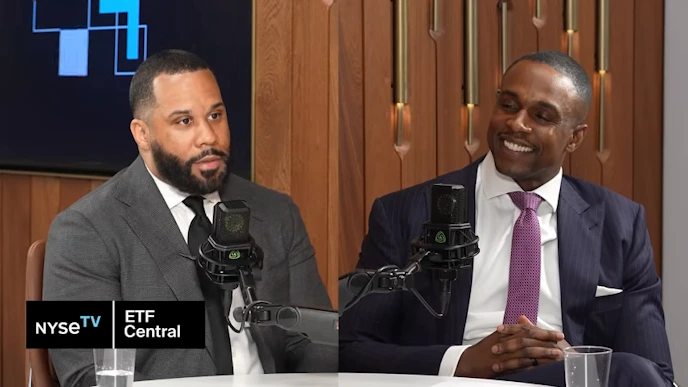
Bilal Little, Director of Exchange-Traded Funds at the NYSE and host of the ETF Central podcast, sits down with Red Panda Founder & CEO Ian Dunlap who discusses his journey from starting in the markets during the 2008 financial crisis to becoming a leading voice in retail investing. Dunlap shares how long-term thinking, a foundation in index funds, and high‑conviction technology investing shaped his philosophy, while platforms like Market Mondays helped him build trust and scale financial education for a broad audience.
Ian Dunlap doesn’t talk like a traditional Wall Street analyst.
He talks like someone who learned investing the hard way, built conviction during market chaos, and then decided to hand the blueprint back to the people. That authenticity is exactly why millions of retail investors now follow him across social media and tune into Market Mondays every week.
During his ETF Central appearance with host Bilal Little, Dunlap unpacked everything from Nvidia and AI mania to market risk, private credit, and why too many investors have forgotten the power of simply holding great companies for a long time.
And honestly, the conversation felt less like a finance interview and more like a masterclass in modern wealth building.
The 2008 Crash That Changed Everything
Dunlap’s investing origin story starts during the 2008 financial crisis.
While most people saw panic and devastation, a friend working under Jamie Dimon at JPMorgan told him to start buying stocks aggressively. At the time, Dunlap didn’t fully understand what he was buying. A few months later, the same friend called back and said it was time to liquidate. The trade had generated millions.
That moment permanently reshaped his view of markets.
For Dunlap, the biggest lesson from 2008 wasn’t fear. It was access.
People connected to institutional information networks understood crashes differently than everyday investors. While the public panicked, sophisticated investors quietly viewed the collapse as a generational buying opportunity.
That disconnect became the foundation for everything he built afterward.
Market Mondays and the Democratization of Finance
Dunlap explained that his reputation as the “Master Investor” didn’t come from flashy predictions or viral moments. It came from consistency and generosity.
For years, he openly shared research, investment ideas, and frameworks with friends and followers online. Long before financial content became mainstream on social media, he was posting about companies like Apple and Facebook because he genuinely believed in their long-term dominance.
Then COVID happened.
Suddenly, millions of people were stuck at home, staring at financial uncertainty, stimulus checks, and zero commission trading apps. Dunlap and the Market Mondays team stepped directly into that moment with educational content focused on ownership, investing, and wealth planning.
The timing couldn’t have been better.
But what made Market Mondays different wasn’t just the content. It was the honesty.
Dunlap didn’t simply tell audiences which companies sounded exciting. He explained where he would enter positions, how technicals aligned with fundamentals, why some industries were terrible long-term investments, and how hedge fund-style thinking could apply to retail portfolios.
That level of transparency built trust quickly.
And judging by today’s audience sizes, the market clearly wanted it.
Why Nvidia Was Never an Accident
One of the most revealing parts of the interview came when Dunlap described his early conviction around Nvidia.
He started investing in the company back in 2016 because of its exposure to gaming and semiconductor competition with AMD. Even before the AI explosion, he understood the long-term strategic importance of chip infrastructure.
That’s important because many investors now chase Nvidia after the move already happened.
Dunlap’s framework is different. He looks for companies capable of dominating entire generations.
His philosophy is straightforward. Start with index funds as the portfolio foundation. Add concentrated positions in elite technology companies. Hold them for years, not months.
That last point matters most.
He argued that modern investing culture has incorrectly framed long-term investing as “boring,” while glorifying risky short-term speculation like zero-day options trading.
Meanwhile, investors who simply held Microsoft, Apple, or Nvidia through multiple cycles created life-changing wealth.
Not exactly boring if you ask your brokerage account.
The Real Risk in Today’s Markets
Despite his optimism around technology, Dunlap wasn’t blindly bullish.
In fact, much of the conversation focused on structural risks building underneath the market.
He raised concerns about geopolitical instability, private credit exposure, government debt, AI overinvestment, and deteriorating global leadership.
One particularly sharp observation involved private credit markets.
Dunlap questioned why companies increasingly structure financing away from traditional balance sheets. In his view, whenever financial institutions aggressively move risk off-book, investors should pay close attention.
Bilal Little expanded on that concern, noting that private investment vehicles becoming widely marketed to retail investors is usually a warning sign, not a comfort signal.
That exchange captured the tone of the entire interview: optimistic about innovation, but realistic about fragility.
AI Hype vs. AI Reality
Naturally, AI dominated a major portion of the discussion.
Dunlap made it clear that not every company benefiting from AI headlines deserves investor capital. He used Super Micro Computer as an example of market enthusiasm disconnecting from underlying fundamentals.
His core argument was simple: investors must understand the actual business model before chasing momentum.
Revenue quality matters. Margins matter. Founders matter. Intellectual property matters.
That’s where AI itself becomes useful.
Dunlap now uses tools like Claude and GPT to accelerate research workflows that once took hours. Investors can aggregate analyst reports, compare financial metrics, and identify risks faster than ever before.
But he stressed that AI should enhance judgment, not replace it.
The investor still has to think.
The Death of the Traditional 60/40 Portfolio?
One of the more fascinating moments came when Dunlap questioned whether the traditional 60/40 portfolio model still works in modern markets.
His criticism centered around the bond market’s prolonged weakness and the growing realization that traditional diversification may not protect investors the same way it once did.
Little responded with a broader framework. Commodities are underowned. International equities remain overlooked. Emerging markets deserve more attention. Active ETF strategies are becoming increasingly compelling.
That ETF discussion became especially interesting.
Little explained how active ETF managers are now offering institutional-quality strategies with transparency, downside protection, tactical positioning, and access to areas historically unavailable to retail investors.
The implication was clear: the future portfolio may look far more dynamic than the classic stock-and-bond allocation investors grew up with.
The Biggest Mistake Retail Investors Are Making
Toward the end of the interview, Dunlap identified what may be the most dangerous trend in today’s market.
Investors have normalized unrealistic returns.
After the SPAC boom, meme stocks, NFTs, and AI rallies, many younger investors now believe 100%-plus annual returns are standard.
They aren’t.
Dunlap described someone complaining that Apple was “only” returning 12% to 13% annually. In any historical context, that’s an elite long-term outcome.
That perspective shift matters because markets eventually punish unrealistic expectations.
The easy-money era doesn’t last forever.
But quality businesses do.
Building the Next Decade
As the conversation wrapped, Dunlap hinted at bigger ambitions ahead, including a book and a documentary focused on investing culture and trading.
Given the impact he’s already had on retail finance education, those projects will likely attract serious attention.
Because whether you agree with every investment call or not, Dunlap represents something increasingly important in modern markets: financial education delivered in a language everyday people actually understand.
And in an era overloaded with hype, noise, and overnight experts, that may be the most valuable asset of all.
Please note this article is for information purposes only and does not in any way constitute investment advice. It is essential that you seek advice from a registered financial professional prior to making any investment decision.
Topics
See all
This article does not have a tagged topic
Segments
See all
No specific market segments were tagged
Mentioned ETFs
No specific ETFs were tagged



Active Trader Report: Use of Leveraged & Inverse ETFs Way Up
Direxion partnered with Compound Insights and Vanda to explore what’s driving the evolution of active trading — and how active traders are using leveraged and inverse funds across equities, single stocks, commodities, and volatility.