Turn ETF ideas into real portfolios. Try the builder now →



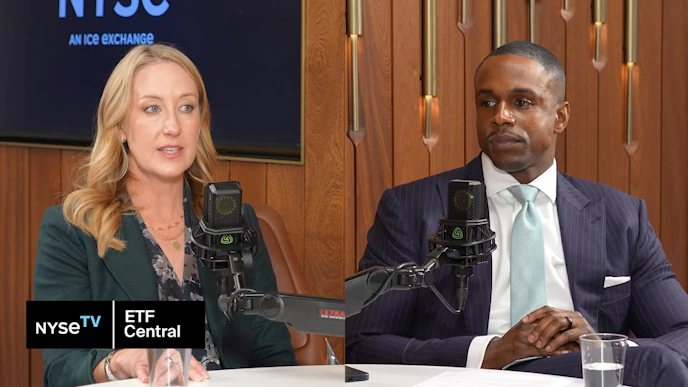
Bilal Little, Director of Exchange-Traded Funds at the NYSE and host of the ETF Central podcast, sits down with Holly Framsted, Head of Product at Capital Group, to discuss the firm’s rapid ETF expansion, the staying power of active management, and why advisers are rethinking how they build portfolios. Their conversation also explores Capital Group’s global growth, its approach to product innovation, and the role ETFs, models, and private markets could play in the next phase of investing.
From Criminal Psychology to Capital Group
Holly Framsted did not exactly grow up dreaming of a career in asset management. She studied psychology at UCLA and thought she was headed for a future in criminal profiling. The plan was forensics, investigations, maybe even tracking down serial killers. Then came a summer internship in Washington, D.C., and a quick realization that the law enforcement path was not for her.
That pivot changed everything. After college, she moved across the country, took a receptionist job at a private equity firm, and got her first look at investing.
What started as curiosity turned into a full-blown career. She eventually landed at Barclays Global Investors, worked in risk management and portfolio management, earned her CFA charter, and built the kind of background that makes stumbling into finance sound suspiciously like destiny.
Now she leads product at Capital Group, a role that sits right at the intersection of investing, client demand, and real-world delivery. In plain English, she helps turn investment ideas into usable products, whether that means SMAs, ETFs, or other vehicles clients actually want.
The ETF Buildout Was Not an Accident
Framsted joined Capital Group five years ago, just as the firm was getting serious about ETFs. At the time, the lineup was basically nonexistent. Today, it is a very different story. Capital Group has grown to 25 ETFs in the U.S., four in Canada, and more than $120 billion in ETF assets.
For a firm with more than $3 trillion overall, that is still one piece of the puzzle, but it is a rapidly growing one.
The key point is that this was not some trendy late-career reinvention. Clients had been asking for ETFs for years. They wanted the tax efficiency. They wanted exchange trading. They wanted to use active and passive strategies in the same wrapper across client portfolios. What held things back was not lack of demand. It was the market itself.
According to Framsted, active management in ETF form needed the right regulatory structure before it could really work at scale. Once that changed, Capital Group started small with five ETFs and built from there. The logic was simple. If advisers wanted to manage whole portfolios using ETFs, then Capital Group needed a full suite, not a token cameo appearance.
A Giant That Many Investors Still Miss
One of the more surprising parts of the conversation is how often Capital Group gets overlooked in broader ETF chatter. This is not a niche manager trying to break into the big leagues. It is the largest active asset manager in the world, but because it does not play in passive, it can sometimes feel oddly underdiscussed.
Framsted describes the firm as focused. That might be the best one-word summary. Capital Group specializes in long-only, fundamental active equity and fixed income investing. It does not try to be everything to everyone, and that consistency is central to its identity.
Its investing process, known as the Capital System, is also unusual. Rather than relying on one star manager, funds are divided among multiple portfolio managers, each running a slice of the strategy. That structure spreads responsibility, reduces key-person risk, and brings a wider range of conviction ideas into a single portfolio. It also helps explain why Capital Group’s brand has long been associated with steadiness over flash.
They are not trying to swing for the fences. They are trying to be there when the fences fall down.
Why ETFs Matter to Advisers
Framsted’s view of ETFs is practical, not romantic. She does not frame them as magic. She frames them as problem solvers.
Advisers like ETFs first and foremost because of tax efficiency, especially in the U.S. Add in intraday trading, easier access, transparent pricing, and cleaner operational plumbing, and the appeal becomes obvious. Once active management became available in that same structure, the case got stronger. Advisers no longer had to choose between the wrapper they preferred and the investment approach they wanted.
Still, she argues that one of the biggest misunderstandings in the market is why ETFs are tax efficient in the first place. Many investors assume it is because indexed funds trade less. Framsted pushes back on that. The real driver is the transaction mechanism inside the ETF structure, particularly in-kind creation and redemption. That means active ETFs can potentially deliver tax advantages too, provided they are built and managed correctly.
That education process is still ongoing. Investors hear “ETF” and often assume “tax efficient” without digging deeper. Framsted’s point is that nothing in this business is automatic. The wrapper matters, but so do the mechanics inside it.
No House View, by Design
If you are looking for a neat, top-down Capital Group macro call, Framsted is not going to give you one. That is intentional.
She says the firm does not produce a house view because the whole point of the Capital System is to let different perspectives show up in portfolios. Portfolio managers are not being told what to think. Tactical calls are expressed from the bottom up through security selection, not through broad firmwide declarations.
That philosophy matters in a market where leadership has started to broaden beyond the mega-cap names that dominated recent years. Rather than making blunt top-down shifts, Capital Group prefers diversified portfolios that can reflect changing conditions through stock choices. Framsted argues that this lets investors capture a wider set of opportunities without chasing headlines.
Global Reach, Private Markets, and the Next Frontier
Capital Group may have deep American roots, but it is increasingly thinking globally. The firm now has 33 offices and 9,000 associates worldwide, with a growing footprint in London, Tokyo, Singapore, Hong Kong, Sydney, and Canada. Framsted notes that ETFs have actually helped unlock some of that reach, since they are easier for global investors to access than traditional mutual funds.
She also sees product innovation moving toward private markets, though not through ETFs, at least not yet. Capital Group has partnered with KKR and is using interval funds to provide public-private exposure. Her reasoning is straightforward.
Private assets are illiquid, and investors should be compensated for that illiquidity. A structure that pretends otherwise may be convenient, but it can also create confusion about what investors really own and how quickly they can exit.
That same problem-solving mindset shows up in model portfolios, another fast-growing part of the business.
Capital Group now manages about $250 billion in model assets, and one in five U.S. financial advisers uses its active ETFs in some form.
Advisers want packaged solutions so they can spend less time tinkering with allocations and more time serving clients. Framsted sees that trend as durable.
The Disney Stock Story Says It All
The best moment of the interview came at the end. Asked for her first childhood memory of money, Framsted told a story about receiving one share of Disney stock as a kid.
Owning that share got her into annual shareholder meetings, and those meetings came with Disneyland tickets.
She voted on directors, kept the stock certificate, and got an early lesson in ownership without even realizing it.
That story lands because it captures the broader theme of the conversation. Framsted has built a career around access, structure, and making investing usable for real people.
At Capital Group, she is now doing that on a much bigger stage.
Please note this article is for information purposes only and does not in any way constitute investment advice. It is essential that you seek advice from a registered financial professional prior to making any investment decision.
Topics
See all
This article does not have a tagged topic
Segments
See all
No specific market segments were tagged
Mentioned ETFs
No specific ETFs were tagged



Expert-Built ETF Portfolios, All in One Place
Don’t start from scratch. Discover ready-made ETF portfolios built by professionals to match different goals, timelines, and market views. Use them as inspiration or as a starting point for your own allocation.