ETF model portfolios designed for real investor needs. Discover →



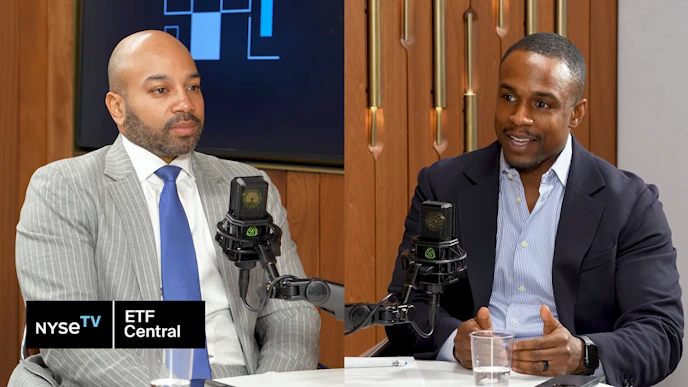
Bilal Little, Director of Exchange-Traded Funds at the NYSE and host of the ETF Central podcast, sits down with AssetLink Founder & CEO Devon Drew to unpack how AI is transforming distribution, why data is the new edge in asset gathering, and what it takes to win in an increasingly competitive, tech-driven landscape.
From Cold Calls to Code
Devon Drew has seen it all.
Nearly two decades in the industry, from cold-calling days to major firms like Vanguard and Alger, he has lived through every evolution of distribution. But one thing never changed: the pain.
Every Monday started the same way. Who do I call? When do I call them? How do I win?
It did not matter whether you were at a $10 trillion giant or a $20 billion shop. Distribution was still fragmented, manual, and inefficient.
That realization became the foundation for Asset Link.
The Core Problem: Data Without Direction
Drew’s insight is simple but powerful. The answers have always been in the data.
The problem is extracting intelligence from it.
Asset Link is built to solve exactly that. It pulls together fragmented data sources, normalizes them, and turns them into actionable insights. Think of it as a navigation system for distribution.
Instead of juggling five different platforms and spreadsheets, a wholesaler can simply ask:
Which advisors in Dallas manage over $100 million, allocate heavily to buffer ETFs, and are most likely to engage?
And get an answer instantly.
In Drew’s words, if you cannot do that in seconds in the near future, you are already behind.
A New Operating System for Distribution
At its core, Asset Link bridges two worlds: financial advisor intelligence and AI infrastructure.
The platform unifies data, layers in AI, and delivers insights in a way that is actually usable. The goal is not to replace the human. It is to remove everything that slows them down.
Less time researching. More time building relationships.
And that is where the real value lies.
Because in a business driven by AUM growth, efficiency scales directly into revenue.
The Three Personas Driving Adoption
Asset Link is not just built for one type of user. It serves three key personas:
First, business developers and wholesalers. These are the frontline users who need precision targeting and better engagement tools.
Second, broker-dealers and RIAs. They use the data to recruit advisors and identify high-value opportunities.
Third, private equity firms and aggregators. For them, the platform becomes a sourcing engine for acquisitions in a rapidly consolidating wealth landscape.
Each group is solving a different problem, but all roads lead back to the same thing: better intelligence.
The AI Shift Is Getting Real
AI is no longer theoretical. It is already reshaping how distribution works.
Drew describes a near future where two intelligent agents are doing the heavy lifting.
One agent represents the asset manager. It understands products, portfolios, and positioning down to the granular level.
The other represents the advisor. It understands client needs, preferences, and portfolio construction.
Those two agents talk to each other first.
By the time a wholesaler shows up, the groundwork is already done. The conversation shifts from pitching products to building relationships.
That is the real disruption.
Legacy vs. Agile Advisors
One of the most important shifts happening right now is the divide between legacy and agile advisors.
Legacy firms are still operating with traditional models. Lower allocations to alternatives. Slower adoption of new tools.
Agile advisors are different. They are lean, tech-enabled, and moving fast.
Consider this. New breakaway firms are allocating close to 20 percent to alternatives, compared to roughly 3 to 4 percent at legacy firms.
That is not a small gap. That is a structural shift.
They are also moving geographically. New wealth hubs are emerging in places like Miami, Austin, Charlotte, Scottsdale, and Nashville.
The implication is clear. If you are distributing products, you need to align with where capital is going, not where it used to be.
The Death of Brute Force Distribution
Cold calling is not dead, but it is no longer enough.
Drew puts it bluntly. If your strategy is dialing through a list of 5,000 advisors, you are already losing.
The firms that win will be the ones that combine relationships with precision.
That means using data to know exactly when to call, what to say, and why it matters.
Going from a one percent success rate to three percent may not sound like much. But at scale, that is the difference between average and elite.
The Internal Problem No One Talks About
One of the most overlooked issues in asset management is internal misalignment.
Marketing, distribution, and product teams often operate in silos. Different leaders, different priorities, different messages.
The result is inefficiency and confusion.
Drew points to firms investing heavily in unified systems where data flows through a central engine. The goal is one cohesive message, delivered with precision across every channel.
The challenge is cost. Not every firm can invest at that level.
Which is why the next generation of winners will look less like traditional asset managers and more like fintech companies.
Agility Is the New Edge
If there is one word that defines the future, it is agility.
Advisors are breaking away with 40 percent less headcount. They are leveraging API-driven custodians. They are building billion-dollar businesses with lean teams.
That trend is only accelerating.
Drew believes it is entirely possible that within a few years, a single advisor could manage a billion dollars with the right technology stack.
For asset managers, the message is clear. You are no longer just competing on product. You are competing on how well you enable your partners to grow.
Building the Moat Before the Wave Hits
Asset Link’s long-term vision goes beyond dashboards and insights.
Drew is betting on autonomous distribution.
A world where systems not only surface insights, but recommend and execute next-best actions without human intervention.
The company has already secured intellectual property around this concept, positioning itself ahead of where the industry is heading.
The timeline is uncertain. The direction is not.
Final Takeaway
Devon Drew is not just building a tool. He is building infrastructure for the next era of distribution.
His thesis is simple:
Data is the advantage.
AI is the engine.
Agility is the edge.
And the firms that put all three together will not just compete.
They will dominate.
Please note this article is for information purposes only and does not in any way constitute investment advice. It is essential that you seek advice from a registered financial professional prior to making any investment decision.
Topics
See all
This article does not have a tagged topic
Segments
See all
No specific market segments were tagged
Mentioned ETFs
No specific ETFs were tagged



Expert-Built ETF Portfolios, All in One Place
Don’t start from scratch. Discover ready-made ETF portfolios built by professionals to match different goals, timelines, and market views. Use them as inspiration or as a starting point for your own allocation.