Open Now: The Global ETF Survey Take the Survey →



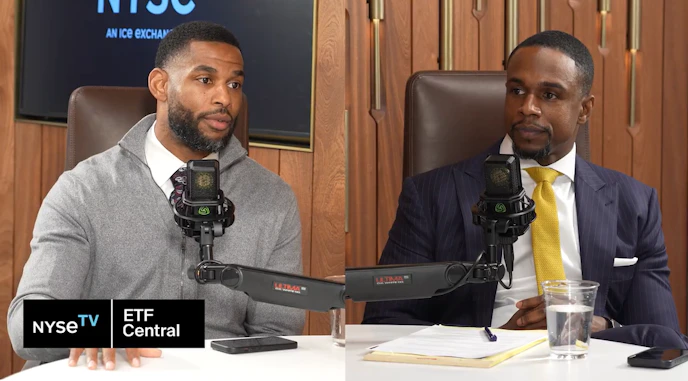
Bilal Little, Director of Exchange-Traded Funds at the NYSE and host of the ETF Central podcast, sits down with former NFL star and Champion Venture Partners co-founder Marques Colston to unpack how sports is evolving into a serious asset class—and why everyday investors may finally get a seat at the table.
From the Huddle to the Hustle: Rebuilding After the NFL
When Marques Colston walked away from a 10-year career with the New Orleans Saints—complete with a Super Bowl ring in the 2009–2010 season—he didn’t retire. He retooled.
He became an owner-operator of an indoor football team. An angel investor. A financial advisor. An adjunct professor at the University of New Orleans.
A program builder at Columbia Business School, where he taught athletes entrepreneurship and venture investing.
That’s not a midlife crisis. That’s reps.
Colston describes his business journey as a series of “paid internships”—except he flipped the model and wrote the checks himself. Angel investing wasn’t just about putting money to work. It was about putting himself in the work. Learning by doing. Pressure-testing conviction in real time.
Sound familiar? It should. That’s athlete DNA.
Escaping the “Former Athlete” Box
Transitioning from NFL star to finance professional isn’t as glamorous as it sounds. Yes, fame opens doors. But as Colston points out, once you’re in the room, you may still be wearing the wrong uniform.
You’re shaking hands.
Signing autographs.
Taking pictures.
But not getting to do the work.
The hard truth? Some people will never see you as more than the “former football guy.” The faster you recognize that, the better. Colston learned to identify who was genuinely interested in what he could build—versus who just wanted proximity to the brand.
His strategy is pure pattern recognition:
- Invest time where perception is flexible.
- Stop wasting energy where it’s fixed.
- Build mutually beneficial relationships, not superficial ones.
In markets and in life, capital allocation matters. That includes your time.
The Big Idea: Sports as an Asset Class
Colston’s latest venture is Champion Venture Partners, a firm built around a simple thesis: sports is no longer just entertainment—it’s a maturing asset class.
The goal? Launch a publicly available interval fund—Champion Fund—that invests across the entire sports value chain, not just the headline-grabbing franchises.
We’re talking about exposure to:
- Teams and clubs
- Real estate and stadium ecosystems
- Media and streaming rights
- Hospitality and adjacent service businesses
- Technology and data infrastructure
This isn’t about buying the Lakers at $10 billion and calling it a day. It’s about understanding what keeps that $10 billion growing.
As institutional capital floods into sports—private equity buying minority stakes, family owners seeking liquidity—the return expectations rise. And when returns are expected, reinvestment follows.
Growth needs fuel. Fuel comes from infrastructure. Infrastructure lives across the value chain.
Democratizing the Owner’s Box
Historically, investing in sports meant being ultra-high-net-worth or institutional. That’s changing.
Between ETFs, interval funds, and post-COVID product innovation, access to alternatives has expanded. Colston sees sports as the perfect entry point for democratizing alternative investing—because it’s universal.
Fans and athletes create the value.
But historically, they couldn’t own it.
That disconnect is the opportunity.
Colston’s north star is giving retail investors—accredited and non-accredited—the ability to “play in the same sandbox” as institutional capital. Not just watching the game. Owning a slice of the ecosystem.
Media Is the Real Game
Here’s where things get interesting.
Sports used to be seasonal entertainment. Now it’s 24/7/365 content. The real driver of valuations? Distribution.
Linear networks like CBS and ABC bid up rights for decades. Now deep-pocketed streamers—Netflix, Amazon, Apple—are in the mix. Appointment viewing still matters, but the battlefield has shifted.
As legacy media gets displaced, it will hunt for new properties. That’s where emerging leagues get compelling.
Think:
- Pickleball
- Niche combat sports
- Minor leagues with digital-native audiences
The thesis isn’t “this sport is cool.” It’s:
- Are the league fundamentals strong?
- Does the league pull weaker teams upward?
- Can it generate sustainable media partnerships?
Mature leagues (NFL, NBA, MLB, NHL) operate at a different lifecycle stage. Emerging leagues require early-stage underwriting—less nostalgia, more fundamentals.
Data: The Hidden Gold Mine
If media is oxygen, data is jet fuel.
Colston points to developments like The Battery in Atlanta—an integrated ecosystem of stadium, retail, hospitality, and mixed-use real estate. Above ground, it’s entertainment. Below ground, it’s data extraction.
Three hours in a modern stadium generates:
- Location data
- Engagement data
- Purchase behavior
- Betting activity
- Streaming and social interaction metrics
The explosion in sports betting and predictive markets is data monetization in real time.
The next wave?
Licensing it.
Packaging it.
Building recurring revenue around it.
Sports organizations aren’t just teams anymore. They’re data platforms.
Reading Between the Public Lines
Here’s the tricky part: most franchises are private. So how do you get signal?
Colston watches the public partners.
- Media companies and streamers
- Advertisers
- Technology platforms
The lone public outlier in the NFL is the Green Bay Packers, whose financial disclosures offer rare insight. Beyond that, investors read tea leaves through partnerships—who’s signing deals, at what scale, and with what strategic intent.
It’s ecosystem investing. Follow the dominoes.
NIL and the Professionalization of College Sports
Name, Image, and Likeness (NIL) deals have blown the doors off college athletics. Hundreds of millions of dollars are flowing into universities through donor collectives.
The novelty is exciting. The sustainability? TBD.
Colston sees the next phase as inevitable:
- Guardrails around player movement
- Clearer compensation frameworks
- A shift from donor-driven chaos to professionalized operations
Athletes are getting paid like pros. Coaches have been paid like pros. But many athletic departments still operate on amateur-era infrastructure.
That mismatch won’t last.
Expect tiering. If you’re not in the Big Ten or SEC, you may need to redefine what “winning” means. Scarcity will protect elite brands. Others will compete on different metrics.
And eventually, donors will ask the question every investor asks:
Where’s my ROI?
Five Years Out: Beyond Sports
Colston’s five-year vision isn’t just about returns. That’s table stakes.
The bigger mission: use sports as a gateway to make alternative investing broadly accessible.
Wealth-building pathways differ based on background and access. Sports is ubiquitous. It’s relatable. It’s emotional. That makes it an ideal on-ramp into alternatives.
If Champion Venture Partners succeeds, it won’t just create alpha in sports—it will expand who gets to pursue alpha at all.
What Business Should Understand About Athletes
Everyone asks Colston what skills translate from Sundays to the boardroom.
His answer? Not as many as you think.
You still have to learn the new industry.
You still have to master the role.
What transfers isn’t what you do. It’s how you do it.
The real growth wasn’t on Sunday. It was the process of getting to Sunday.
Going from an undersized 180-pound freshman at Hofstra to a Super Bowl champion required vision, discipline, repetition, and belief. That process—turning vision into reality—is portable.
Athletes who understand that can repurpose the blueprint anywhere.
Colston’s playing days are over. But if sports is becoming a global, data-driven, institutional asset class, he may have just found a bigger arena.
Please note this article is for information purposes only and does not in any way constitute investment advice. It is essential that you seek advice from a registered financial professional prior to making any investment decision.
Topics
See all
This article does not have a tagged topic
Segments
See all
No specific market segments were tagged
Mentioned ETFs



The ETF Industry Is Evolving Fast
From AI infrastructure to active strategies, the ETF landscape is shifting. Share your perspective in the 7th Annual Global ETF Survey and get exclusive early access to the final report.