Explore professionally built ETF model portfolios. Discover now →



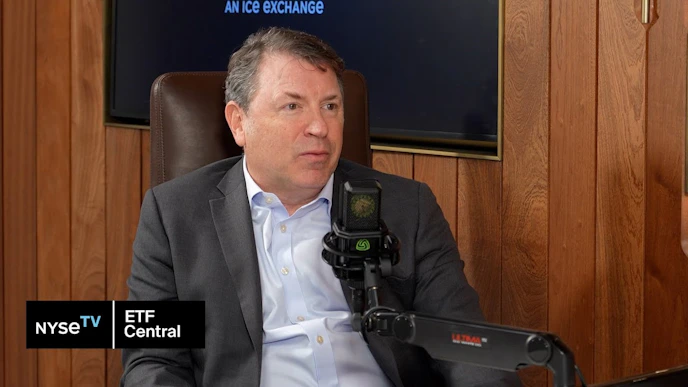
Bilal Little, Director of Exchange-Traded Funds at the NYSE and host of the ETF Central podcast, sits down with Head of Exchange-Traded Solutions Tim Reilly to talk all things ETFs—from 2025’s explosive growth and trading innovations to the regulatory shifts and product trends shaping the road ahead into 2026.
From Solomon Brothers to the NYSE: Tim Reilly’s Wall Street Journey
Tim Reilly’s path to leading the ETF business at the New York Stock Exchange wasn’t a straight shot—but it’s been eventful.
He started his career at the iconic (and now defunct) Salomon Brothers on the program trading desk, survived the merger with Citigroup, and over two decades helped build major trading businesses from the inside.
Later, stints at fintech firms sharpened his entrepreneurial edge, before landing at the NYSE where he now oversees ETFs, bonds, and closed-end funds. In short: he’s seen it all, and now he’s helping shape what’s next.
2025: A Banner Year for ETFs (Again)
If 2025 had a theme, it was growth. U.S.-based ETFs now clock in at $13.5 trillion in AUM, and $1.44 trillion in flows poured into the market this year.
Reilly notes that 75% of that capital went into NYSE-listed ETFs, confirming the exchange’s dominance in the space. Whether it’s crypto ETFs, actively managed funds, or new launches from well-known brands like Baron Funds, the NYSE has been at the center of the action.
But Reilly's not resting on records.
He’s aware “record-breaking” gets overused—and emphasizes the NYSE’s edge lies in its consistency, market quality, and relentless partnership with issuers, regulators, and market makers.
The Trading Powerhouse Behind the Curtain
Beyond just listing, NYSE is also the trading venue for ETFs.
And by Reilly’s account, it's not even close. ARCA, one of NYSE’s five exchanges, handles the vast majority of ETF trades, especially in the high-flying crypto ETF world.
Tim breaks it down: ETFs typically see heavier morning trading, while traditional equities (think Delta or Visa) dominate at the 4 PM close. That’s part of why the NYSE puts so much emphasis on high-quality opening and closing auctions. Liquidity, tight spreads, and price stability? Not just buzzwords—these are critical for delivering a good investor experience.
He also points out a telling stat: at peak market stress (like in Q1-Q2 of 2025), ETFs made up 25% of all trading volume.
Why? Their hedging utility shined when volatility spiked—and now, with a rally in full swing, bullish ETFs are back in favor.
Human + Tech = Floor Advantage
One surprising trend: issuers are returning to the NYSE trading floor.
ETFs traditionally lived on electronic venues, but a two-and-a-half-year-old program is bringing them back to “the floor”—where companies like Nike and Uber already reside.
Why does this matter?
It’s about pairing automation with human oversight.
Reilly explains that during market imbalances or in illiquid ETFs, having a designated market maker (a real human!) can help smooth volatility and provide better price discovery. Not every product needs this, but for certain issuers, it’s a serious edge.
Around-the-Clock Trading? Almost There
One hot-button topic is 23/5 trading. The NYSE is moving toward a near-continuous trading environment, aiming to keep markets open 23 hours a day, five days a week.
Why not 24/7?
Because an hour of downtime is critical for handling corporate actions, splits, and data integrity. “It may sound odd,” Reilly says, “but it’s responsible.” This shift opens U.S. markets to global investors and gives access to retail traders who operate outside traditional hours—all while preserving the integrity that defines U.S. capital markets.
Innovation’s New Frontier: Digital Assets and Private Markets
The ETF space isn't just growing—it’s morphing.
Digital asset ETFs (like those tracking Solana and XRP) are gaining steam, bringing crypto exposure to traditional investors. But even more intriguingly, private credit and private equity-style strategies are entering the ETF world.
Reilly calls the ETF wrapper “an access point,” whether for municipal bonds, commodities, or private assets. And while ETFs won’t replace every structure, they’re becoming a powerful delivery mechanism for a broader set of strategies—including some that were once reserved for institutions.
Regulation: More Accessible, More Transparent
Reilly highlights three key regulatory shifts that reshaped 2025 and will impact 2026:
- Improved Auctions – NYSE enhanced its auction mechanics, particularly on ARCA, making opening and closing prices more transparent and efficient.
- Simplified Listings – The SEC’s move toward generic listing standards has made it easier (and faster) for ETFs to come to market, especially in commodities and digital assets.
- Redefining Round Lots – By adjusting what counts as a standard trading unit (especially for high-priced ETFs), the SEC helped lower trading costs for retail investors—an underappreciated but powerful change.
Looking ahead, all eyes are on multi-share class rules, which could allow investors to switch from mutual funds to ETFs more seamlessly—no tax hits, no friction.
What’s Hot in 2026: Income, Options, and Alternatives
When asked about what products are drawing attention going into 2026, Reilly doesn’t hesitate: income strategies are leading the pack.
From structured yield products to fixed income and options-based ETFs, the chase for yield isn’t slowing.
There’s also growing interest from mutual fund firms venturing into alternative assets, and possibly even a “serious maybe” on interval funds making a comeback.
Reilly admits he didn’t expect to talk much about closed-end funds in late 2025—but here we are.
Growth Brings Risks—Especially Product Bloat
Reilly’s Main Concern Heading Into 2026?
The sheer number of ETFs. With nearly 1,000 new products launching a year, he worries about quality control. Some ETFs are underdeveloped, under-distributed, and disappear within six months.
He doesn’t claim to be the arbiter of what makes a good ETF, but acknowledges that early closures don’t serve investors well. The NYSE, he says, is disciplined in what it lists—but the industry at large may need to slow the churn.
The Final Word: “I Won’t Back Down”
As the interview wraps, Reilly gives us a peek into his Spotify Wrapped: his top song (besides a Christmas tune or two) is Tom Petty’s “I Won’t Back Down.” Fitting, really. It’s a quiet anthem of resilience—and one that sums up the NYSE’s mindset heading into 2026.
More innovation, more collaboration, and more investors entering the market. As Reilly puts it: “You never know what the market will bring. But we’re well positioned to adapt—and deliver.”
Please note this article is for information purposes only and does not in any way constitute investment advice. It is essential that you seek advice from a registered financial professional prior to making any investment decision.
Topics
See all
This article does not have a tagged topic
Segments
See all
No specific market segments were tagged
Mentioned ETFs
No specific ETFs were tagged



Calamos Investments Powers the Next Phase of the Autocallable Revolution
Join J.P. Morgan’s Bram Kaplan, Head of Americas Equity Derivatives Strategy and Matt Kaufman from Calamos Investments as they dive into the growing global opportunity in autocallable income—an increasingly dominant strategy within structured products, now available through ETFs.
Accepted for 1 CE Credit