Open Now: The Global ETF Survey Take the Survey →



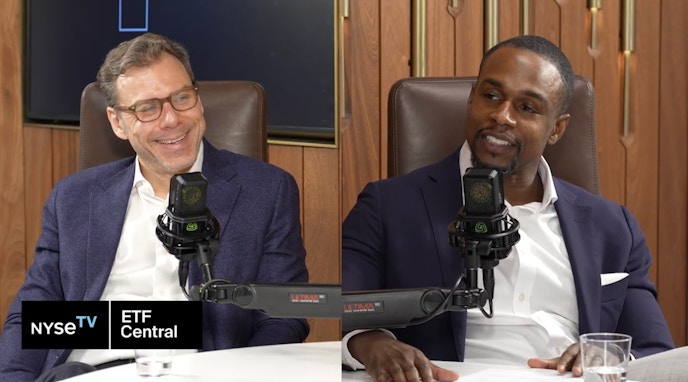
Bilal Little, Director of Exchange-Traded Funds at the NYSE and host of the ETF Central podcast, sits down with Bryon Lake, Chief Transformation Officer at Goldman Sachs Asset Management, to talk about the future of active ETFs, private market access, and how technology is reshaping the investor experience.
Ringing the Bell and Making It Real
Bryon Lake kicks off this ETF Central interview on a relatable note: ringing the NYSE bell isn’t just ceremonial—it’s how his family finally “gets” what he does. For Lake, who’s been in the ETF game for 25 years, ringing that bell connects abstract financial milestones with something universally understood.
He encourages his team to snap selfies at the Exchange, send them to friends, and say, “I did something cool today.” Because let’s be honest—most people don’t know what asset managers actually do. But everyone knows the New York Stock Exchange.
The Transformation Mandate: Less Complexity, More Impact
Lake holds two titles at Goldman Sachs Asset Management (GSAM): Global Co-Head of the Third-Party Wealth Business and Chief Transformation Officer. The latter isn’t just a buzzwordy title—it's a north star role.
His mission? Think five years ahead and start building today.
He’s focused on integrating Goldman’s asset management capabilities into a more scalable, digital-first platform that can serve financial advisors, institutions, and individual investors more effectively.
As the industry shifts, Lake's job is to make sure Goldman evolves with it—particularly as clients increasingly want to interact digitally while still relying on personal relationships and trusted advice.
The Goldman Edge: Public, Private, and Everything in Between
GSAM has $3.5 trillion in assets under management and ranks in the top 10 globally.
What sets them apart? Breadth and scale. They play in public markets, private markets, and across the full spectrum in between.
Lake points to their ability to deliver solutions like direct indexing (for tax efficiency and personalization), evergreen alternatives (making illiquid investments accessible), and now—active ETFs.
The common theme? Solving real problems at scale.
Why ETFs Are the MP3 of Finance
Lake draws a compelling analogy: ETFs are to investing what MP3s were to music.
They’re not a genre; they’re the how. Just as MP3s allowed you to listen to anything, anywhere, ETFs offer investors convenient, transparent, tax-efficient, intraday-accessible exposure to markets.
The real shift, though, is in combining this technology with active management.
Active ETFs, despite representing only 10% of total ETF assets, are attracting a third of new flows. The demand is clear: investors still want skill-based management—they just want it in a better wrapper.
Goldman’s Active ETF Hits—and a Big Move
Goldman’s active ETF assets have tripled over the past year, now exceeding $53 billion.
Their strategy is simple: take best-in-class investment capabilities (think munis, income strategies, covered calls) and distribute them via ETFs.
Enter the Innovator acquisition. Goldman saw a perfect cultural and strategic fit: Innovator, known for pioneering defined outcome ETFs, brings 150 products and $30 billion in AUM.
It's a move that catapults Goldman into the top 10 ETF issuers. But more importantly, it gives them a powerful new toolkit to offer clients income, risk-managed growth, and structured solutions—all wrapped in a simple, accessible ETF format.
Defined outcome strategies, Lake explains, are like plugging an acoustic guitar into an amp. It’s still the same instrument, but now it can rock.
Democratization of Sophistication
A key theme throughout the interview: strategies once reserved for big institutions are now available to everyday investors. Whether it's direct indexing, alternatives, or structured outcomes, technology has slashed costs and barriers to entry.
Platforms like Robinhood and Wealthfront are giving more retail investors access, while defined outcome ETFs let them fine-tune risk and return in ways that used to require custom option strategies.
Goldman sees this as a continuation of the trend: better access, better tools, and smarter portfolios for all.
Education Is the New Alpha
As investment products get more advanced, so does the need for education. Lake emphasizes that asset managers have a duty to educate—not just advisors, but end investors too.
Goldman’s answer: GSIU (Goldman Sachs Investment University), a platform designed to help professionals and clients understand not just what they’re investing in, but why it works.
As more complex strategies make their way into retail portfolios, this kind of clarity becomes a differentiator.
Unlocking Private Markets with Goldman & T. Rowe
Goldman has been doing “private investing” since before it had a label—private credit, equity, real estate, and infrastructure. With new regulations and evergreen wrappers, these strategies are now viable even in retirement accounts like 401(k)s.
Lake sees the next evolution as convergence: “Big institutions have been able to do this for years,” he says. “Now, thanks to technology and education, these are starting to work their way into individual investors’ portfolios.”
That vision turned into action in September 2025, when Goldman Sachs and T. Rowe Price announced a strategic partnership focused on expanding access to both public and private markets. Goldman backed the move with a $1 billion investment in T. Rowe Price stock, underscoring their long-term alignment.
By December, the firms launched their first co-branded model portfolios on GeoWealth—blending Goldman’s alternatives expertise with T. Rowe’s public market leadership. Designed for both mass-affluent and high-net-worth investors, these portfolios mark a step toward more personalized, institution-grade investing. A fifth model, expected in 2026, will incorporate direct indexing and evergreen private funds—bringing private access full circle.
What’s Next: Themes for the Next 5 Years
Lake wraps with three big themes:
- Better Tools = Better Portfolios
Investors have more options than ever to build precise, goal-aligned portfolios—whether they’re chasing yield, saving for retirement, or donating to charity. - From Blunt Instruments to Precision Playlists
Just like we don’t rely on radio anymore, investors no longer settle for generic products. They want custom exposure, built from a suite of sophisticated tools. - Convergence of Public and Private Assets
As more private companies stay private longer, investors are hungry for access. Expect continued blending of private equity, credit, and alternatives into mainstream portfolios—especially as vehicles like ETFs and model portfolios evolve.
Please note this article is for information purposes only and does not in any way constitute investment advice. It is essential that you seek advice from a registered financial professional prior to making any investment decision.
Topics
See all
This article does not have a tagged topic
Segments
See all
No specific market segments were tagged
Mentioned ETFs
No specific ETFs were tagged



Expert-Built ETF Portfolios, All in One Place
Don’t start from scratch. Discover ready-made ETF portfolios built by professionals to match different goals, timelines, and market views. Use them as inspiration or as a starting point for your own allocation.