Ready-made ETF portfolios built for real investor needs. Explore now →



SCHD: A quality factor ETF disguised as a dividend index ETF
SCHD offers investors palpable exposure to the investment and profitability risk factors, which could explain its past outperformance compared to other dividend ETFs.

Keep up with what matters in ETFs
Get timely ETF insights, market trends, and top ideas straight to your inbox.
Your newsletter subscriptions with us are subject to ETF Central's Privacy Policy and Terms and Conditions.
Previously, I examined whether U.S. dividend-focused ETFs were worth it. I found that they generally tended to under-perform a regular index fund on a total return basis over the long run. I also found that the outperforming ones did not because they paid dividends, but because they had higher Fama-French risk factor exposures.
So, not all dividend ETFs are created equal. Some may have enticingly high yields but poor long-term total returns, even when those payments are reinvested on time. Others can exclude certain stock market sectors and companies that have historically performed well, but don't pay dividends, such as technology and Berkshire Hathaway.
One dividend ETF that has strongly outperformed its peer group since 2012 is the Schwab U.S. Dividend Equity ETF (SCHD). To illustrate my earlier point, SCHD didn't outperform because it paid the highest yields. Rather, it did so by having the best quality holdings, as expressed by its higher exposure to the Fama-French investment and profitability risk factors.
Like what you're reading?
Stay in the loop — get the latest ETF insights: trends, analysis, and expert picks.
What does quality mean anyways?
As mentioned earlier, quality stocks have robust exposure to investment and profitability risk factors. Earlier, I wrote about the Fama-French risk factors of value and size, referring to:
- The returns of high-book-value stocks minus the returns of low-book-value stocks (High minus Low, or HmL).
- The returns of small-cap stocks minus the returns of large-cap stocks (Small minus Big, or SmB).
Well, value and size are just two of the five factors in the Fama-French model. The last two, investment and profitability play a large role in producing quality stocks and explaining outperformance. They are:
- The returns of companies with conservative investments minus the returns of companies with aggressive investments (Conservative minus Aggressive, or CmA).
- The returns of companies with strong operating profitability versus the returns of companies with weak operating profitability (Robust minus Weak, or RmW).
According to a study by the CFA Institute, both the investment and profitability risk factors have played a role in explaining a stock's outperformance versus a benchmark. While investment's power has faded somewhat post-2004, profitability has consistently delivered:
"Over all economic cycles since 1963, going long high quality stocks, or profitable firms, and shorting their low quality, unprofitable counterparts has been a great investment strategy. And the power of the factor has not diminished."
The authors further noted that despite the definition of "quality" changing over time with different fund managers using various criteria, screening for profitability and investment metrics ensured that most of the "quality return premium" was captured.
How does SCHD stack up?
SCHD passively tracks the Dow Jones U.S. Dividend 100, which holds 102 large-cap U.S. stocks selected for quality and sustainability of dividends and strong financial ratios. With a low expense ratio of 0.06%, it is one of the most popular ETFs among U.S. dividend investors.
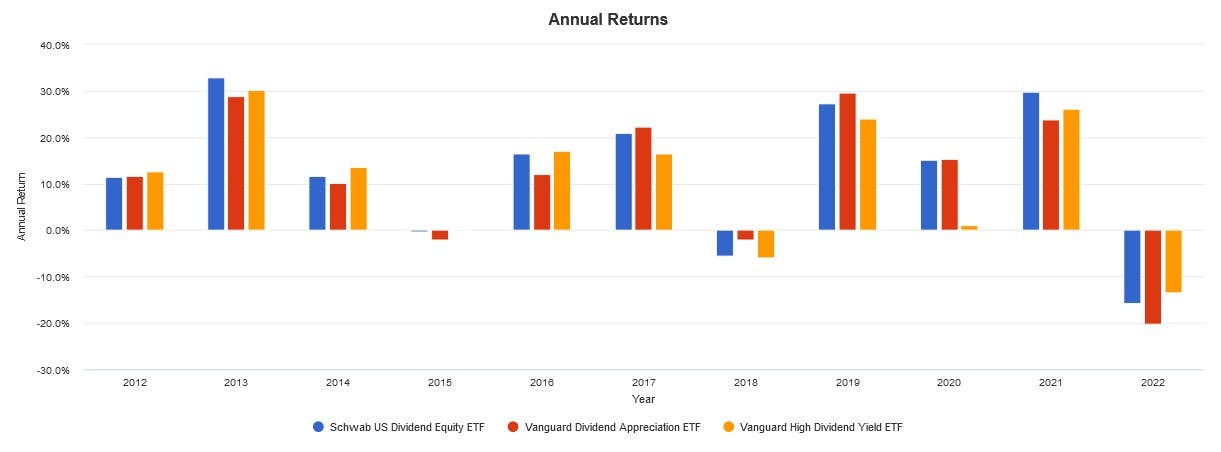
I backtested the performance of SCHD from 2022 to the present against two of its peers that use different styles of dividend investing (historical growth vs. high yields). They were the Vanguard Dividend Appreciation ETF (VIG) and the Vanguard High Dividend Yield ETF (VYM).


Why SCHD outperformed
SCHD beat VIG and VYM handily, with better trailing and total returns over various periods. But what could explain this outperformance? I did a factor regression to find out the following:

Historically, SCHD delivered greater exposure to the investment and profitability risk factors than VIG and VYM while achieving alpha. VYM had greater exposure to investment, while VIG had greater exposure to profitability, but SCHD had both.
All three ETFs had negative loadings for the size risk factor, which is not surprising given they're comprised of large caps. Funny enough, VYM also doubles as a decent value ETF, given its higher exposure to the value risk factor.
Honestly, this isn’t anything new. Vanguard themselves conducted research on high yield and historical growth dividend strategies in 2017 and came to the same conclusion. They noted that:
"Compared with other equities, the performance of these strategies has been time-period dependent and largely explained by their exposure to a handful of equity factors: value and lower volatility for high-dividend-yielding equities and lower volatility and quality for dividend growth equities."
The lesson here? Consider screening your dividend ETFs for factor loadings, because these are what truly drive long-term investment returns.
Please note this article is for information purposes only and does not constitute investment advice.
Latest ETF News
See all ETF newsETF comparison: NEOS S&P 500 High Income ETF (SPYI) Versus Goldman Sachs S&P 500 Premium Income ETF (GPIX)
There’s an ETF for That? Investing Like University Endowments

Could Water ETFs Be the Next AI Bottleneck Trade?

What is a Boomer Candy ETF?



 Advantages of ETFs over Mutual Funds1/6
Lower Costs
In this guide, we'll explore the advantages of ETFs over mutual funds, giving you valuable insights into why ETFs have gained significant popularity among investors like yourself.
Leveraged ETFs: Unlocking the Potential for Amplified Returns1/6
Understanding Leveraged ETFs
Explore leveraged ETFs: potential for amplified returns & risks. 5 ETFs to consider across equities, commodities & fixed income.
What is a Leveraged ETF?1/6
Introducing Leveraged and Inverse ETFs
In this guide, we'll dive into the world of leveraged ETFs, exploring their definition, mechanics, potential risks, and rewards.
Recent educational content

ETF Trends
ETF Industry KPIs September 14, 2026
This week’s KPI data overview highlights key metrics and trends shaping the ETF landscape.

ETF Trends
ETF Industry KPIs September 8, 2026
This week’s KPI data overview highlights key metrics and trends shaping the ETF landscape.
ETF Trends
ETF Industry KPIs August 31, 2026
This week’s KPI data overview highlights key metrics and trends shaping the ETF landscape.
ETF Trends
ETF Industry KPIs August 24, 2026
This week’s KPI data overview highlights key metrics and trends shaping the ETF landscape.
Browse all educational columns



Expert-Built ETF Portfolios, All in One Place
Don’t start from scratch. Discover ready-made ETF portfolios built by professionals to match different goals, timelines, and market views. Use them as inspiration or as a starting point for your own allocation.