Global ETF Survey Is Live! 600+ ETF Professionals Weigh In. See Results →



How to become a value investor using ETFs
These ETFs are great for capturing value stock exposure at a low price.


Keep up with what matters in ETFs
Get timely ETF insights, market trends, and top ideas straight to your inbox.
Your newsletter subscriptions with us are subject to ETF Central's Privacy Policy and Terms and Conditions.
Value stocks are those of companies perceived by the market as being underpriced relative to their fundamentals. As a whole, they have been resurging lately. Year-to-date, their performance as a whole has greatly outperformed the market, dropping only slightly relative to the deep drawdowns seen in indexes like the S&P 500 and NASDAQ 100.
These stocks are often those of more traditional (some would say "boring) companies in sectors like consumer staples, healthcare, industrials, finance, or energy. Often, these companies are mature blue-chip stocks, with strong balance sheets and high dividend yields. Valuation metrics that define value stocks include a low price to earnings, price to sales, price to book, and price to free cash flow ratios.
Some of the most famous investors in history were value investors. Notable examples include Benjamin Graham and his protégé, Warren Buffett, whose flagship company Berkshire Hathaway (BRK.A/BRK.B) made its fortune buying the shares of undervalued companies.
Global ETF Survey 2026 is Live!
With 1,790 new products launched by July 2026, choosing is harder than ever. Our Global ETF Survey 2026, built on 620 professional investors and allocators, shows how active, fixed income, options-based and thematic ETFs are reshaping fund selection.
How has value investing historically performed?
According to Eugene Fama and Kenneth French's Five-Factor model, value stocks are riskier, and thus investors are compensated for that risk by the "value premium." Stocks that are cheaper in terms of the valuation metrics enumerated above are more volatile and unpredictable, and investors are compensated with greater returns for assuming that risk.
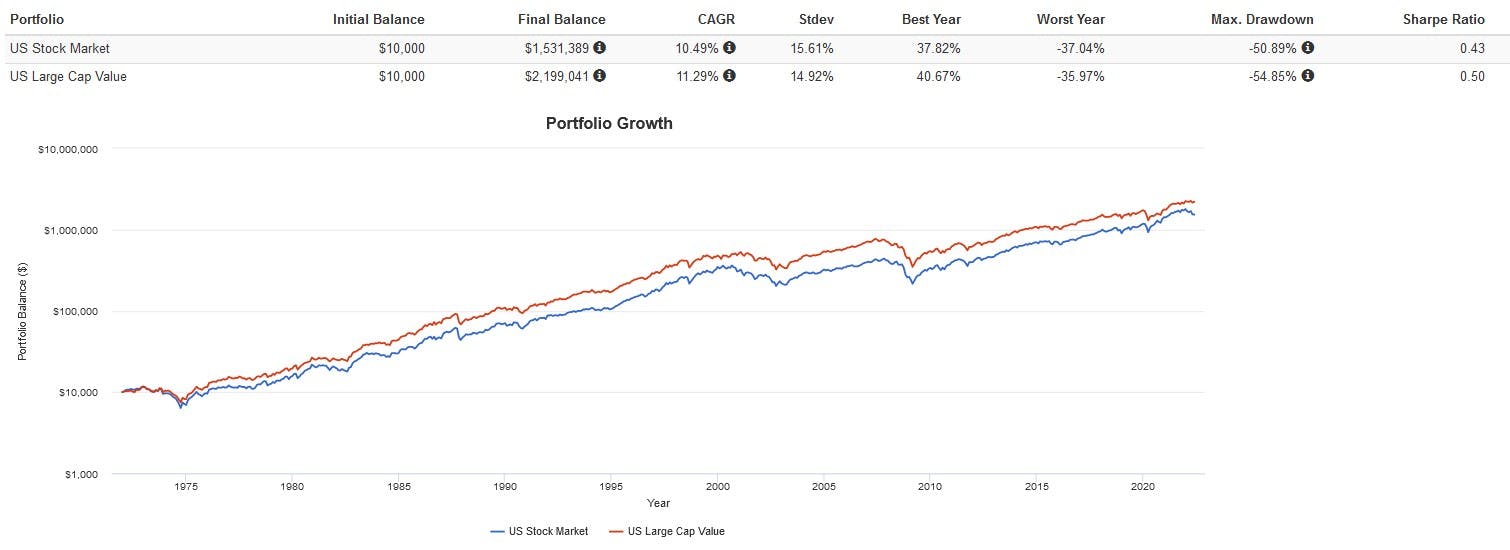
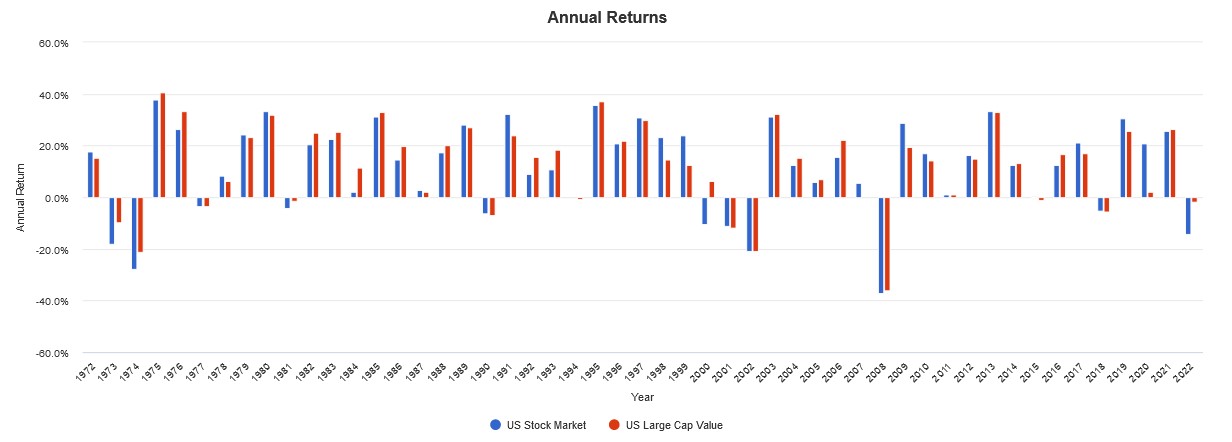
The historical evidence seems to validate this. From 1972 to the present, U.S. large-cap value stocks soundly beat the total U.S. stock market, with a greater total return, less volatility, and better risk-adjusted returns. Looking at the annual returns, we see that this outperformance occurs in sustained bursts. While growth stocks outperformed in much of the last decade, value stocks are making a strong comeback in 2022, with U.S. large-cap value stocks only down -1.6% compared to the total stock market at -14.24%.
The biggest risk to a value investing strategy is impatience and the fear of missing out. Despite the strong evidence for the value risk factor occurring throughout history, it can be difficult for average investors to stick to a value stock tilt when the rest of the market is going through the roof during a bull run. Imagine being a value investor between 2017 and 2021 when the FANG stocks were taking off, and the growth of stock-heavy NASDAQ hit all-time highs.
Value investors who cannot stay the course and trust in the theory will inevitably capitulate and sell out of their value stocks precisely at the moment when they should be building a position instead. Value investors who abandon their strategy to chase performance are almost always destined to "buy high, sell low." As Warren Buffett noted: "It is far better to buy the stock of a wonderful company at a fair price than a fair company at a wonderful price."
Examples of value ETFs
An easy way to tilt your portfolio to value stocks is via an exchange-traded fund (ETF) that tracks a basket of them. Various ETFs offer different types of exposures to various subsets of value stocks, such as U.S. only, international developed, international emerging, mega, large, mid, or small-cap. In return for an expense ratio, investors gain instant access to a managed portfolio that rebalances itself regularly, allowing them to stay hands-off and passive.
I used ETF Central’s screener to find a list of value ETFs and described them based on their strategy, holdings, market cap, geography, and expense ratio. Other ways to test the quality of a value ETF include comparing their valuation metrics and running a factor regression test for the value risk factor.
Keep in mind that a value tilt is inherently a form of active management, even if passive index ETFs are used. By overweighting value stocks, investors consciously bet on that market segment outperforming. Before investing, ensure you have thought out your investment thesis and risk tolerance carefully.
Vanguard Value ETF (VTV)
- Assets under management: $95 billion
- Expense ratio: 0.04%
- Index: CRSP US Large Cap Value Total Return Index
- Market cap: Large
- Geography: U.S.
- Strategy: Passive index
- Holdings: 346
Vanguard Small-Cap S&P 600 Value ETF (VIOV)
- Assets under management: $1 billion
- Expense ratio: 0.15%
- Index: S&P Small Cap 600 Value Total Return Index
- Market cap: Small
- Geography: U.S.
- Strategy: Passive index
- Holdings: 459
iShares Russell 2000 Value ETF (IWN)
- Assets under management: $1 billion
- Expense ratio: 0.24%
- Index: Russell 2000 Value Total Return Index
- Market cap: Small
- Geography: U.S.
- Strategy: Passive index
- Holdings: 1,236
Invesco S&P 500 Pure Value ETF (RPV)
- Assets under management: $3 billion
- Expense ratio: 0.35%
- Index: S&P 500 Pure Value Total Return Index
- Market cap: Large
- Geography: U.S.
- Strategy: Passive index
- Holdings: 120
Dimensional International Value ETF (DFIV)
- Assets under management: $3 billion
- Expense ratio: 0.35%
- Index: N/A
- Market cap: Large/Mid
- Geography: Developed international
- Strategy: Actively managed
- Holdings: 519
Topics
See all
This article does not have a tagged topic
Mentioned ETFs
Further reading

Latest ETF News
See all ETF newsBeyond Big Tech: The Increasing Specialization of AI ETFs

There's an ETF for That? Humanoid Robotics and Physical AI

How Some ETF Issuers Use Their Own Funds for Cash Management

These Public-Private ETFs Invest in Polymarket and Anduril

There's an ETF for That? Frontier Markets



 Advantages of ETFs over Mutual Funds1/6
Lower Costs
In this guide, we'll explore the advantages of ETFs over mutual funds, giving you valuable insights into why ETFs have gained significant popularity among investors like yourself.
Leveraged ETFs: Unlocking the Potential for Amplified Returns1/6
Understanding Leveraged ETFs
Explore leveraged ETFs: potential for amplified returns & risks. 5 ETFs to consider across equities, commodities & fixed income.
What is a Leveraged ETF?1/6
Introducing Leveraged and Inverse ETFs
In this guide, we'll dive into the world of leveraged ETFs, exploring their definition, mechanics, potential risks, and rewards.
Recent educational content
First Look ETF
First Look ETF: Income, International, and Cash Flow ETFs
In this season 6 episode of First Look ETF, Stephanie Stanton @etfguide examines the latest ETF marketplace trends with NYSE and guests.


ETF Trends
ETF Industry KPIs October 5, 2026
This week’s KPI data overview highlights key metrics and trends shaping the ETF landscape.

ETF Trends
ETF Industry KPIs September 28, 2026
This week’s KPI data overview highlights key metrics and trends shaping the ETF landscape.
ETF Trends
ETF Industry KPIs September 22, 2026
This week’s KPI data overview highlights key metrics and trends shaping the ETF landscape.