ETF model portfolios designed for real investor needs. Discover →



U.S. Dividend ETFs: Are they worth it?
Are dividend-oriented funds really superior to regular index funds?


Keep up with what matters in ETFs
Get timely ETF insights, market trends, and top ideas straight to your inbox.
Your newsletter subscriptions with us are subject to ETF Central's Privacy Policy and Terms and Conditions.
Dividend stocks – who doesn't love them? Even the newest of investors understand the concept of a dividend payment – a reward from the company you invested in for being a loyal shareholder. Taking part in the profits, if you will.
In bull markets, reinvesting the dividends and letting them compound plays a huge role in boosting total returns. In bear markets, the green from the dividend payment can be a much-needed psychological boost for investors on the brink of capitulating. For retirees, dividends can help ensure a regular stream of income.
That being said, there is an age-old question we have to answer, one that is a sore point of contention between the dividend die-hards and the regular passive investors. Does dividend investing work? That is, does it result in better total returns than a regular buy-and-hold approach using index funds?
Like what you're reading?
Stay in the loop — get the latest ETF insights: trends, analysis, and expert picks.
Does dividend growth investing work?
The short answer here is "yes, but not for the reasons you may imagine". To sum it up, dividend investing works not because stocks pay dividends, but because dividend-paying stocks also tend to provide excess exposure to alpha-generating Fama-French risk factors, such as value, profitability, and quality.
To understand, we have to examine a paper from 1961 from Merton Miller and Franco Modigilani titled "Dividend Policy, Growth, and the Valuation of Shares". In this paper, Miller and Modigilani advanced their "dividend irrelevance theory", which argued that investors should be indifferent between a $1 dividend (which causes the stock price to drop by $1, all else being equal) versus receiving $1 by selling shares.
This makes sense. Dividends are not "magical money printers". That's a common mental accounting fallacy used by dividend investors. They are paid out of the after-tax retained earnings of the company. A company pays dividends when it has no better use for the cash (i.e., they cannot use it for further growth), and thus elects to return excess profits to shareholders. If I wanted a dividend payment, I could achieve the same result by selling shares.
However, dividend-paying stocks tend to be from higher quality, lower-valuation, more profitable companies. That is, aside from a few with unsustainably high payout ratios, dividend-generating companies tend to be good business. After all, they must have done something right to have a surplus of cash to give back to shareholders, right? Broke companies generally don't pay dividends, and a discontinued dividend payment (like what General Electric did in 2018) is a bad sign.
And that is the revelation here. Dividend growth investing doesn't perform well because of the dividends paid – it's because dividend stocks tend to be more profitable, undervalued, and of higher quality on average. Dividend growth (consecutive payouts and increases) just tends to be an incidentally correlated criteria for screening these factors. Investors could arguably achieve the same results by tilting their portfolios using factor funds that screen for value, profitability, and quality. Vanguard conducted research on their own dividend funds and concluded that the outperformance was precisely due to excess exposure to these risk factors.
A dividend growth portfolio is basically a bunch of large-cap value stocks with good profitability and sustainable investments, but you could achieve the same results without focusing on dividends, which tends to exclude otherwise fantastic stocks that do not pay them.
U.S. dividend ETFs
This is just my opinion, but if I was a U.S. dividend investor, I would select funds not based on their history of dividend growth or current dividend yield, but on their exposure to the value, profitability, and quality risk factors. This can be done via a simple Five-Factor Fama-French Regression Analysis.
That being said, there are instances where dividend funds are appropriate. Retirees in the withdrawal phase who rely on a steady stream of income and cannot psychologically bear to sell shares during downturns can benefit from dividend funds. The lower volatility and better quality of dividend stocks might also help here. Supplementing this with corporate bonds and covered call overlays can further enhance income, at the cost of total returns.
I've provided a backtest of some popular U.S. dividend ETFs below vs the S&P 500 with all dividends reinvested since 2011.
- Vanguard Dividend Appreciation ETF (VIG): 0.06% expense ratio.
- Vanguard High Dividend Yield ETF (VYM): 0.06% expense ratio.
- Schwab U.S. Dividend Equity ETF (SCHD): 0.06% expense ratio.
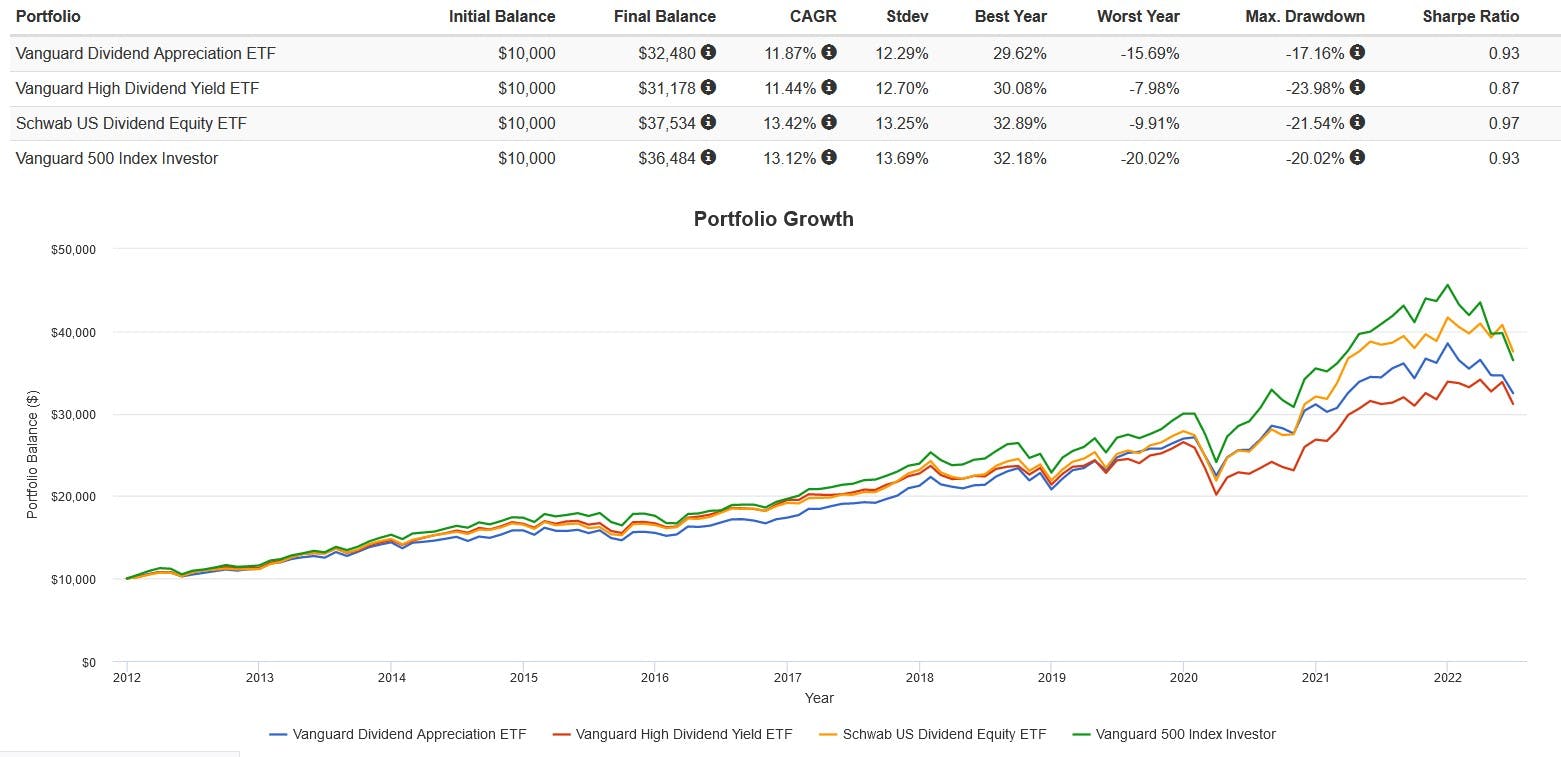
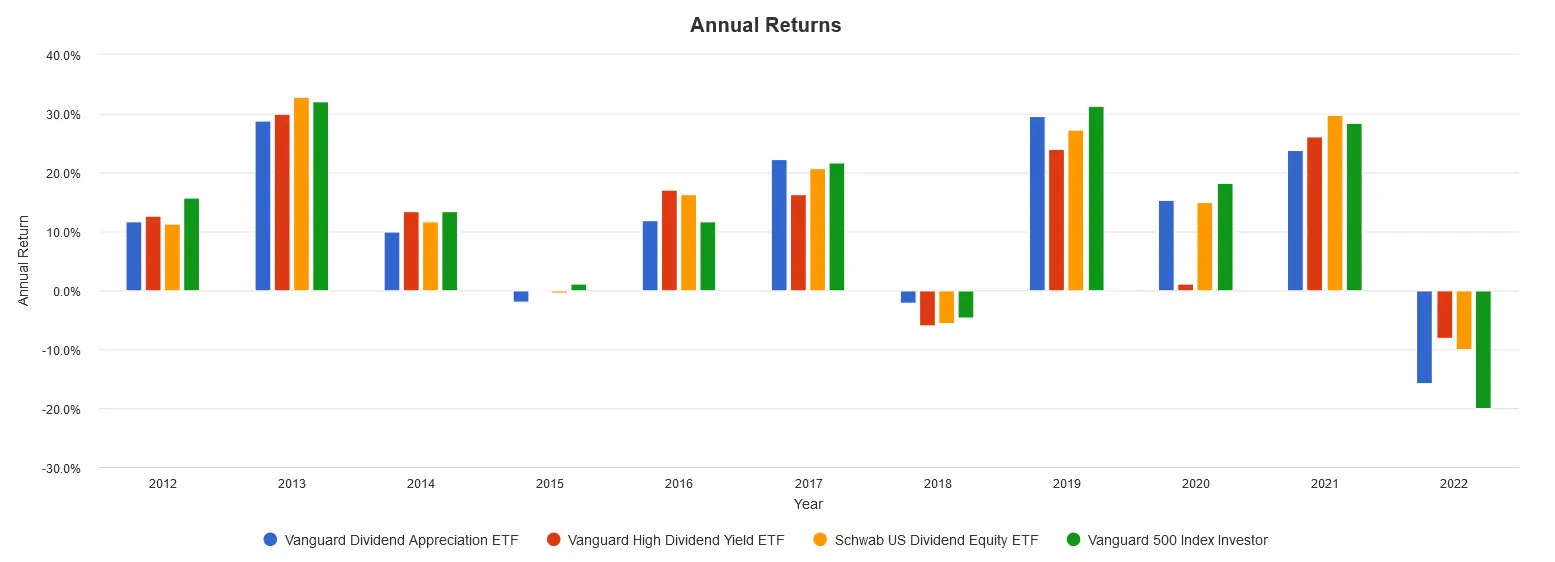
Note that only SCHD beat the S&P 500 in terms of total returns (and risk-adjusted ones too). This is due to its higher exposure to value, quality, and investment factors, being comprised of just 100 large-cap U.S. dividend-paying stocks.
Mentioned ETFs
Further reading
Latest ETF News
See all ETF newsThese Public-Private ETFs Invest in Polymarket and Anduril

There's an ETF for That? Frontier Markets

10-Year Treasury Yield Hits 5%: Which Bond ETFs Offer the Most Direct Exposure?

ETF comparison: NEOS S&P 500 High Income ETF (SPYI) Versus Goldman Sachs S&P 500 Premium Income ETF (GPIX)




 Advantages of ETFs over Mutual Funds1/6
Lower Costs
In this guide, we'll explore the advantages of ETFs over mutual funds, giving you valuable insights into why ETFs have gained significant popularity among investors like yourself.
Leveraged ETFs: Unlocking the Potential for Amplified Returns1/6
Understanding Leveraged ETFs
Explore leveraged ETFs: potential for amplified returns & risks. 5 ETFs to consider across equities, commodities & fixed income.
What is a Leveraged ETF?1/6
Introducing Leveraged and Inverse ETFs
In this guide, we'll dive into the world of leveraged ETFs, exploring their definition, mechanics, potential risks, and rewards.
Recent educational content

ETF Trends
ETF Industry KPIs September 28, 2026
This week’s KPI data overview highlights key metrics and trends shaping the ETF landscape.

ETF Trends
ETF Industry KPIs September 22, 2026
This week’s KPI data overview highlights key metrics and trends shaping the ETF landscape.

First Look ETF
First Look ETF: Income, Corporate Arbitrage, and Growth and Value Investing
First Look ETF September 2026: iCapital, Mast Investments and North Square unpack new ETFs targeting monthly income, merger arbitrage and complementary growth and value exposure.

ETF Trends
ETF Industry KPIs September 14, 2026
This week’s KPI data overview highlights key metrics and trends shaping the ETF landscape.
Browse all educational columns



Expert-Built ETF Portfolios, All in One Place
Don’t start from scratch. Discover ready-made ETF portfolios built by professionals to match different goals, timelines, and market views. Use them as inspiration or as a starting point for your own allocation.