Open Now: The Global ETF Survey Take the Survey →



ETF Comparison: Vanguard Dividend Appreciation ETF (VIG) Versus Vanguard High Dividend Yield ETF (VYM)
Here’s how this low-cost dividend duo from Vanguard stack up head-to-head.

Keep up with what matters in ETFs
Get timely ETF insights, market trends, and top ideas straight to your inbox.
Your newsletter subscriptions with us are subject to ETF Central's Privacy Policy and Terms and Conditions.
In part 2 and 3 of ETF Central's "Ultimate Guide to Dividend ETFs," we covered high yield dividend ETFs and dividend growth ETFs, respectively.
We noted that these strategies can be particularly effective for gaining indirect exposure to value and quality stocks in addition to providing above-average income potential.
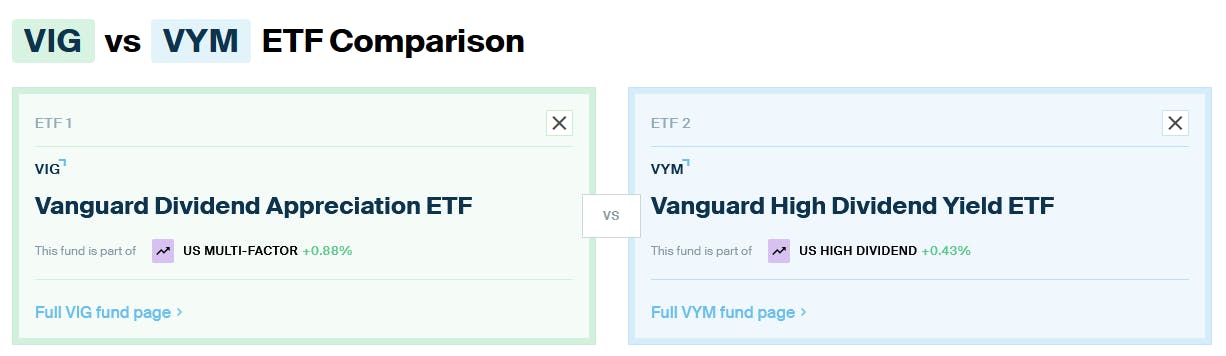
Today, we'll analyze two of the best ones listed on the NYSE: Vanguard Dividend Appreciation ETF
Like what you're reading?
Stay in the loop — get the latest ETF insights: trends, analysis, and expert picks.
VIG vs VYM: Total cost of ownership
Unsurprisingly, both ETFs are dirt cheap thanks to Vanguard’s focus on low fees. Both VIG and VYM charge a 0.06% expense ratio, which equates to just $6 in annual fees for a $10,000 investment.
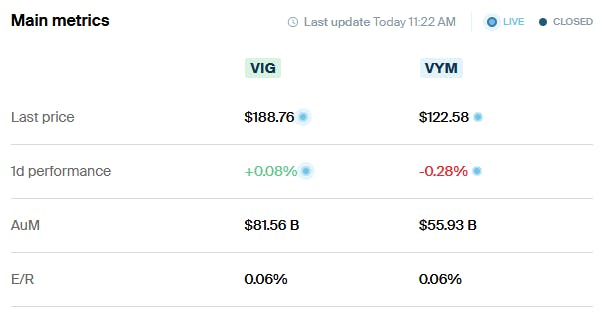
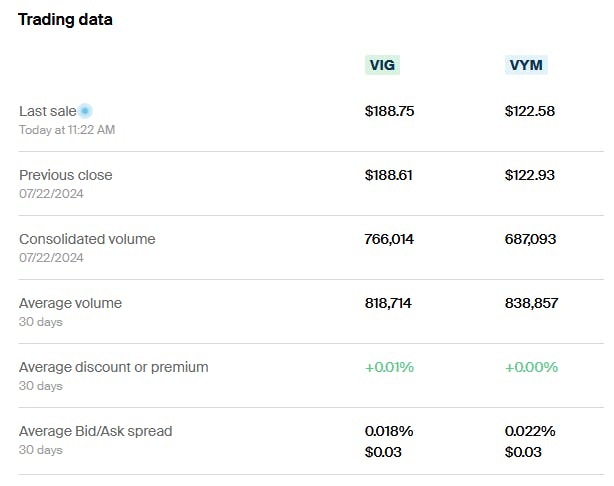
In terms of liquidity, both ETFs also have low bid-ask spreads. VIG has a spread of 0.018% and VYM has a spread of 0.022%. When you add these to the expense ratio, we have a clear tie. Neither ETF is better than the other here for costs.
VIG vs VYM: Methodology and holdings
Where VIG and VYM really begin to differ is with respect to their benchmarks and portfolio compositions.
VIG tracks the S&P U.S. Dividend Growers Index, while VYM tracks the FTSE High Dividend Yield Index. This results in VIG holding 339 stocks compared to VYM’s 555 holdings. Unsurprisingly, VYM offers a higher income with a trailing 12-month yield of 2.9% compared to 1.78% for VIG.

This difference in income is due to their index criteria. VYM’s index includes companies that yield above the 55th percentile in its selection universe. On the other hand, VIG’s index is far more stringent, requiring holdings to have a 10-year history of dividend growth. It also excludes the top 25% highest-yielding companies eligible and is market-cap weighted, subject to a 4% cap on each stock.
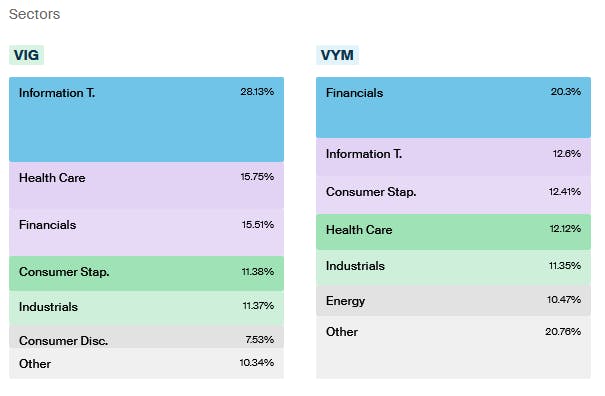
These criteria result in palpable differences in sector composition. VIG’s sector composition is fairly close to the broad market, with overweights in technology, healthcare, and financials. Conversely, VYM focuses more on financials, technology, and consumer staples. Both ETFs emphasize industrials, but VYM also emphasizes energy significantly.
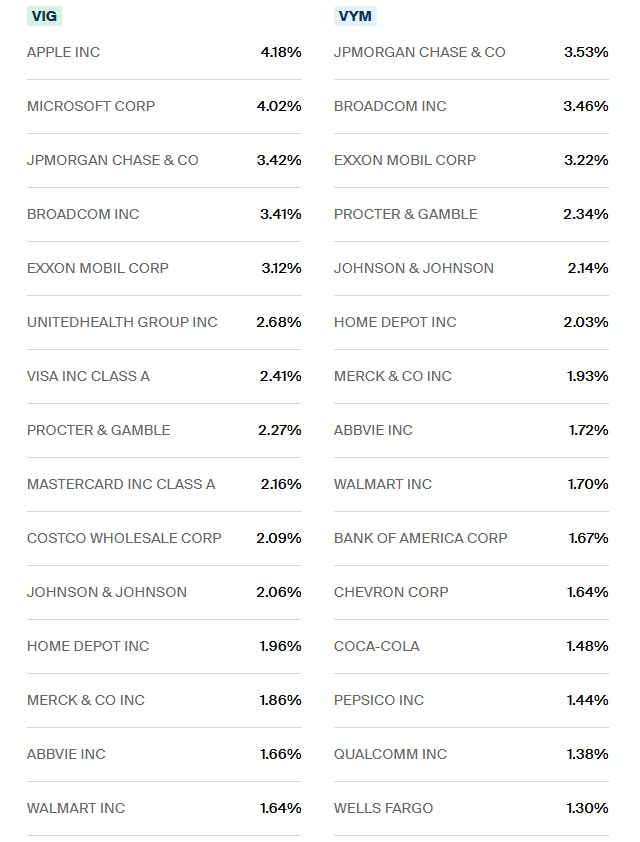
The difference is more clearly seen in their top 15 holdings. VIG includes Apple, Microsoft, Broadcom, Mastercard, and Visa, indicating a tilt towards growth-oriented, high-quality companies.
VYM, on the other hand, has more “old economy” stocks such as JPMorgan Chase, ExxonMobil, Procter & Gamble, Bank of America, Chevron, Coca-Cola, and PepsiCo.
Both ETFs share some common healthcare companies in their top holdings, including AbbVie, Merck, and Johnson & Johnson, which are known for their high yields and histories of increasing dividends.
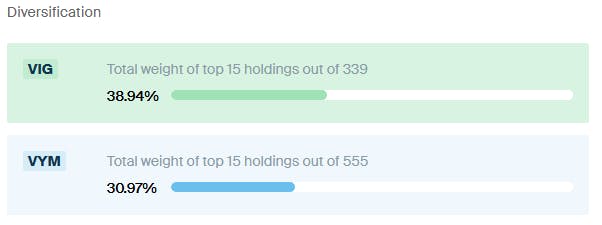
Finally, neither ETF is excessively top-heavy. The top 15 holdings account for 38.94% of VIG and 30.97% of VYM, providing a balanced diversification across their portfolios.
VIG vs VYM: Risk and return
As always, it’s important to remember that past returns don’t predict future performance, but they can provide insights into how two ETFs with similar strategies and objectives have fared historically. This can help you assess their suitability for your risk appetite.
Over three-year and one-year trailing periods, the performance between VIG and VYM has been roughly a tie. VYM outperformed over the three-year period, while VIG took the lead over the one-year period. Both ETFs have seen good inflows over the past three years, although year-to-date, investors have pulled out net flows.
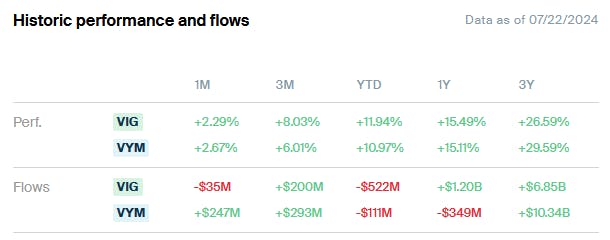
Practically speaking, we can assume that VYM will outperform when value stocks excel, and VIG will have the upper hand when quality stocks dominate. Vanguard has actually mentioned this before, noting:
“The performance of these strategies has been time-period dependent and largely explained by their exposure to a handful of equity factors: value and lower volatility for high-dividend-yielding equities and lower volatility and quality for dividend growth equities.”
In terms of risk, both ETFs are quite similar in terms of volatility, with comparable standard deviations. However, VIG does have a higher and more prolonged three-year maximum drawdown.
This discrepancy can be attributed to VYM’s defensive portfolio, which includes a higher allocation to energy stocks that fared better during the high inflation and rising rate period of 2022. Conversely, VIG’s greater concentration in technology stocks did not perform as well during that time.

Either way, both ETFs are excellent choices for dividend investors. For younger investors, the dividend growth focus of VIG is appealing. If you are looking for above-average qualified dividends, VYM’s portfolio is hard to beat. Both offer exceptional value with a 0.06% expense ratio, making them cost-effective options for building a dividend-focused portfolio.
Please note this article is for information purposes only and does not in any way constitute investment advice. It is essential that you seek advice from a registered financial professional prior to making any investment decision.
Latest ETF News
See all ETF newsHow Investors can Maximize Tax Efficiency with Income ETFs

Trump Accounts: Here's Which ETFs You Can Invest In

The Two Best Types of Fixed-Income ETFs For Managing Cash

ETF Comparison: Roundhill Generative AI & Technology ETF Versus iShares A.I. Innovation and Tech Active ETF




 Advantages of ETFs over Mutual Funds1/6
Lower Costs
In this guide, we'll explore the advantages of ETFs over mutual funds, giving you valuable insights into why ETFs have gained significant popularity among investors like yourself.
Leveraged ETFs: Unlocking the Potential for Amplified Returns1/6
Understanding Leveraged ETFs
Explore leveraged ETFs: potential for amplified returns & risks. 5 ETFs to consider across equities, commodities & fixed income.
What is a Leveraged ETF?1/6
Introducing Leveraged and Inverse ETFs
In this guide, we'll dive into the world of leveraged ETFs, exploring their definition, mechanics, potential risks, and rewards.
Recent educational content

ETF Trends
ETF Industry KPIs July 20, 2026
This week’s KPI data overview highlights key metrics and trends shaping the ETF landscape.

ETF Trends
ETF Industry KPIs July 13, 2026
This week’s KPI data overview highlights key metrics and trends shaping the ETF landscape.

First Look ETF
First Look ETF: Cash Deployment, Bond, and Hedged ETFs
In this season 6 episode of First Look ETF, Stephanie Stanton examines the latest ETF marketplace trends with NYSE and guests.

ETF Trends
ETF Industry KPIs July 6, 2026
This week’s KPI data overview highlights key metrics and trends shaping the ETF landscape.
Browse all educational columns



Expert-Built ETF Portfolios, All in One Place
Don’t start from scratch. Discover ready-made ETF portfolios built by professionals to match different goals, timelines, and market views. Use them as inspiration or as a starting point for your own allocation.