Open Now: The Global ETF Survey Take the Survey →



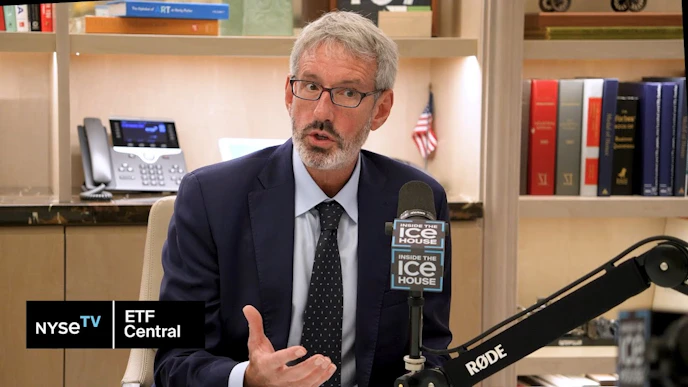
Bilal Little, Director of Exchange-Traded Funds at the NYSE and host of the ETF Central podcast, sits down with Eric Fine, Head of Emerging Markets Debt at VanEck and Portfolio Manager of the VanEck Emerging Markets Bond ETF
Wall Street Veteran with a Worldview
Eric Fine didn’t take the traditional route to the trading desk.
Raised overseas by Depression-era parents—his father a spy and economist, his mother a diplomat and former secretary to Harry Truman—Eric’s perspective on global finance was shaped early by politics, policy, and history.
Before joining VanEck, he helped build Russia’s first securities clearing system during the post-Soviet privatization era and later led research and prop trading at Morgan Stanley.
For Fine, emerging markets aren’t exotic.
They’re familiar terrain filled with opportunity—especially if you know how to read the policy tea leaves.
Emerging Markets Are Beating Developed Ones at Their Own Game
One of Fine’s central messages is surprisingly simple. If you want to understand global economics in 2025, talk to an EM bond manager.
The common narrative paints EM as volatile and risky, but Fine flips that on its head. Many emerging economies are now better managed than their developed counterparts.
Why? Because they've already lived through the chaos of hyperinflation and broken banking systems.
Countries like Mexico, Indonesia, and South Africa have central banks that are fiercely independent and focused on inflation control. Fiscal orthodoxy is the norm, not the exception.
Meanwhile, developed economies—especially the US—are tiptoeing into fiscal dominance territory, where central banks become handcuffed by massive government debt.
Fiscal Dominance and the New Inflation Narrative
Fine puts the current market narrative into one word.
Fiscal dominance. That’s when central banks can no longer prioritize inflation control because raising rates would bankrupt their own governments.
He argues this isn’t just theory—it’s happening now. The US has high debt, low real interest rates, and inflation risks.
Compare that to much of Asia and Latin America, where debt is lower and real rates are higher. The outcome is stark. Stronger currencies, more resilient bond markets, and better long-term investment returns.
He points to the Chinese yuan (CNY) as a case study.
Despite all the noise, CNY is undervalued by roughly 30% according to the BIS. It’s been outperforming expectations quietly and consistently.
Central banks across the globe are catching on. They’re not only hoarding gold. They’re also shifting into local currency EM bonds—but without the fanfare or press releases.
Debunking the Risk Myth
Many investors still see EM bonds as risky. Fine says that view is outdated.
Over the past few years, EM local bonds have had lower volatility than developed market bonds. They’ve also provided better returns, especially when inflation-adjusted.
Why? Because EM central banks didn’t forget the 1990s. They maintain real interest rates and conservative fiscal policies.
Even geopolitical noise like tariffs or trade wars haven’t derailed EM performance in 2025. While markets expected EM currencies to collapse on fears of new Trump-era tariffs, the opposite happened. Currencies rallied. Bonds surged. EM economies were prepared.
Why a Blended Strategy Wins
Fine’s approach isn’t about picking one shiny corner of the EM universe. He advocates for a blended EM bond fund—a mix of sovereigns, corporates, and local currencies.
The logic is straightforward. Flexibility allows managers to shift exposure across regions and risk types depending on what’s attractive.
For example, when investors rushed into Chinese investment-grade corporates, Fine stayed out.
They looked expensive. After the property sector meltdown, valuations improved and his team built selective exposure—only to exit once prices rebounded. His process is bottom-up, focused on what’s cheap and what’s real, not what’s trending.
What’s Working in 2025
So what’s the biggest surprise this year? The market’s refusal to acknowledge how strong CNY has been and how structurally sound EM countries have become.
The biggest disappointment? Argentina.
While Fine didn't hold Argentine debt during its recent missteps, he watched with frustration as its leadership ignored obvious policy red flags and delayed key reforms like currency floatation.
Still, the fallout created new opportunities.
What’s Driving the EM Tailwind?
Fine highlights a little-discussed but powerful driver. Trade dynamics.
Most EM countries now trade more with China than with the US. If the yuan is strengthening, their currencies naturally benefit. Brazil, Malaysia, Chile, and others are catching tailwinds—not headwinds.
Add to that a surprising political reality. EM countries are now the ones with 60–80% approval ratings.
Their populations support orthodox economic management.
Contrast that with developed countries, where political instability and populist pressures are making sound fiscal decisions nearly impossible.
Rethinking the Safe Asset
When investors think “safe,” they often picture US Treasuries.
Fine challenges that thinking.
He compares it to holding Portuguese bonds during the eurozone crisis—safe until they weren’t.
He urges investors to reconsider what constitutes safety.
Gold has already sent the message. It’s up 50% vs the dollar. Central banks know this.
They’re quietly buying EM debt, building reserve lines in rupee, real, and other local currencies. The demand is real, even if it doesn’t make headlines.
The Case for EM Bonds in a Nutshell
If you’re looking for low debt, high real yields, strong currencies, and responsible central banking, EM bonds check every box.
The kicker? They’re still misunderstood. That’s the opportunity.
Fine recommends blended EM bond exposure managed by professionals who understand the nuances of each country and sector. The upside is thematic, supported by macro trends and backed by real capital flows—from central banks to institutional investors.
Please note this article is for information purposes only and does not in any way constitute investment advice. It is essential that you seek advice from a registered financial professional prior to making any investment decision.
Topics
See all
This article does not have a tagged topic
Segments
See all
No specific market segments were tagged
Mentioned ETFs
No specific ETFs were tagged



Build and Analyze Your ETF Portfolio Like a Pro
Create your own ETF portfolio in minutes and instantly see allocations, exposures, performance, and risk. Visualize diversification across asset classes, regions, and sectors. Stress-test ideas, compare benchmarks, and refine your strategy with professional-grade analytics.