Ready-made ETF portfolios built for real investor needs. Explore now →



Two WisdomTree Leveraged ETFs that can be held long-term
These ETFs are leveraged but can be held long-term due to their unique construction.

Keep up with what matters in ETFs
Get timely ETF insights, market trends, and top ideas straight to your inbox.
Your newsletter subscriptions with us are subject to ETF Central's Privacy Policy and Terms and Conditions.
Most leveraged ETFs on the market are the daily resetting type. That is, the funds target 2x, or 3x the daily returns of a benchmark. They achieve this through the use of swaps that deliver the daily total return of the underlying asset. The crucial thing to note here is that the swap exposure resets daily.
This causes the fear of "volatility drag," where the ETF's long-term performance will differ from its leveraged target. While not too much of a problem for leveraged ETFs with benchmarks that have positive expected returns (like a broad market index), it can become acute during volatile markets.
This, coupled with the high expense ratios of most leveraged ETFs makes them not ideal for a long-term holding. A 2x S&P 500 fund won't decay to nothing, but its long-term performance won't be exactly 2x that of the S&P 500. The longer the holding period, the greater the tracking error becomes.
That being said, there are some leveraged funds out there that do not use the daily resetting leverage seen in the typical ETF meant for day-trading. These ETFs gain leveraged exposure using futures in a more sustainable and cost-effective manner. That being said, they are still advanced investments best suited for knowledgeable investors. Let's explore two options.
Like what you're reading?
Stay in the loop — get the latest ETF insights: trends, analysis, and expert picks.
WisdomTree U.S. Efficient Core Fund (NTSX-0.22%)
I wrote about the benefits of NTSX in an earlier article on "return stacking." The fund is basically a 60/40 portfolio of stocks and Treasury bonds leveraged up 1.5x to 90/60. Historically, the 60/40 portfolio has been a great balance of risk and return. By applying leverage, NTSX juices it up to target the same risk, but with a higher return than a 100% stock allocation.
NTSX uses leverage very efficiently. Instead of swaps, the ETF uses bond futures. For every $100 invested in the ETF, $90 is invested in a basket of 500 large-cap U.S. equities. The equity side is non-leveraged. On the bond side, the remaining $10 is held in cash collateral for 7–10 year intermediate Treasury futures that provide 6x notional exposure.
Because NTSX leverages only the bond side with futures, the fund avoids the volatility drag from daily resetting leverage using swaps and is also very tax efficient. Bond distributions are taxable at the ordinary income rate. Using futures conveniently avoids this. This is much safer compared to using margin as the downside risk of leveraged stocks is much greater.
Investors can use NTSX on its own as a 1.5x leveraged 60/40 portfolio for just a 0.20% expense ratio. However, I think the best use of NTSX is for capital-efficient investing. For example, holding NTSX at 67% of your overall asset allocation gives you the risk/return profile of a 60/40 portfolio. The remaining 33% can be used for additional non-correlated assets to diversify. Holding gold, commodities, managed futures, or just plain cash can help when stocks and bonds fall in tandem (like in 2022 so far).
WisdomTree Efficient Gold Plus Equity Strategy Fund ETF (GDE-0.34%)
If NTSX is 90/60 stocks and bonds, then GDE can be described as 90/90 stocks and gold. One of the main weaknesses of NTSX is its susceptibility to rising interest rates and inflation. Under this scenario, bond prices fall, and bonds tend to become more positively correlated with stocks. This reduces their diversification benefit substantially. We saw this in 2022 when stocks and bonds fell together.
GDE remedies this via a substantial allocation to gold. I covered the benefits and risks of gold ETF investing here, but it's sufficient to know that gold has a historically low correlation with both stocks and bonds. It also tends to be more resilient during inflationary times, making it an excellent diversifier for a stock and bond portfolio.
Like NTSX, GDE allocates 90% of its capital toward large-cap U.S. equities. The remaining 10% is held as cash collateral for gold futures that give 9x notional exposure. Hence the 90/90 stock/gold allocation for a total of 1.8x accounting leverage. This is probably one of the safest ways to hold leveraged gold without worrying about volatility decay or a K-1 tax form.
I think a good use for GDE is as a pair for NTSX. Holding, say 70/30 NTSX/GDE would result in a portfolio of 90% stocks, 42% intermediate Treasurys, and 27% gold for a total of 1.59x leverage. This allows investors to diversify without reducing their equity allocations too much. Like NTSX, GDE also costs a very reasonable expense ratio of 0.20%.
Hypothetical historical performance
Here's how a simulated NTSX and GDE would have performed versus the S&P 500 from 1992 to the present day. Keep in mind that this backtest is hypothetical in nature, does not reflect actual investment results and is not a guarantee of future results. The hypothetical returns do not reflect trading costs, transaction fees, commissions, or actual taxes due on investment returns.
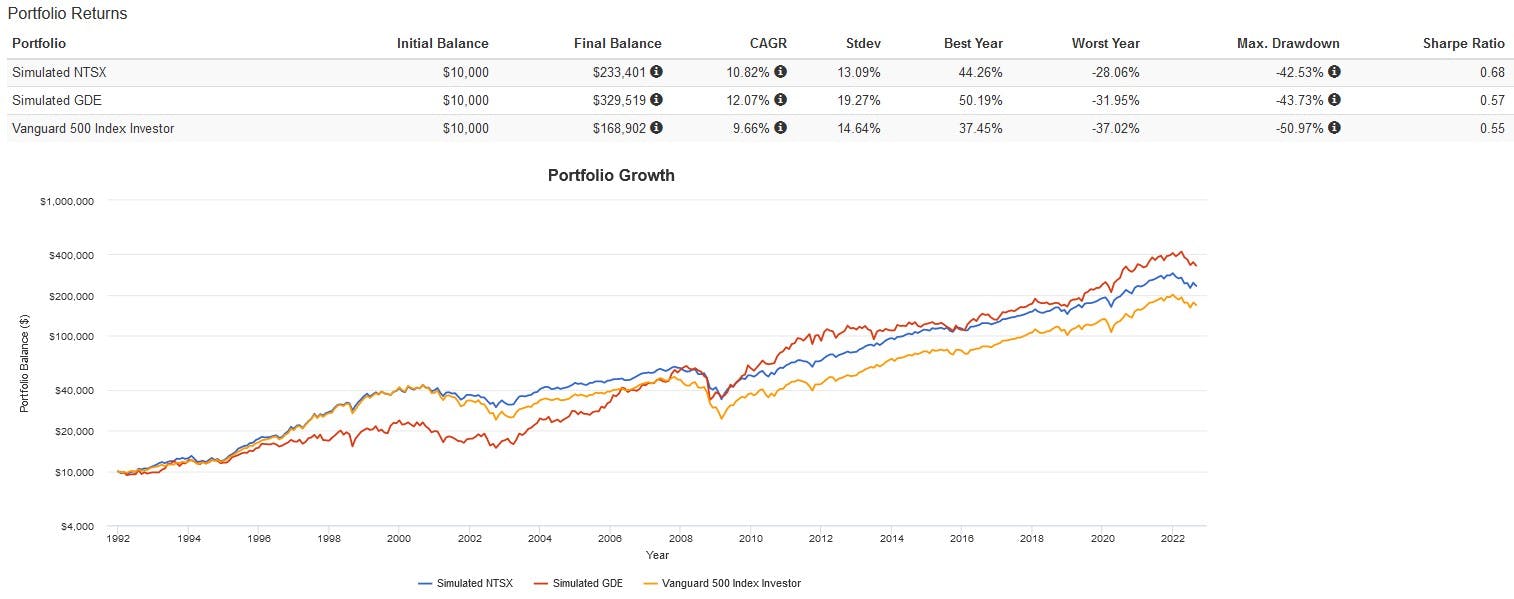


The results are an excellent illustration of the benefits of diversification: a portfolio of volatile, uncorrelated assets with positive expected returns can be leveraged up to either:
- Match the returns of 100% stocks but with lower risk; or
- Exceed the returns of 100% stocks, but with similar risk.
This all, of course, depends on correlation. In times like 2022 when correlations turn positive, much of the diversification benefit is lost and the losses get amplified by leverage. Keep this in mind before you consider investing!
Please note this article is for information purposes only and does not constitute investment advice.

Latest ETF News
See all ETF newsThere’s an ETF for That? Investing Like University Endowments

Could Water ETFs Be the Next AI Bottleneck Trade?

What is a Boomer Candy ETF?

ETF Comparison: NEOS Nasdaq-100 High Income ETF (QQQI) Versus Goldman Sachs Nasdaq-100 Premium Income ETF (GPIQ)




 Advantages of ETFs over Mutual Funds1/6
Lower Costs
In this guide, we'll explore the advantages of ETFs over mutual funds, giving you valuable insights into why ETFs have gained significant popularity among investors like yourself.
Leveraged ETFs: Unlocking the Potential for Amplified Returns1/6
Understanding Leveraged ETFs
Explore leveraged ETFs: potential for amplified returns & risks. 5 ETFs to consider across equities, commodities & fixed income.
What is a Leveraged ETF?1/6
Introducing Leveraged and Inverse ETFs
In this guide, we'll dive into the world of leveraged ETFs, exploring their definition, mechanics, potential risks, and rewards.
Recent educational content
ETF Trends
ETF Industry KPIs September 14, 2026
This week’s KPI data overview highlights key metrics and trends shaping the ETF landscape.

ETF Trends
ETF Industry KPIs September 8, 2026
This week’s KPI data overview highlights key metrics and trends shaping the ETF landscape.
ETF Trends
ETF Industry KPIs August 31, 2026
This week’s KPI data overview highlights key metrics and trends shaping the ETF landscape.
ETF Trends
ETF Industry KPIs August 24, 2026
This week’s KPI data overview highlights key metrics and trends shaping the ETF landscape.
Browse all educational columns



Expert-Built ETF Portfolios, All in One Place
Don’t start from scratch. Discover ready-made ETF portfolios built by professionals to match different goals, timelines, and market views. Use them as inspiration or as a starting point for your own allocation.