Ready-made ETF portfolios built for real investor needs. Explore now →



This Dividend ETF Uses the "Dogs of the Dow" Strategy
DJD is a unique, yet seldom talked-about, ETF that U.S. dividend investors may like.


Keep up with what matters in ETFs
Get timely ETF insights, market trends, and top ideas straight to your inbox.
Your newsletter subscriptions with us are subject to ETF Central's Privacy Policy and Terms and Conditions.
The Dot-Com Bubble of 2000 was the first time that the internet and investing clashed, and the results could be described as "interesting." One result was the proliferation of novel investment strategies based on promising backtests (or more likely some severe data-overfitting).
A great example was the Motley Fool's "Foolish Four" investment style, which used a formula consisting of the following:
- Determining the yield and price for all 30 stocks in the Dow Jones Industrial Average (DJIA-0.18%).
- Dividing the yield for each stock by the square root of its price.
- Ranking the stocks from highest to lowest based on the result from step two.
- Discarding the highest-ranking stock and purchasing the other four in equal weightings.
This approach turned out to be wishful heuristics masquerading as quantitative rigor. Astute readers will note that the steps are arbitrary and excessively convoluted. To their credit, the Motley Fool eventually discontinued this approach and provided a candid post-mortem assessment.
Still, methods like the "Foolish Four" still exist today. A great example is the "Dogs of the Dow" strategy, which has a website that looks like it's time-traveled here from 2005. Let's look at how this strategy works and how it can be implemented via a unique ETF from Invesco.
Like what you're reading?
Stay in the loop — get the latest ETF insights: trends, analysis, and expert picks.
What are the Dogs of the Dow?
The Dogs of the Dow strategy popped up in 1991 via a book and website by Michael B. O'Higgins. The term "Dogs" refers to the most undesirable, highest-yielding stocks in the DJIA. All else being equal, a decline in share price increases yields, so high yields can be an indicator of recent underperformance.
Each year, the strategy selects the 10 DJIA stocks with the highest trailing 12-month yields and purchases them in equal amounts. The strategy relies on the blue-chip, large-cap nature of the Dog stocks to play defensive, benefitting from the high dividend yield while waiting for an eventual rebound.
According to the "Dog Years" section on the website, the strategy has outperformed the S&P 500 slightly since 2000. Starting in 2000 would have benefitted the DJIA immensely given the Dot-Com Bubble and its resilience compared to the S&P 500. 2022 was also a year where the DJIA outperformed.
Since then, the strategy has evolved into other variations, such as the "Small Dogs of the Dow" and "Dogs of the Dow X" to name a few. Despite its dated origins, the strategy still has a popular following due to its intuitive appeal and wide array of resources for new investors.
A Dogs of the Dow ETF?
There's no ETF that explicitly utilizes the Dogs of the Dow strategy, but there is one that comes close: the innocuously named Invesco Dow Jones Industrial Average Dividend ETF (
DJD takes a unique approach to the DJIA index by weighting its components by the 12-month dividend yield, much like how the Dogs of the Dow strategy does. The stocks are then weighted based on their relative yield, with the ETF currently having 28 holdings.
The main difference is that DJD uses a yield-weighted approach to all Dow stocks with dividend payments, while the Dogs of the Dow Strategy equal-weights the top 10 highest-yielding stocks. This makes DJD more diversified and less volatile.
Historically, DJD has under-performed its passive market-cap weighted index counterpart, the SPDR Dow Jones Industrial Average ETF Trust (
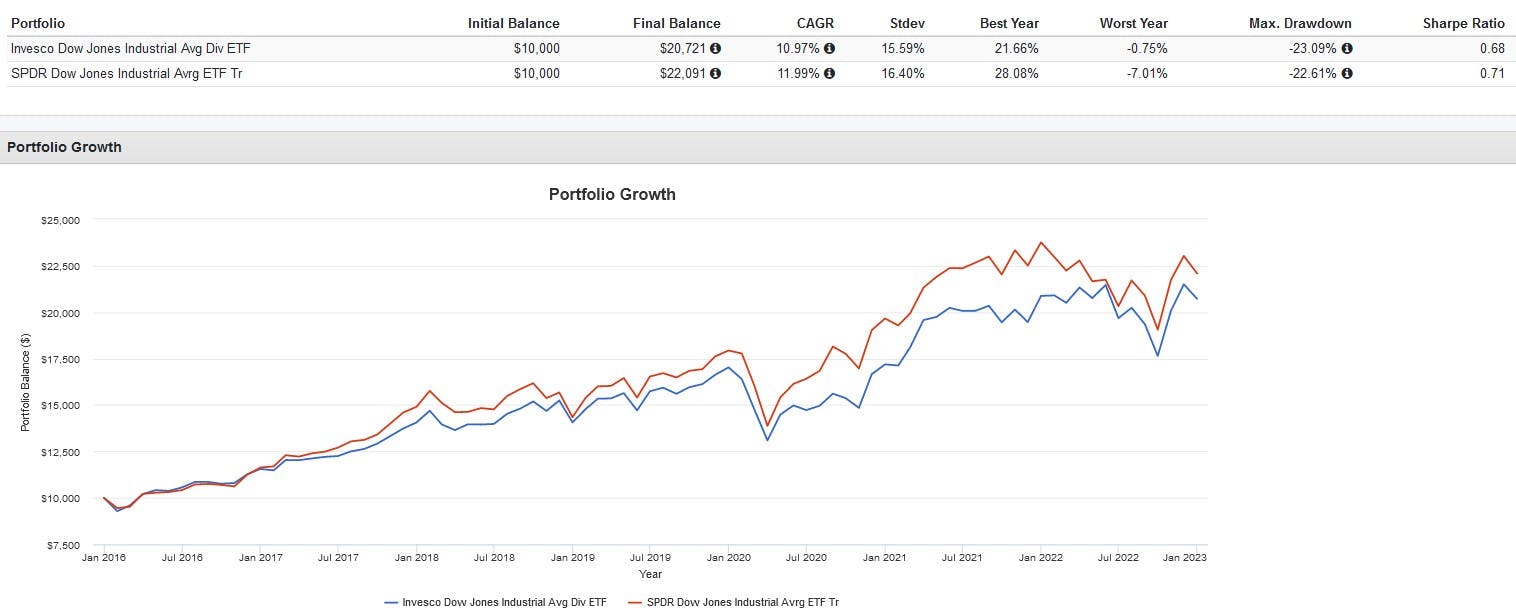
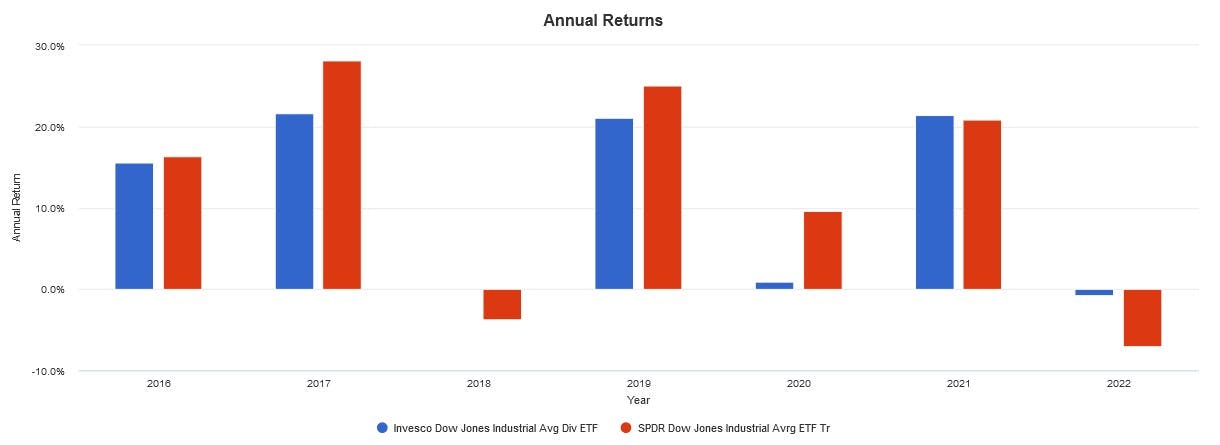
Investors interested in comparing DJD's current holdings to the 2023 Dogs of the Dow list can do so via the embedded links. Finally, DJD is very inexpensive for a niche dividend ETF, costing just 0.07%. It also has a fairly attractive 12-month distribution yield of 3.10%.
Please note this article is for information purposes only and does not in any way constitute investment advice. It is essential that you seek advice from a registered financial professional prior to making any investment decision.
Latest ETF News
See all ETF newsCould Water ETFs Be the Next AI Bottleneck Trade?

What is a Boomer Candy ETF?

ETF Comparison: NEOS Nasdaq-100 High Income ETF (QQQI) Versus Goldman Sachs Nasdaq-100 Premium Income ETF (GPIQ)





 Advantages of ETFs over Mutual Funds1/6
Lower Costs
In this guide, we'll explore the advantages of ETFs over mutual funds, giving you valuable insights into why ETFs have gained significant popularity among investors like yourself.
Leveraged ETFs: Unlocking the Potential for Amplified Returns1/6
Understanding Leveraged ETFs
Explore leveraged ETFs: potential for amplified returns & risks. 5 ETFs to consider across equities, commodities & fixed income.
What is a Leveraged ETF?1/6
Introducing Leveraged and Inverse ETFs
In this guide, we'll dive into the world of leveraged ETFs, exploring their definition, mechanics, potential risks, and rewards.
Recent educational content

ETF Trends
ETF Industry KPIs September 8, 2026
This week’s KPI data overview highlights key metrics and trends shaping the ETF landscape.

ETF Trends
ETF Industry KPIs August 31, 2026
This week’s KPI data overview highlights key metrics and trends shaping the ETF landscape.
ETF Trends
ETF Industry KPIs August 24, 2026
This week’s KPI data overview highlights key metrics and trends shaping the ETF landscape.
What’sTheFund
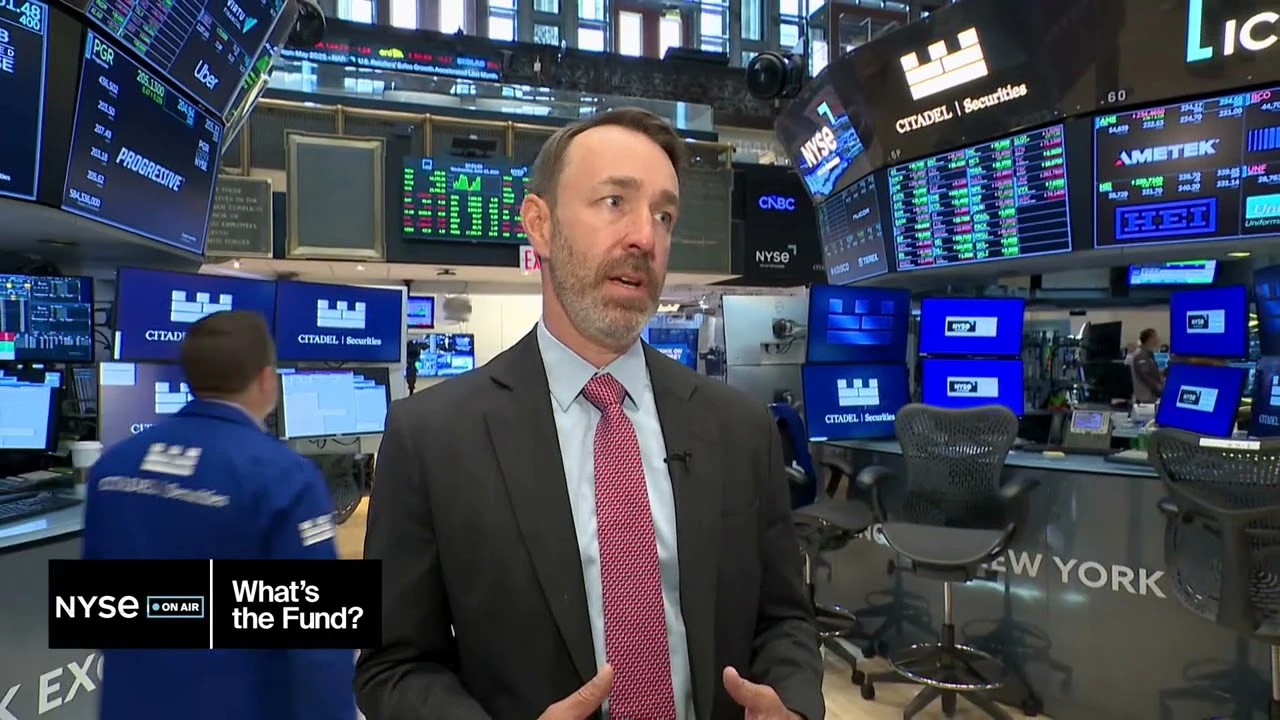
What's the Fund | Ocean Park Diversified Income ETF (DUKZ)
James St Aubin, Chief Investment Officer at Ocean Park Asset Management, discuss the DUKZ ETF, exposing investors to the whole spectrum of asset classes in the fixed income markets, through their rules-based process.

Browse all educational columns



Expert-Built ETF Portfolios, All in One Place
Don’t start from scratch. Discover ready-made ETF portfolios built by professionals to match different goals, timelines, and market views. Use them as inspiration or as a starting point for your own allocation.