Ready-made ETF portfolios built for real investor needs. Explore now →



Dow Jones Beat the S&P 500 in 2022: 3 ETFs to Invest in the Dow
The boring old Dow Jones Industrial Average turned out to be a pretty good investment in 2022.


Keep up with what matters in ETFs
Get timely ETF insights, market trends, and top ideas straight to your inbox.
Your newsletter subscriptions with us are subject to ETF Central's Privacy Policy and Terms and Conditions.
The long-lived Dow Jones Industrial Average is still tracked as a benchmark of U.S. equity performance but doesn’t really garner much attention in terms of ETF coverage.
After all, why would anybody want to invest in an archaic, price-weighted index of just 30 U.S. stocks when you can access 500 of them easily with the numerous S&P 500 ETFs out there?
Well, a good reason that many discovered in 2022 is the DJIA's relative resilience to bear markets. Last year, the DJIA ended with a -7.01% return with dividends reinvested, compared to the S&P 500 which lost 18.7%. The tech heavy Nasdaq 100 performed the worst with a -32.58% return.
Naturally, investors love chasing past performance, and the outstanding performance of the DJIA in 2022 has numerous other financial media outlets speculating for the upcoming year. This article will give you a deep dive on investing in the DJIA and some ETFs to do so with.
Like what you're reading?
Stay in the loop — get the latest ETF insights: trends, analysis, and expert picks.
Why the Dow?
Investors new to the DJIA should give my previous article on it a read. In that article, I went over its construction, methodology, and historical performance.
This article will focus on the possible reasons behind the DJIA's performance as defined by its exposure to certain Fama-French factors, namely investment and profitability.
Both of these factors play a large role in creating "quality" stocks, which have historically produced better returns. The factors are defined as follows:
- Investment: The returns of companies with conservative investments minus the returns of companies with aggressive investments (Conservative minus Aggressive, or CmA).
- Profitability: The returns of companies with strong operating profitability versus the returns of companies with weak operating profitability (Robust minus Weak, or RmW).
For an excellent summary of the power of these two factors, I suggest reading this article from the CFA institute, which notes:
"Over all economic cycles since 1963, going long high quality stocks, or profitable firms, and shorting their low quality, unprofitable counterparts has been a great investment strategy. And the power of the factor has not diminished."
I performed a factor regression of the most popular DJIA ETF on the market, the SPDR Dow Jones Industrial Average ETF Trust (DIA) against the SPDR S&P 500 ETF (SPY). The regression was done using monthly returns over a 36-month roll period.

Compared to SPY, DIA had much higher loadings for investment and profitability, and a surprisingly slightly higher loading for value (HmL). It had a negative loading to size (SmB), which is expected given that it is entirely comprised of large-cap stocks.
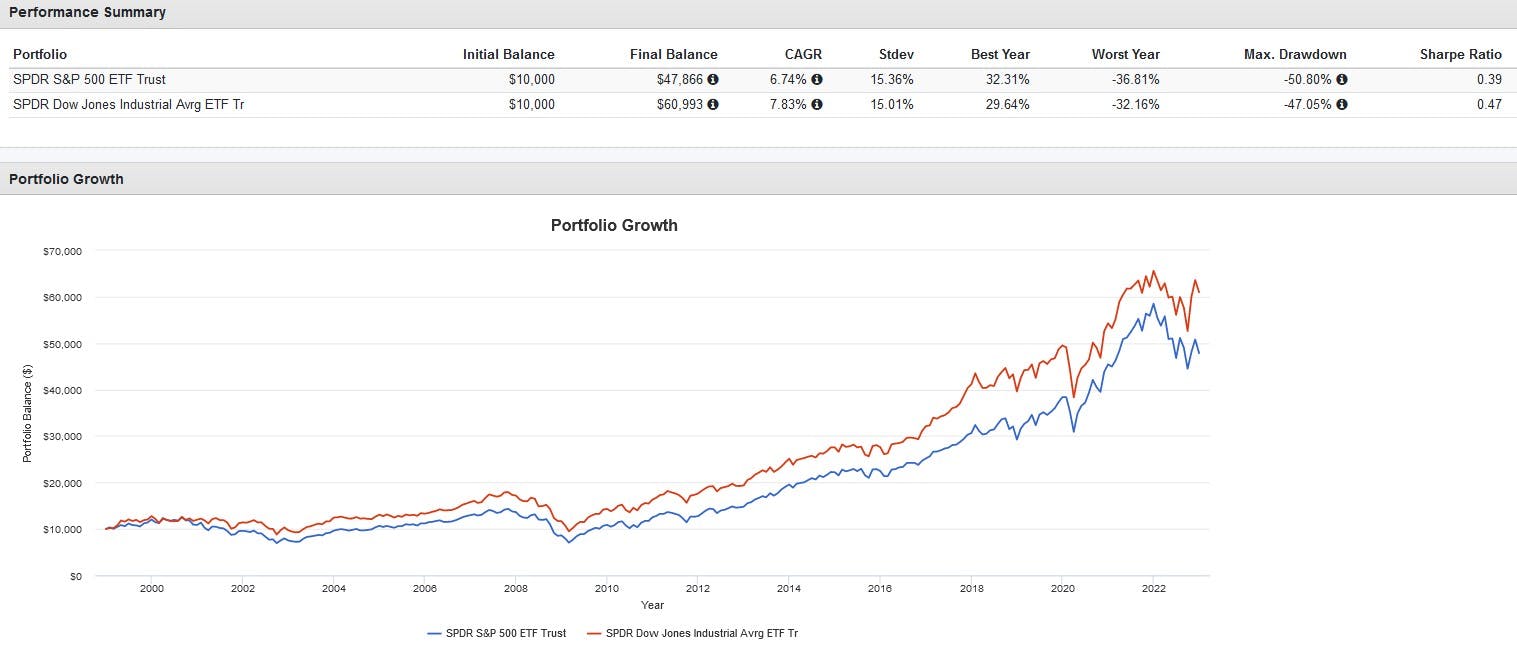
Historically, DIA has outperformed SPY from 1999 to the present on both a trailing and rolling return basis, with better risk-adjusted returns and lower drawdowns.

Dow ETF options
If you're convinced by this (keeping in mind that backtests are rearward looking and should not be used to predict future results), then the most straightforward ETF option for investing in the DJIA is DIA. This ETF is price-weighted like the DJIA is and costs a 0.16% expense ratio.
If you're not a fan of the date price-weighting methodology, a good alternative could be the First Trust Dow 30 Equal Weight ETF (EDOW), which simply holds all 30 of the DJIA stocks in an equal-weight allocation. However, it does charge a much higher expense ratio of 0.50%.
A really interesting DJIA ETF in my opinion is the Invesco Dow Jones Industrial Average Dividend ETF (DJD), which uses a variation of the "Dogs of the Dow" strategy by holding stocks based on their 12-month dividend yield over the prior year. DJD is pretty cheap too, with a 0.07% expense ratio.
Please note this article is for information purposes only and does not in any way constitute investment advice. It is essential that you seek advice from a registered financial professional prior to making any investment decision.
Latest ETF News
See all ETF newsCould Water ETFs Be the Next AI Bottleneck Trade?

What is a Boomer Candy ETF?

ETF Comparison: NEOS Nasdaq-100 High Income ETF (QQQI) Versus Goldman Sachs Nasdaq-100 Premium Income ETF (GPIQ)




 Advantages of ETFs over Mutual Funds1/6
Lower Costs
In this guide, we'll explore the advantages of ETFs over mutual funds, giving you valuable insights into why ETFs have gained significant popularity among investors like yourself.
Leveraged ETFs: Unlocking the Potential for Amplified Returns1/6
Understanding Leveraged ETFs
Explore leveraged ETFs: potential for amplified returns & risks. 5 ETFs to consider across equities, commodities & fixed income.
What is a Leveraged ETF?1/6
Introducing Leveraged and Inverse ETFs
In this guide, we'll dive into the world of leveraged ETFs, exploring their definition, mechanics, potential risks, and rewards.
Recent educational content

ETF Trends
ETF Industry KPIs September 14, 2026
This week’s KPI data overview highlights key metrics and trends shaping the ETF landscape.

ETF Trends
ETF Industry KPIs September 8, 2026
This week’s KPI data overview highlights key metrics and trends shaping the ETF landscape.
ETF Trends
ETF Industry KPIs August 31, 2026
This week’s KPI data overview highlights key metrics and trends shaping the ETF landscape.
ETF Trends
ETF Industry KPIs August 24, 2026
This week’s KPI data overview highlights key metrics and trends shaping the ETF landscape.
Browse all educational columns



Expert-Built ETF Portfolios, All in One Place
Don’t start from scratch. Discover ready-made ETF portfolios built by professionals to match different goals, timelines, and market views. Use them as inspiration or as a starting point for your own allocation.