Open Now: The Global ETF Survey Take the Survey →



The State of Options-based ETF, May 2024: YieldMax ETFs Hit Double-Digit Yields
Here's a look at how exactly these YieldMax ETFs have been distributing extremely high levels of income.


Keep up with what matters in ETFs
Get timely ETF insights, market trends, and top ideas straight to your inbox.
Your newsletter subscriptions with us are subject to ETF Central's Privacy Policy and Terms and Conditions.
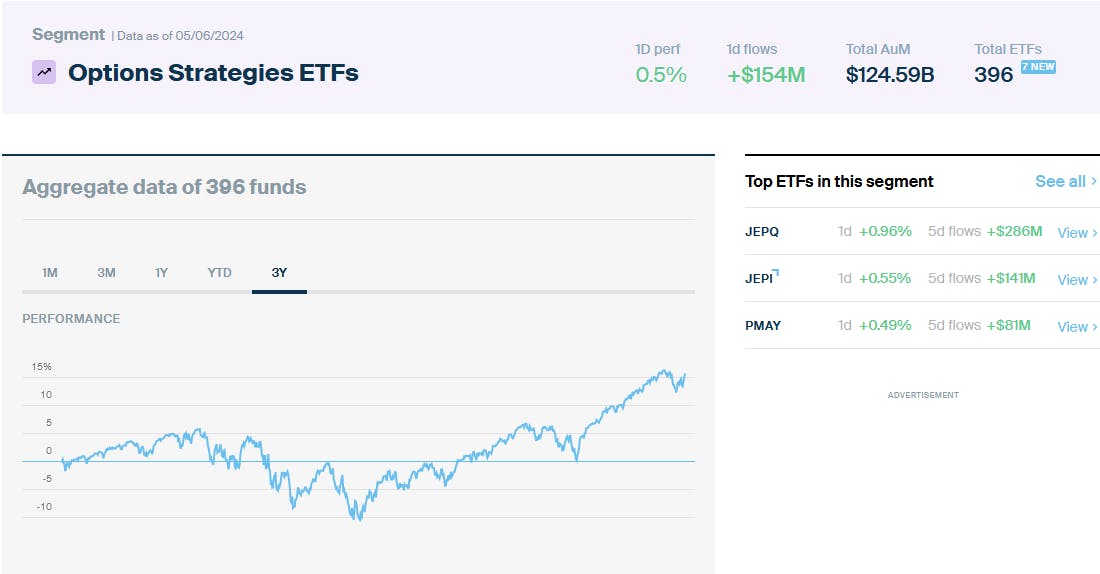
The options-based ETF segment, currently valued at approximately $124.6 billion in assets under management and comprising 396 ETFs, continues to grow rapidly. Notably, on May 6th, 2024, this segment witnessed inflows of $154 million according to ETF Central Data.
For a detailed understanding of the various strategies employed within this sector, refer to our comprehensive four-part series:
- Options Strategies in ETFs, Part 1: A Grand Overview
- Options Strategies in ETFs, Part 2: Covered Call ETFs
- Options Strategies in ETFs, Part 3: Buffer ETFs
- Options Strategies in ETFs, Part 4: Put-Selling and Leverage
But among the providers in this competitive niche, YieldMax stands out not only for its unique single-stock approach but also for its ability to consistently deliver double-digit yields. Here's a deeper look into how the YieldMax ETFs operate and the current options (pun intended) they offer investors.
Get data on 14,000+ ETFs
Access Trackinsight's reliable and comprehensive data with 500M+ points on 14,000+ ETFs.
What are YieldMax ETFs, and how do they work?
YieldMax ETFs offer a unique twist to the traditional covered call strategy, commonly used by retail investors and advisors to generate income from highly traded stocks.
Instead of directly owning the underlying securities and selling calls against them or a reference index like the SPX or NDX, YieldMax employs a "synthetic covered call strategy."
Here's how it works:
Instead of purchasing the stock, YieldMax combines a short put and a long call to create what's known as a synthetic stock position. This method is not only capital efficient but also mirrors owning the actual stock.
The real twist comes with the addition of selling a short call to generate income, which forms the core of the covered call strategy. However, since the ETF doesn't hold the underlying shares, there's nothing to get called away if it does expire in-the-money and gets assigned.
To back these positions and add a layer of security, YieldMax uses Treasuries as collateral. In today's environment of higher interest rates, this also contributes to earning a competitive yield.
The result? YieldMax ETFs provide above-average monthly income and exposure to the returns of the underlying reference asset without physically holding it. However, like all covered call ETFs, the upside is capped, and there is still exposure to downside risk.
Some of the current YieldMax ETFs available
Here's an overview of the most popular covered call ETFs YieldMax currently offers. As you can see, most of these ETFs focus on a single stock, featuring double-digit distribution yields. This isn't a typo – they really do pay that much, but it isn't a free lunch by any means.
The distribution yield is calculated by multiplying the ETF's distribution-per-share by twelve (12) and dividing the resulting amount by the ETF's most recent Net Asset Value (NAV).
Remember, this distribution rate is not the total return you should expect, as the share prices of these ETFs can fall. All figures are accurate as of May 7, 2024.
- YieldMax TSLA Options Income Strategy ETF : 0.99% expense ratio, 53.78% distribution yieldTSLY
- YieldMax Innovation Option Income Strategy ETF : 0.99% expense ratio, 54.26% distribution yieldOARK
- YieldMax AAPL Options Income Strategy ETF : 0.99% expense ratio, 24.31% distribution yieldAPLY
- YieldMax NVDA Options Income Strategy ETF : 0.99% expense ratio, 55.67% distribution yieldNVDY
- YieldMax AMZN Options Income Strategy ETF : 0.99% expense ratio, 50.55% distribution yieldAMZY
- YieldMax META Options Income Strategy ETF : 0.99% expense ratio, 56.05% distribution yieldFBY
- YieldMax GOOGL Options Income Strategy ETF : 0.99% expense ratio, 45.55% distribution yieldGOOY
- YieldMax COIN Options Income Strategy ETF : 0.99% expense ratio, 119.10% distribution yieldCONY
- YieldMax NFLX Options Income Strategy ETF : 0.99% expense ratio, 69.54% distribution yieldNFLY
- YieldMax DIS Options Income Strategy ETF : 0.99% expense ratio, 41.75% distribution yieldDISO
- YieldMax MSFT Options Income Strategy ETF : 0.99% expense ratio, 32.36% distribution yieldMSFO
- YieldMax XOM Options Income Strategy ETF : 0.99% expense ratio, 22.80% distribution yieldXOMO
- YieldMax JPM Options Income Strategy ETF : 0.99% expense ratio, 25.64% distribution yieldJPMO
- YieldMax AMD Options Income Strategy ETF AMDY-7.2%: 0.99% expense ratio, 36.93% distribution yield
- YieldMax PYPL Options Income Strategy ETF : 0.99% expense ratio, 60.45% distribution yieldPYPY
- YieldMax SQ Options Income Strategy ETF : 0.99% expense ratio, 62.79% distribution yieldSQY
- YieldMax MRNA Options Income Strategy ETF : 0.99% expense ratio, 56.27% distribution yieldMRNY
The distribution yields of these covered call ETFs are exceptionally high, primarily due to the nature of the underlying strategy and the volatility of the reference assets.
Selling options on stocks like Tesla using a synthetic strategy, for instance, can command high premiums because these stocks are more volatile. When you sell a call option, you collect a premium upfront, which contributes to the fund's income.
This strategy effectively compensates you for the risk of capping potential gains if the underlying stock rises beyond the strike price of the call option.
As a result, the higher the volatility of the underlying stock, the higher the potential income from selling the option, but it also reflects the increased risk you're taking by using this strategy.
Please note this article is for information purposes only and does not in any way constitute investment advice. It is essential that you seek advice from a registered financial professional prior to making any investment decision.
Latest ETF News
See all ETF newsMoneyShow Chart of the Day 7/16/26: Good News/Bad News on Inflation (and the Fed)


MoneyShow Chart of the Day 7/1/26: The H1 Scorecard – and What Comes Next

MoneyShow Chart of the Day 6/22/26: Are World Cup Videos Helping US Companies Clean Up?

MoneyShow Chart of the Day 6/3/26: AI. AI. AI. (And a Handful of Other Stocks, Too)




 Advantages of ETFs over Mutual Funds1/6
Lower Costs
In this guide, we'll explore the advantages of ETFs over mutual funds, giving you valuable insights into why ETFs have gained significant popularity among investors like yourself.
Leveraged ETFs: Unlocking the Potential for Amplified Returns1/6
Understanding Leveraged ETFs
Explore leveraged ETFs: potential for amplified returns & risks. 5 ETFs to consider across equities, commodities & fixed income.
What is a Leveraged ETF?1/6
Introducing Leveraged and Inverse ETFs
In this guide, we'll dive into the world of leveraged ETFs, exploring their definition, mechanics, potential risks, and rewards.
Recent educational content

ETF Trends
ETF Industry KPIs July 20, 2026
This week’s KPI data overview highlights key metrics and trends shaping the ETF landscape.

ETF Trends
ETF Industry KPIs July 13, 2026
This week’s KPI data overview highlights key metrics and trends shaping the ETF landscape.
First Look ETF
First Look ETF: Cash Deployment, Bond, and Hedged ETFs
In this season 6 episode of First Look ETF, Stephanie Stanton examines the latest ETF marketplace trends with NYSE and guests.

ETF Trends
ETF Industry KPIs July 6, 2026
This week’s KPI data overview highlights key metrics and trends shaping the ETF landscape.
Browse all educational columns



Build and Analyze Your ETF Portfolio Like a Pro
Create your own ETF portfolio in minutes and instantly see allocations, exposures, performance, and risk. Visualize diversification across asset classes, regions, and sectors. Stress-test ideas, compare benchmarks, and refine your strategy with professional-grade analytics.