Explore professionally built ETF model portfolios. Discover now →



Options Strategies in ETFs, Part 4: Put-Selling and Leverage
The final installment in our four-part series on options strategies in ETFs examines some more niche and advanced strategies investors can access.


Keep up with what matters in ETFs
Get timely ETF insights, market trends, and top ideas straight to your inbox.
Your newsletter subscriptions with us are subject to ETF Central's Privacy Policy and Terms and Conditions.
Over the past three articles, we've delved deep into the world of options strategies in ETFs. From providing a comprehensive overview to exploring the nuances of covered calls and the protective features of buffer ETFs, we've laid a foundation on the subject.
Now, in this final installment, we turn our attention to some of the more advanced, niche, and innovative strategies available to investors. While these strategies might not dominate in terms of assets under management, they present intriguing avenues for investment.
They are instrumental in reshaping the way we think about risk and return, offering new possibilities in the rapidly evolving ETF landscape for retail investors and advisors alike.
Like what you're reading?
Stay in the loop — get the latest ETF insights: trends, analysis, and expert picks.
Put-selling: another way to generate income
Put-selling, or writing puts, is a strategy where an investor sells a put option. A put option gives the buyer the right, but not the obligation, to sell a stock at a specified price (the strike price) by a certain time (the expiration date).
When you sell this option, you are agreeing to buy the stock at the strike price if the buyer chooses to exercise their option. If the stock never drops to (or below) the strike price by the expiration date, the option expires worthless and you, the seller, gets to keep the premium you received for selling it.
At its core, selling a cash-secured put is functionally similar to the covered call strategy. With covered calls, you own a stock and sell call options to generate income. If the stock rises above the strike price, your stock might get called away.
But with cash-secured puts, instead of owning a stock, you have cash. If the stock drops below the strike price, you might be obligated to buy it with your cash. In both cases, you get to keep the premium from the sold options.
Imagine a stock is trading at $50. You sell a put option with a strike price of $48 that expires in a month, and you receive a $2 premium. Three scenarios can occur:
- The stock stays above $48: The put option expires worthless. You keep the $2 premium. Your profit is $2.
- The stock drops to $46: You are obligated to buy the stock at $48, even though it's currently $46. But remember, you received a $2 premium. So, your effective purchase price is $46, which is the current market price. You break even.
- The stock drops below $46: Let's say it drops to $40. You're obligated to buy at $48. After factoring in the $2 premium, your effective purchase price is $46. You're at a $6 loss per share.
Like covered calls, the premiums received from selling puts are influenced by a variety of variables:
- Volatility: If the underlying stock is more volatile, the premium tends to be higher.
- Time to Expiration: Longer durations generally mean higher premiums because there's more time for the stock to move.
- Strike Price: Puts with strike prices closer to the current stock price (at-the-money) will generally have higher premiums than those further away.
The primary benefit of this strategy is the consistent premium income generated from selling the puts. Selling puts can also lead to reduced portfolio volatility, especially in relatively flat markets.
However, as with covered calls, there is still downside risk. If the underlying stock drops significantly, you could be obligated to buy it at a price much higher than its current value.
An example is the WisdomTree PutWrite Strategy Fund (
A new game-changer in this space is the Defiance S&P 500 Enhanced Option Income ETF (
By capitalizing on the rapid time decay, or theta, the strategy seeks to enhance potential returns and produce outsized monthly income. This rapid decay means the option loses value quickly, which is advantageous for the seller (JEPY, in this case).
Leveraging with options in ETFs
While we discussed the use of buying put options as protection for buffer ETFs in part 3 of our series, another exciting use is buying call options for speculation. Specifically, buying call options offers a way to leverage returns without the need for margins or futures.
Recall that a call option provides the holder the right (but not the obligation) to buy a stock at a specified price within a set period. Since only a premium is paid upfront to hold this right, the potential return can be substantial if the underlying asset's price rises.
This inherent property of call options can be used to create leverage, making it a tool for magnifying returns without borrowing money.
ETFs can therefore harness the power of call options to boost potential returns. An example is the Simplify US Equity PLUS Upside Convexity ETF (
The strategy involves buying and selling SPXW (S&P 500 Weekly) call options with different strike prices and expiration dates, as seen below:
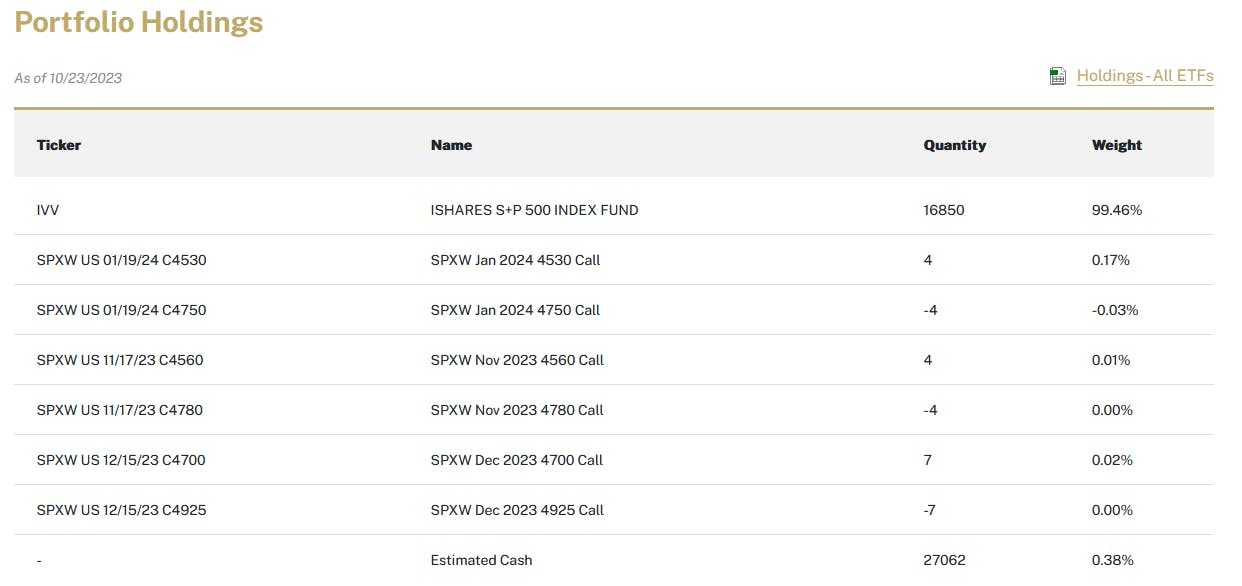
The long call options, like the SPXW Jan 2024 4530 Call, provide the potential for enhanced upside, especially if the S&P 500 index moves dramatically in a short period. The short call options, such as the SPXW Jan 2024 4750 Call, might be used to offset some of the costs of the long positions or to manage the exposure level strategically.
Apart from enhancing returns, options can also be employed for capital efficiency. The Amplify BlackSwan Growth & Treasury Core ETF (
The notional equity exposure from these SPY LEAPs is around 70%. So, even though only 10% is directly invested in these options, their embedded leverage translates to a much larger effective equity position. The result? A portfolio roughly equivalent to 70% stocks and 90% treasuries.
The key takeaway
Over the course of this four-part series, we've journeyed through a significant portion of the U.S. options ETF landscape.
From understanding the mainstays like covered call and buffer ETFs to delving into more specialized strategies such as put selling and leveraging, we've unpacked the mechanisms that drive these innovative funds.
Yet, it's essential to recognize that the investment world is in a constant state of flux. With new ETFs launching daily, the horizon of options strategies will likely shift, and tomorrow's offerings might differ from today's.
The inherent customizability of options, when married with the flexibility of the ETF structure, offers a canvas for immense creativity. This dynamic duo paves the way for endless possibilities, promising versatile and potentially groundbreaking products in the future.
For those curious to keep a pulse on these ever-changing offerings, the ETF Central screener can be a valuable tool. Simply select "Options Strategies" under the "Strategy" filter, and dive deep into the world of options ETFs.
Please note this article is for information purposes only and does not in any way constitute investment advice. It is essential that you seek advice from a registered financial professional prior to making any investment decision.

Latest ETF News
See all ETF newsEquity Investing 101: Understanding U.S. Large-Cap Growth ETFs

Tony's ETF Buyer's Guide: Sector ETFs (Vanguard versus State Street SPDR)

Options Strategies in ETFs, Part 3: Buffer ETFs

Options Strategies in ETFs, Part 2: Covered Call ETFs




 Advantages of ETFs over Mutual Funds1/6
Lower Costs
In this guide, we'll explore the advantages of ETFs over mutual funds, giving you valuable insights into why ETFs have gained significant popularity among investors like yourself.
Leveraged ETFs: Unlocking the Potential for Amplified Returns1/6
Understanding Leveraged ETFs
Explore leveraged ETFs: potential for amplified returns & risks. 5 ETFs to consider across equities, commodities & fixed income.
What is a Leveraged ETF?1/6
Introducing Leveraged and Inverse ETFs
In this guide, we'll dive into the world of leveraged ETFs, exploring their definition, mechanics, potential risks, and rewards.
Recent educational content

ETF Trends
ETF Industry KPIs September 8, 2026
This week’s KPI data overview highlights key metrics and trends shaping the ETF landscape.

ETF Trends
ETF Industry KPIs August 31, 2026
This week’s KPI data overview highlights key metrics and trends shaping the ETF landscape.
ETF Trends
ETF Industry KPIs August 24, 2026
This week’s KPI data overview highlights key metrics and trends shaping the ETF landscape.
What’sTheFund
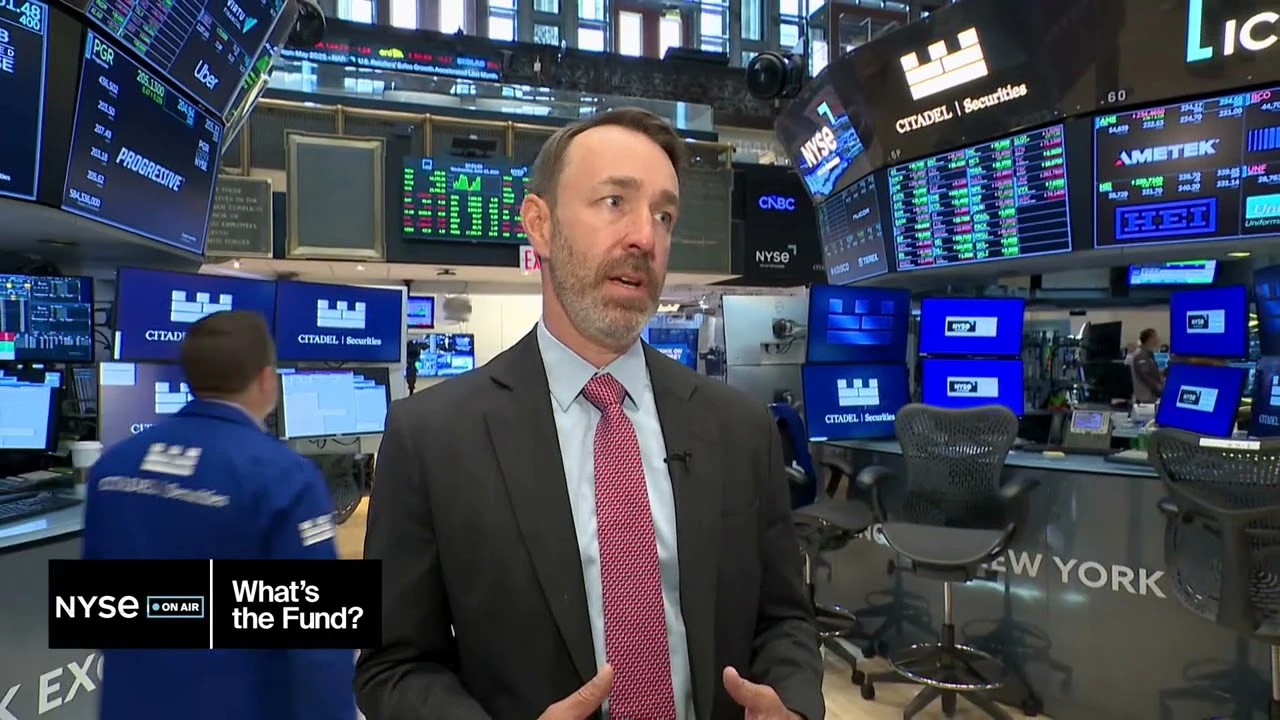
What's the Fund | Ocean Park Diversified Income ETF (DUKZ)
James St Aubin, Chief Investment Officer at Ocean Park Asset Management, discuss the DUKZ ETF, exposing investors to the whole spectrum of asset classes in the fixed income markets, through their rules-based process.

Browse all educational columns



Build and Analyze Your ETF Portfolio Like a Pro
Create your own ETF portfolio in minutes and instantly see allocations, exposures, performance, and risk. Visualize diversification across asset classes, regions, and sectors. Stress-test ideas, compare benchmarks, and refine your strategy with professional-grade analytics.