Create, analyze, optimize your ETF portfolio. Start now →



SEC Opens Door to ETF Share Classes With Dimensional Approval
The SEC has cracked open the door to ETF share classes, granting Dimensional Fund Advisors a first-of-its-kind approval and signaling a structural shift that could reshape trillions in U.S. fund assets.


Keep up with what matters in ETFs
Get timely ETF insights, market trends, and top ideas straight to your inbox.
Your newsletter subscriptions with us are subject to ETF Central's Privacy Policy and Terms and Conditions.
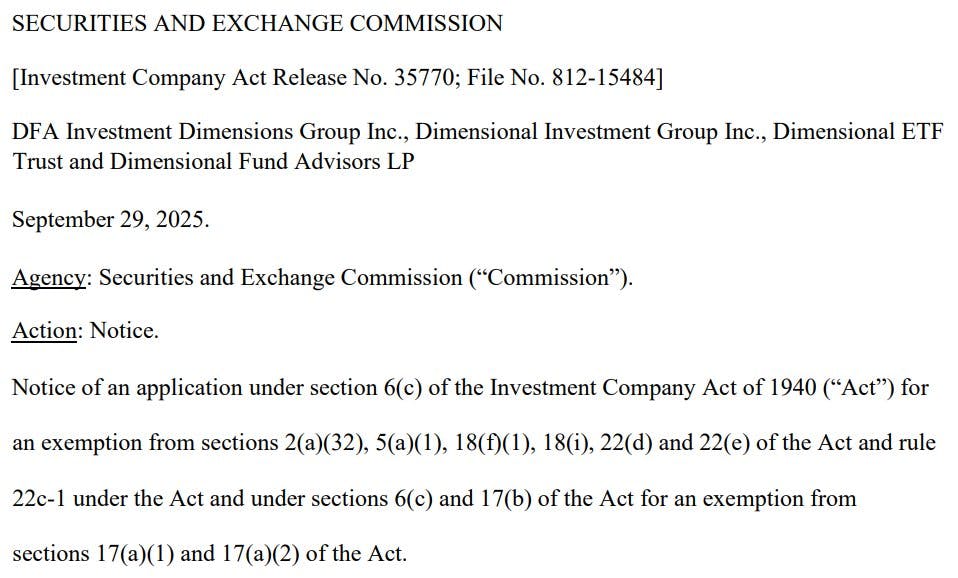
The U.S. Securities and Exchange Commission (SEC) has issued a notice indicating its intent to approve ETF share classes of existing mutual funds, granting Dimensional Fund Advisors the first exemption of its kind since Vanguard’s long-standing patent expired in May 2023.
The decision, published September 29, 2025, represents a watershed moment for fund investing, blurring the line between mutual funds and ETFs and reshaping how investors access strategies.
Source: SEC Notice
Like what you're reading?
Stay in the loop — get the latest ETF insights: trends, analysis, and expert picks.
A Return to Principles
In his statement titled “A Return to Principles: Statement on ETF Share Class Relief”, SEC Commissioner Mark T. Uyeda framed the decision as both overdue and transformative:
“Today, the Commission takes a long-overdue step toward modernizing our regulatory framework for investment companies that reflects the evolution of collective investment vehicles from being primarily daily-redeemable funds to exchange-traded funds (ETFs). The publication of this notice — seeking comment on a proposed multi-class ETF structure — represents a substantive step forward, not just a procedural formality. It is a signal that the Commission is willing to reexamine outdated constraints, embrace innovation, and consider relief that could benefit investors, fund sponsors, and markets alike.”
Uyeda emphasized that the move preserves investor protections while encouraging competition, noting that similar relief has long been held exclusively by Vanguard.
Uyeda added:
For too long, the artificial divide between mutual fund and ETF share classes has limited investor choice, operational efficiency, and resulted in suboptimal tax treatment. The proposed structure would allow a single fund to offer both exchange-traded and traditional mutual fund shares—providing investors with flexibility while preserving the core protections of the Investment Company Act. Moreover, it facilitates competition, in that similar relief has been long held by a single asset manager.
He called the decision “principled modernization,” supported by safeguards such as board oversight, conflict monitoring, and detailed disclosure.
From Patent to Policy
For more than 20 years, Vanguard’s unique patent allowed it to run ETFs as share classes of mutual funds, giving it a structural advantage in scale and tax efficiency. That patent’s expiration in 2023 set the stage for broader industry adoption.
Dimensional Fund Advisors is now the first to gain SEC approval under this framework, but dozens of other asset managers have pending applications.
If these are approved, mutual fund complexes could quickly roll out ETF share classes across hundreds of portfolios, offering investors both traditional mutual fund shares and exchange-traded shares of the same strategy.
What Do ETF Share Classes Mean for Investors?
The approval has clear advantages for investors:
- Tax efficiency through the ETF wrapper’s in-kind creation/redemption process.
- Intraday trading flexibility, unlike mutual funds’ once-a-day pricing.
- Cost synergies as fund sponsors operate a single pool of assets across multiple share classes.
- Choice and accessibility, giving investors multiple entry points into the same strategy.
What Do ETF Share Classes Mean for the Industry?
In a previous article, Emmett Flood from Sound Capital Solutions said that fund sponsors see the dual share class structure as a strategic way to revitalize older products by giving them a more appealing, modern wrapper.
For firms with established fund lineups, this allows them to tap into the surging demand for ETFs without the major undertaking of launching brand-new funds.
On the other hand, industry veteran Nicholas Phillips cautioned that such approval could unleash an “immediate, far-reaching, and potentially overwhelming” wave of ETF share class launches.
He warned that exchanges, market makers, custodians, and authorized participants (APs) could face operational strain:
- Exchanges might be pressed to handle a surge in new symbols and trading activity.
- Market makers and LMMs would need more capital and staff to support liquidity across a flood of new ETFs.
- APs and custodians could struggle with basket processing and operational scale.
- White-label platforms may have to triage client launches, prioritizing larger or better-prepared issuers.
Philipps concluded that readiness—not anticipation—would separate winners from those left scrambling in a transformed landscape.
A Turning Point
The SEC’s approval is more than a procedural update. It is the most significant regulatory shift in ETFs since their creation three decades ago, aligning the regulatory framework with how modern investors allocate capital.
For investors, it brings efficiency and choice. For fund managers, it lowers barriers to entering the ETF market. But for the broader ETF ecosystem—exchanges, APs, market makers, custodians—it is a stress test of operational resilience.
Dimensional Fund Advisors may be the first mover, but the industry is bracing for a wave of approvals that could redefine the scale, scope, and speed of ETF growth in the United States.
Please note this article is for information purposes only and does not in any way constitute investment advice. It is essential that you seek advice from a registered financial professional prior to making any investment decision.
Segments
See all
No specific market segments were tagged
Mentioned ETFs
No specific ETFs were tagged
Further reading
Latest ETF News
See all ETF news
The Weekly ETF Market Monitor (September 21-25, 2026)
ETF News You Missed This Week - September 21 - 25, 2026

The Weekly ETF Market Monitor (September 14-18, 2026)
ETF News You Missed This Week - September 14 - 18, 2026

The Weekly ETF Market Monitor (September 7-11, 2026)

 Advantages of ETFs over Mutual Funds1/6
Lower Costs
In this guide, we'll explore the advantages of ETFs over mutual funds, giving you valuable insights into why ETFs have gained significant popularity among investors like yourself.
Leveraged ETFs: Unlocking the Potential for Amplified Returns1/6
Understanding Leveraged ETFs
Explore leveraged ETFs: potential for amplified returns & risks. 5 ETFs to consider across equities, commodities & fixed income.
What is a Leveraged ETF?1/6
Introducing Leveraged and Inverse ETFs
In this guide, we'll dive into the world of leveraged ETFs, exploring their definition, mechanics, potential risks, and rewards.
Recent educational content

ETF Trends
ETF Industry KPIs September 28, 2026
This week’s KPI data overview highlights key metrics and trends shaping the ETF landscape.

ETF Trends
ETF Industry KPIs September 22, 2026
This week’s KPI data overview highlights key metrics and trends shaping the ETF landscape.

First Look ETF
First Look ETF: Income, Corporate Arbitrage, and Growth and Value Investing
First Look ETF September 2026: iCapital, Mast Investments and North Square unpack new ETFs targeting monthly income, merger arbitrage and complementary growth and value exposure.

ETF Trends
ETF Industry KPIs September 14, 2026
This week’s KPI data overview highlights key metrics and trends shaping the ETF landscape.
Browse all educational columns



Build and Analyze Your ETF Portfolio Like a Pro
Create your own ETF portfolio in minutes and instantly see allocations, exposures, performance, and risk. Visualize diversification across asset classes, regions, and sectors. Stress-test ideas, compare benchmarks, and refine your strategy with professional-grade analytics.