From idea to ETF portfolio in minutes. Build yours now →



How Dual Share Classes Could Reshape ETFs and Mutual Funds
ETFs and mutual funds may no longer be rivals. They're about to become roommates.

Keep up with what matters in ETFs
Get timely ETF insights, market trends, and top ideas straight to your inbox.
Your newsletter subscriptions with us are subject to ETF Central's Privacy Policy and Terms and Conditions.
The expiration of Vanguard’s ETF share class patent in May 2023¹ unlocked what may become one of the most significant structural shifts in the investment industry: the ability for funds to offer both mutual fund and ETF share classes.
This change has triggered a surge of filings with the SEC as managers seek approval to issue ETF shares alongside their existing mutual fund classes.
Like what you're reading?
Stay in the loop — get the latest ETF insights: trends, analysis, and expert picks.
Mutual Funds and ETFs: Dueling Share Classes
ETFs have increasingly become a primary investment vehicle of choice.
The ETF wrapper provides numerous benefits to investors and fund managers alike, including exchange listing and intraday trading, lower fund fees and operating costs, and the ability to utilize in-kind creations and redemptions – the process that allows for capital gains to be efficiently managed so that ETFs investors retain control over the timing of taxable events.
Regardless of their reasoning, investors have continued to shift assets towards ETFs.
Conversely, mutual fund flows have been under pressure.
From 2014 to 2024, ETFs grew from roughly 16% of total U.S. fund assets to approximately 32%, while mutual funds dropped from roughly 84% to 68%².
With record-breaking numbers of ETF launches and increased mutual funds outflows³, the introduction of dual share classes may be arriving at a particularly opportune moment.
Fund sponsors have indicated they view the dual share class structure as an opportunity to revive interest in legacy products by offering a more modern, attractive wrapper.
For firms with well-established fund lineups, this structure offers a rare chance to tap into the growing demand for ETFs without having to create entirely new funds from scratch.
Shareholders will gain the option to invest in funds via the share class that best fits their individual needs, and fund managers can offer a new product that benefits from an existing track record, asset base, and reputation.
The ETF share class might also be a way to expand upon pre-established distribution relationships and introduce funds to entirely new investor bases.
Although having historically competed for the same market share, the introduction of the dual share class model now gives ETFs and mutual funds an opportunity for a complementary existence.
Regulatory Progress and Expectations: All Eyes on the SEC
At its core, the new exemptive relief will allow for an ETF share class to be offered alongside traditional mutual fund share classes. Both share classes will be issued by the same fund, and both share classes will invest in the same underlying assets.
As noted above, they will differ in key areas like how they are bought and sold, fees, operations, and oversight.
The patent expiration eliminated the legal barrier to entry, and since then, more than 70 fund sponsors have submitted applications to the SEC⁴ seeking permission to offer dual share classes.
As of mid-2025, the SEC has not yet approved any new ETF share classes beyond Vanguard’s pioneer product. However, the regulatory tone has shifted.
In early 2025, SEC Commissioner Mark Uyeda called on staff to prioritize the review of ETF share class filings⁵, potentially signaling that a determination is in the works.
While SEC approval is not guaranteed, some industry observers expect the first approvals to arrive as early as late 2025 or early 2026.
The introduction of dual share classes will provide investors with the ability to choose their preferred investment vehicle without forcing fund companies to fragment their offerings.
It may represent the next evolution of the fund industry, enabling legacy mutual funds to survive – perhaps even thrive – in the ETF era.
Sources
1: https://www.etf.com/sections/features/vanguards-patent-expired-now-what
2: https://www.businessinsider.com/investing-in-etf-model-portfolios-advantages-over-mutual-funds-jpmorgan-2024-9
3: https://www.wealthmanagement.com/etfs/growth-themes-drove-performance-and-flows-in-a-record-year-for-u-s-etfs
4: https://www.morningstar.com/funds/our-2025-etf-predictions-midyear-review
5: https://www.sec.gov/newsroom/speeches-statements/uyeda-ici-031725
About Emmett Flood
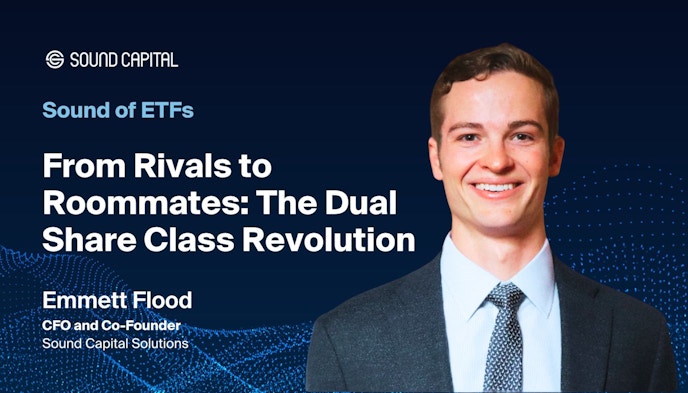
Emmett Flood is the CFO and co-founder of Sound Capital Solutions – an Investment Adviser offering both White Label services and a unique Solutions Provider offering that provides clients with the tools to act as their own ETF Adviser. Emmett is a CPA and holds several FINRA licenses (7, 27, 66). He began his career in public accounting prior to adding his financial reporting and regulatory knowledge to the comprehensive list of expertise and decades of ETF industry experience housed at Sound Capital Solutions.
Disclaimer
Please note this article is for information purposes only and does not in any way constitute investment, legal, or tax advice. It is essential that you seek advice from a registered financial professional prior to making any investment decision. Sound Capital Solutions LLC is committed to adhering to the fiduciary standard, acting in the best interest of its clients at all times. As an RIA, we are obligated to disclose any potential conflicts of interest that may exist to our clients. Information about the firm’s services and fees can be found in the firm’s Form ADV which is available upon request or by visiting the SEC's Investment Adviser Public Disclosure (IAPD) website.”


Latest ETF News
See all ETF newsHow Much ETF Infrastructure Do You Really Need?


Are ETFs Getting Too Complicated? Not Necessarily, But Complexity Has a Cost

Form 4 Has 20 Transaction Codes. None Say "Section 351 ETF Swap"


Who Really Owns a White-Label ETF?

What If a Futures-Based ETF Never Had to Roll Again?

How Do You Build a Winning ETF Business?


 Advantages of ETFs over Mutual Funds1/6
Lower Costs
In this guide, we'll explore the advantages of ETFs over mutual funds, giving you valuable insights into why ETFs have gained significant popularity among investors like yourself.
Leveraged ETFs: Unlocking the Potential for Amplified Returns1/6
Understanding Leveraged ETFs
Explore leveraged ETFs: potential for amplified returns & risks. 5 ETFs to consider across equities, commodities & fixed income.
What is a Leveraged ETF?1/6
Introducing Leveraged and Inverse ETFs
In this guide, we'll dive into the world of leveraged ETFs, exploring their definition, mechanics, potential risks, and rewards.
Recent educational content

ETF Trends
ETF Industry KPIs September 28, 2026
This week’s KPI data overview highlights key metrics and trends shaping the ETF landscape.

ETF Trends
ETF Industry KPIs September 22, 2026
This week’s KPI data overview highlights key metrics and trends shaping the ETF landscape.

First Look ETF
First Look ETF: Income, Corporate Arbitrage, and Growth and Value Investing
First Look ETF September 2026: iCapital, Mast Investments and North Square unpack new ETFs targeting monthly income, merger arbitrage and complementary growth and value exposure.

ETF Trends
ETF Industry KPIs September 14, 2026
This week’s KPI data overview highlights key metrics and trends shaping the ETF landscape.
Browse all educational columns



Expert-Built ETF Portfolios, All in One Place
Don’t start from scratch. Discover ready-made ETF portfolios built by professionals to match different goals, timelines, and market views. Use them as inspiration or as a starting point for your own allocation.