Global ETF Survey Is Live! 600+ ETF Professionals Weigh In. See Results →



Private equity ETFs: Are they worth it?
These funds offer a proxy for retail investors seeking exposure to private equity, but at a cost.


Keep up with what matters in ETFs
Get timely ETF insights, market trends, and top ideas straight to your inbox.
Your newsletter subscriptions with us are subject to ETF Central's Privacy Policy and Terms and Conditions.
The controversial founder and CEO of WeWork, Adam Neuman, is back in Silicon Valley headlines after raising $350 million from Andreessen Horowitz for his new real estate startup Flow.
This deal put private equity back into the public eye after a rough year marked by soaring interest rates, which led to an increased cost of capital and lower deal activity for many firms. Before 2022, private equity was one of the hottest and best-performing asset classes of the last decade.
Private equity firms raise capital from institutional high-net-worth investors to deploy in various private companies. They grow the companies by funding new technologies, making acquisitions, and expanding working capital to produce an acceptable return on their initial investment.
The investors in the private equity firm's fund then receive their portion of this, net of any management and performance fees. Despite concerns about private equity firms inflating their fund's value to lure investors, industry activity remains high.
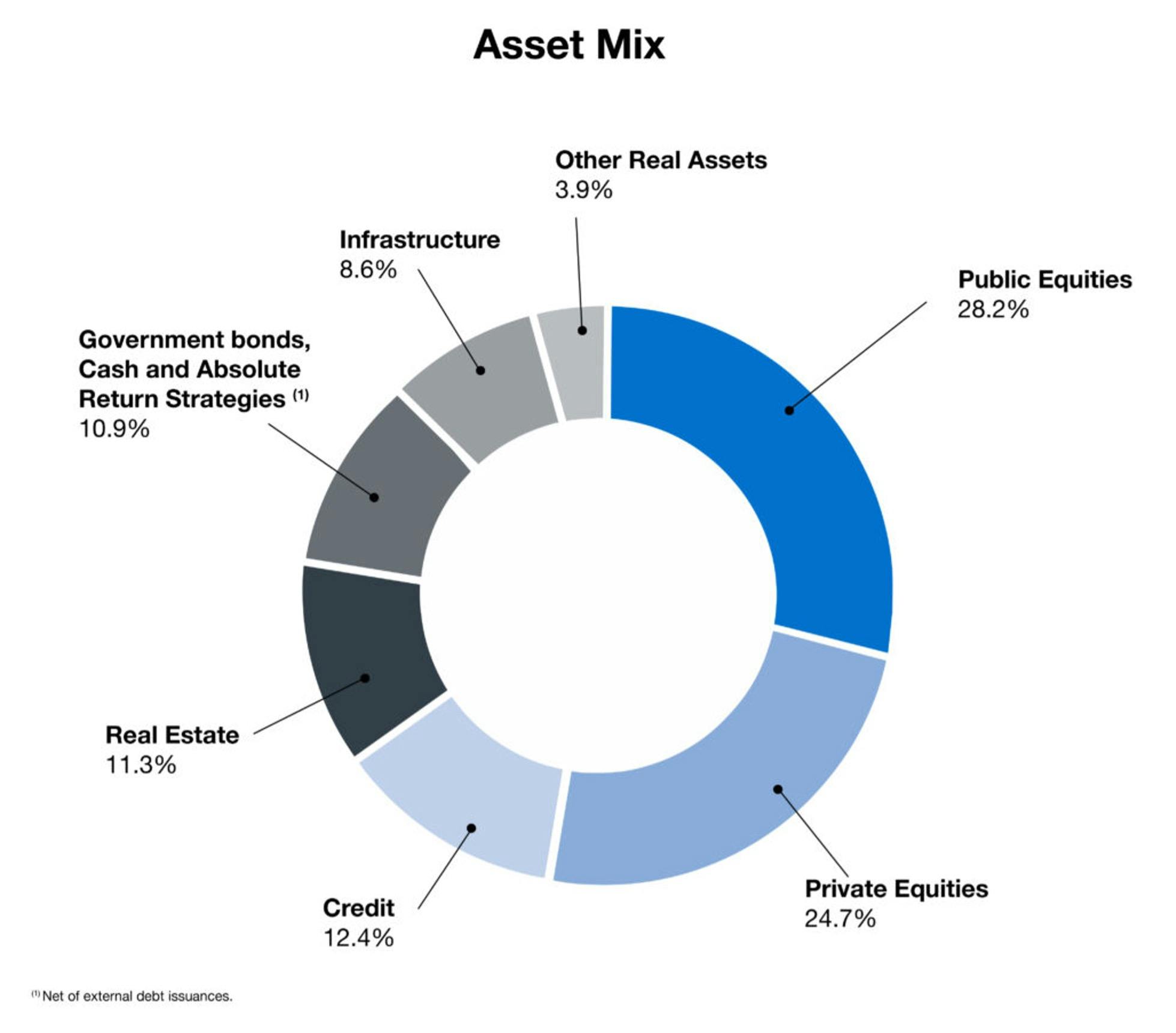
Investors like private equity for its ability to deliver higher-than-average returns that can be uncorrelated to the broader stock and bond market. Notable institutional investors like the Canada Pension Plan (CPP) often allocate a substantial portion of their portfolio to private equity.
However, it's really hard for the average retail investor to invest in private equity. These opportunities are usually locked behind net worth requirements or industry connections. That being said, in recent years, a slew of ETFs have emerged purporting to deliver private equity exposure. Let's see how they stack up.
Global ETF Survey 2026 is Live!
With 1,790 new products launched by July 2026, choosing is harder than ever. Our Global ETF Survey 2026, built on 620 professional investors and allocators, shows how active, fixed income, options-based and thematic ETFs are reshaping fund selection.
Are those ETFs really private equity, though?
Right off the bat, we need to distinguish between investing in a private equity firm's fund directly, versus investing in the shares of a publicly traded private equity firm. Think of this as the difference between buying gold directly, versus buying a share of a gold miner. The latter is a proxy approach that gives some exposure but introduces different sources of risk and returns.
That's the main issue with private equity ETFs. Consider the Invesco Global Listed Private Equity ETF (PSP). This ETF tracks the Red Rocks Global Listed Private Equity Index, which holds 76 publicly traded private equity firms from around the world. The fund is heavily concentrated in the financial sector, with the top 10 holdings currently comprising:
- III LN - 3i Group PLC (5.17%)
- PGHN SW - Partners Group Holding AG (5.02%)
- KKR - KKR & Co Inc (4.93%)
- MRO LN - Melrose Industries PLC (4.59%)
- OWL - Blue Owl Capital Inc (4.56%)
- EQT SS - EQT AB (4.31%)
- CG - Carlyle Group Inc/The (4.18%)
- BX - Blackstone Inc (4.17%)
- SOF - Sofina SA (3.95%)
- TPG - TPG Inc (3.49%)
As I noted earlier, investors who buy a fund like PSP are still one step removed from the real deal. Instead of directly investing your money in a private equity fund (and thus privately held companies), the ETF invests it in an index of publicly traded private equity companies.
Essentially, your investment thesis changes from "investing directly in private equity to generate better/non-correlated returns" to "investing in private equity companies and hoping that they do more deals and are more profitable over time."
Why this isn't ideal
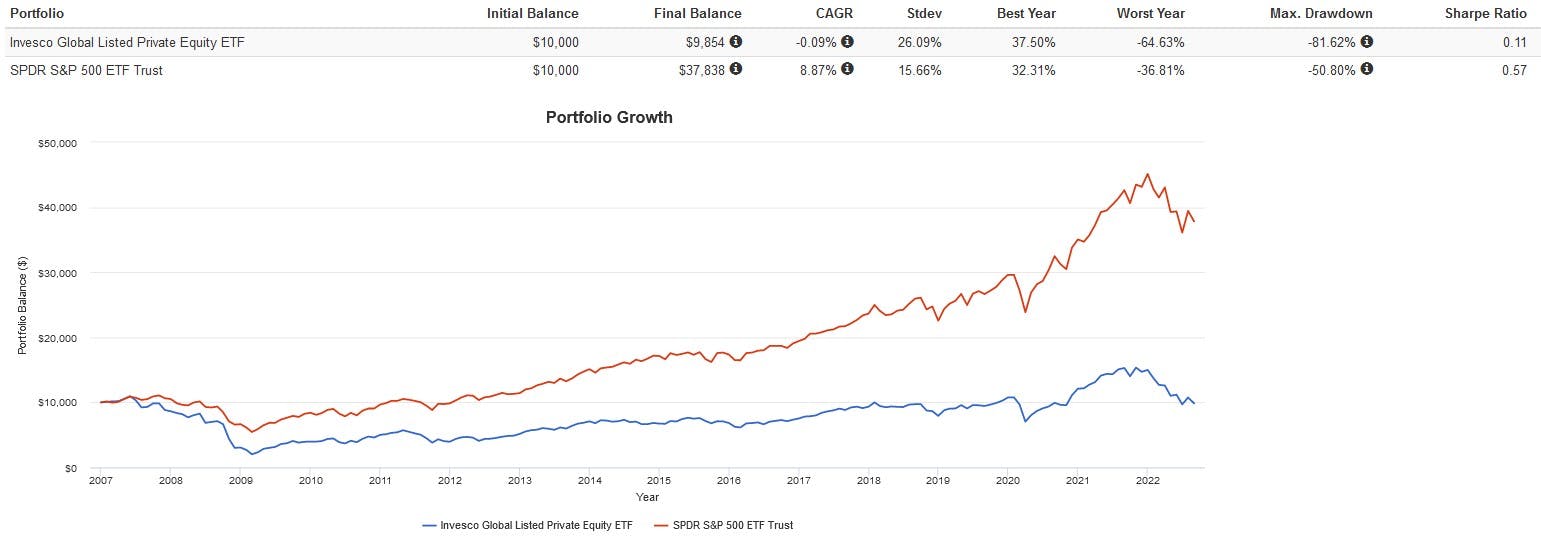
This extra step fundamentally changes the reason to invest in private equity – the ability to deliver better risk-adjusted returns that are uncorrelated to the stock market. By investing in the shares of publicly traded private equity companies, you are once again taking on excessive market risk. Take a look at this chart which compares the correlation of PSP to the S&P 500, for example.

PSP is too correlated to equities to have much of a diversification benefit, and it's understandable why: the ETF is still comprised of stocks, not actual private equity. What you're actually getting is sector concentration – your investment returns now hinge on the private equity industry outperforming. On an annual return basis, we see this occurring.
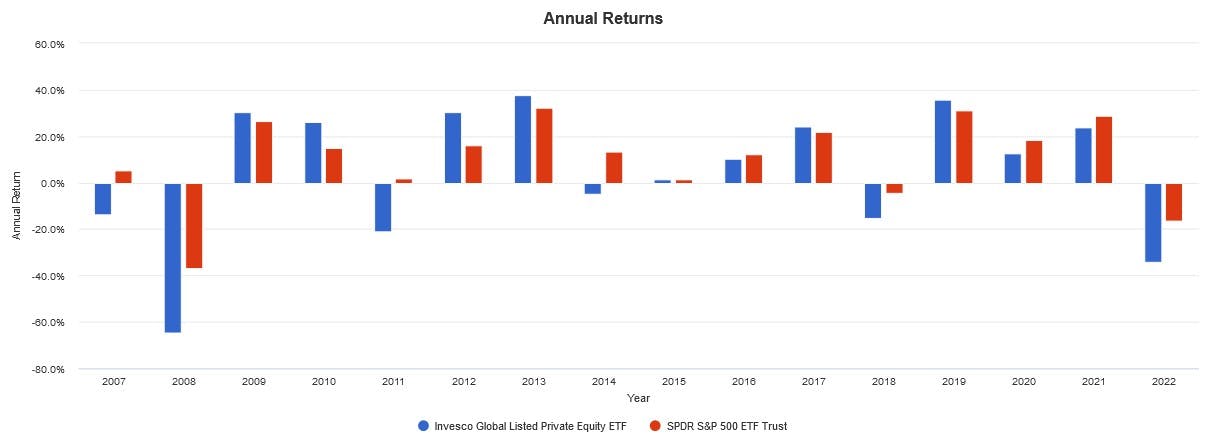
As seen above, when times are good (low-interest rates, bull markets), PSP outperforms the market as more deal activity occurs. The opposite occurs during bad times when PSP draws down severely. The problem with this is that investing in private equity ETFs like PSP becomes a timing exercise.
For example, if you invested right when the fund debuted, you would have to overcome a -64% loss in 2008, which would have resulted in years of under-performance.
The final word on private equity ETFs
I think these ETFs still have a use as a thematic tilt. That is, if you think the private equity industry will outperform (and that's a reasonable thesis during low-interest rate bull markets), then an ETF like PSP might be suitable for your investment objectives.
PSP might not be the best option if you're looking for an alternative investment with positive expected returns and a low correlation to stocks and bonds. In that case, managed futures or commodities might be a better pick for attaining diversification.
Finally, it's worth noting that most private equity ETFs are expensive. PSP charges a management fee of 0.50% but has incurred an overall expense ratio of 1.34%. This is very costly compared to an index ETF (which can go as low as 0.03%) and is even pricier than leveraged ETFs that usually run around 0.90% - 1.00%.
Please note this article is for information purposes only and does not constitute investment advice.

Latest ETF News
See all ETF newsBeyond Big Tech: The Increasing Specialization of AI ETFs

There's an ETF for That? Humanoid Robotics and Physical AI

How Some ETF Issuers Use Their Own Funds for Cash Management

These Public-Private ETFs Invest in Polymarket and Anduril

There's an ETF for That? Frontier Markets



 Advantages of ETFs over Mutual Funds1/6
Lower Costs
In this guide, we'll explore the advantages of ETFs over mutual funds, giving you valuable insights into why ETFs have gained significant popularity among investors like yourself.
Leveraged ETFs: Unlocking the Potential for Amplified Returns1/6
Understanding Leveraged ETFs
Explore leveraged ETFs: potential for amplified returns & risks. 5 ETFs to consider across equities, commodities & fixed income.
What is a Leveraged ETF?1/6
Introducing Leveraged and Inverse ETFs
In this guide, we'll dive into the world of leveraged ETFs, exploring their definition, mechanics, potential risks, and rewards.
Recent educational content

First Look ETF
First Look ETF: Income, International, and Cash Flow ETFs
In this season 6 episode of First Look ETF, Stephanie Stanton @etfguide examines the latest ETF marketplace trends with NYSE and guests.


ETF Trends
ETF Industry KPIs October 5, 2026
This week’s KPI data overview highlights key metrics and trends shaping the ETF landscape.

ETF Trends
ETF Industry KPIs September 28, 2026
This week’s KPI data overview highlights key metrics and trends shaping the ETF landscape.
ETF Trends
ETF Industry KPIs September 22, 2026
This week’s KPI data overview highlights key metrics and trends shaping the ETF landscape.