From idea to ETF portfolio in minutes. Build yours now →



NUSI: an ETF with high yields and crash protection?
NUSI uses an options collar strategy to provide income and downside protection. Has it worked so far?


Keep up with what matters in ETFs
Get timely ETF insights, market trends, and top ideas straight to your inbox.
Your newsletter subscriptions with us are subject to ETF Central's Privacy Policy and Terms and Conditions.
In a previous article, I discussed some of the most popular ETFs that investors can trade options on. I noted that for most investors, sticking to simple options strategies like covered calls and protective puts for income and hedging was best. Options trading can be highly risky and complex.
An innovative ETF that combines both covered calls and puts is the Nationwide Nasdaq-100 Risk-Managed Income ETF (NUSI). This ETF uses an option overlay to not only cap its downside risk but to also enhance its income potential. Compared to covered call ETFs and ETFs with crash protection via puts, NUSI sits somewhere in the middle.
It doesn't have the highest yield compared to say, the Global X Nasdaq 100 Covered Call ETF (QYLD), nor does it have as much downside protection as say, the Cambria Tail Risk ETF (TAIL), but it offers a balanced blend of both. Let's break NUSI down and see what makes the fund tick, its advantages, and disadvantages, and how it can be used.
Like what you're reading?
Stay in the loop — get the latest ETF insights: trends, analysis, and expert picks.
How NUSI works
NUSI starts off pretty simply by tracking the NASDAQ 100 index via a full replication approach (buying and holding all of its underlying stocks). Then, the fund implements a rules-based protective net-credit collar strategy by:
- First selling an at-the-money (ATM) or out-of-the-money (OTM) call NASDAQ 100 index option, which nets NUSI a cash premium.
- Using a portion of that premium, NUSI purchases an out-of-the-money put option, which caps its downside risk.
By doing so, the ETF's upside and downside risks are capped. NUSI might underperform during bull markets as its upside is capped at the strike price of the call option sold.
However, it can outperform during sideways markets if the calls keep expiring out of the money. During a sharp crash, its downside risk is capped at the strike price of the put option purchased.
Below is a diagram from NUSI's whitepaper, which illustrates the payoff of an options collar strategy:
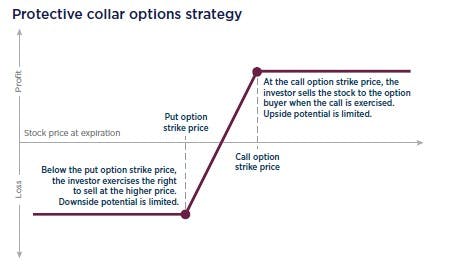
Because the cash premium from selling the call is more than the cost of buying the put, NUSI has a net cash credit leftover, which is paid out to investors as a monthly distribution. Currently, the ETF has a 12-month trailing yield of 9.39%, which is very high.
Advantages/disadvantages of NUSI
I think NUSI is best suited for investors with a low risk tolerance and defined income needs. For instance, the retiree who needs a steady 4% withdrawal rate and low portfolio volatility. With bonds suffering during rising-rate environments, an options collar strategy might be a decent alternative.
Younger investors with a high-risk tolerance and long-time horizon might not like NUSI given its lower total returns, especially during bull markets which are far more common than the conditions we're seeing in 2022. Since its inception, NUSI has underperformed the NASDAQ 100:
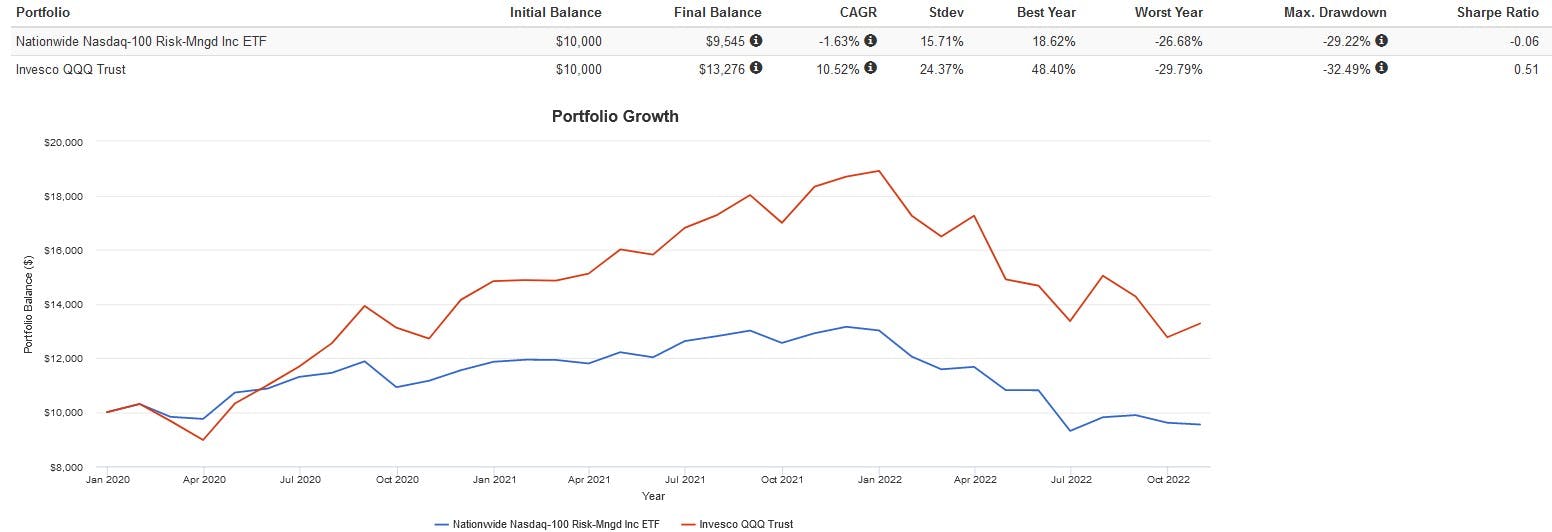
This isn't a completely fair comparison though, as NUSI's strategy isn't achieving the highest total returns. If we look at it from a volatility-reduction standpoint, NUSI posted a lower standard deviation and max drawdown.
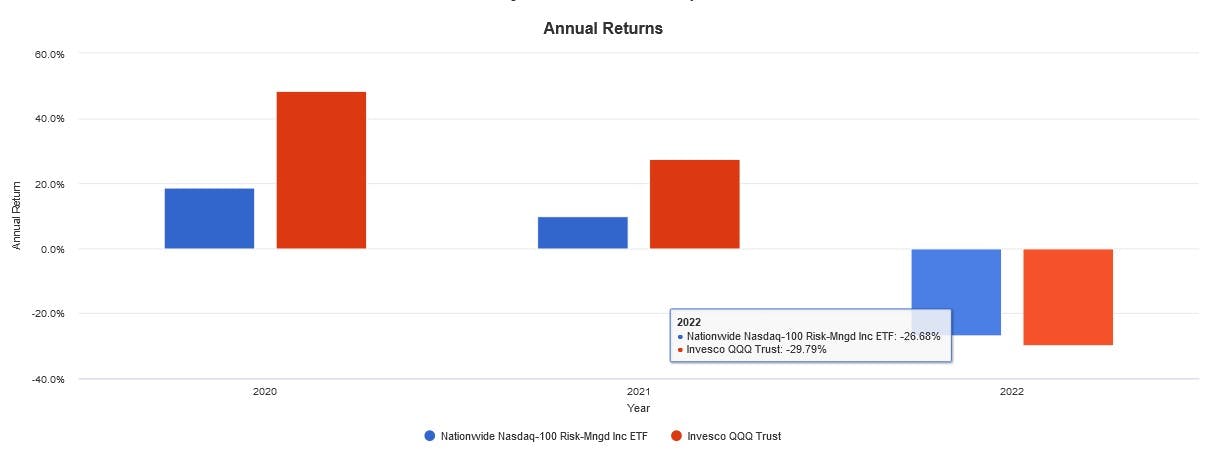
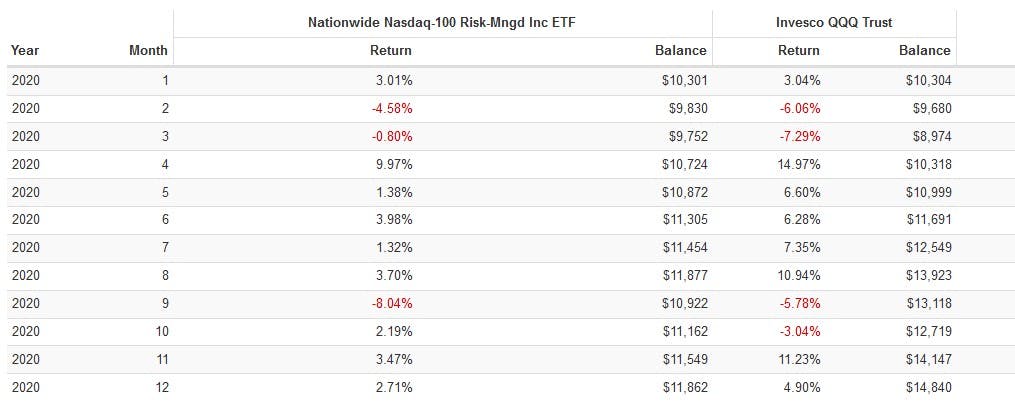
NUSI shines most during prolonged sideways trading markets and sharp crashes. The former helps covered calls expire out of the money, thus not capping its gains, whereas the latter gives the greatest payoff for put options.
We can see the former in action during 2022, where NUSI outperformed NASDAQ 100 due to the cushion provided by its call option premiums.
We can see the latter in action during the March 2020 crash, where NUSI fell far less due to its put options gaining in value.
As with most actively managed funds, finding success with NUSI means understanding your own risk tolerance and investment objectives. If your goal is maximizing long-term returns, a vanilla stock and bond index ETF might be more suitable. If your goal is a defined, consistent source of income with predictable volatility, you could do worse than NUSI.
Please note this article is for information purposes only and does not constitute investment advice.
Topics
See all
This article does not have a tagged topic
Mentioned ETFs
Further reading

Latest ETF News
See all ETF newsETF comparison: NEOS S&P 500 High Income ETF (SPYI) Versus Goldman Sachs S&P 500 Premium Income ETF (GPIX)

There’s an ETF for That? Investing Like University Endowments

Could Water ETFs Be the Next AI Bottleneck Trade?

What is a Boomer Candy ETF?




 Advantages of ETFs over Mutual Funds1/6
Lower Costs
In this guide, we'll explore the advantages of ETFs over mutual funds, giving you valuable insights into why ETFs have gained significant popularity among investors like yourself.
Leveraged ETFs: Unlocking the Potential for Amplified Returns1/6
Understanding Leveraged ETFs
Explore leveraged ETFs: potential for amplified returns & risks. 5 ETFs to consider across equities, commodities & fixed income.
What is a Leveraged ETF?1/6
Introducing Leveraged and Inverse ETFs
In this guide, we'll dive into the world of leveraged ETFs, exploring their definition, mechanics, potential risks, and rewards.
Recent educational content

ETF Trends
ETF Industry KPIs September 14, 2026
This week’s KPI data overview highlights key metrics and trends shaping the ETF landscape.

ETF Trends
ETF Industry KPIs September 8, 2026
This week’s KPI data overview highlights key metrics and trends shaping the ETF landscape.
ETF Trends
ETF Industry KPIs August 31, 2026
This week’s KPI data overview highlights key metrics and trends shaping the ETF landscape.
ETF Trends
ETF Industry KPIs August 24, 2026
This week’s KPI data overview highlights key metrics and trends shaping the ETF landscape.
Browse all educational columns



Build and Analyze Your ETF Portfolio Like a Pro
Create your own ETF portfolio in minutes and instantly see allocations, exposures, performance, and risk. Visualize diversification across asset classes, regions, and sectors. Stress-test ideas, compare benchmarks, and refine your strategy with professional-grade analytics.