Explore professionally built ETF model portfolios. Discover now →



Covered call ETFs: How did they perform in the 2022 bear market?
The unusual market conditions this year have been very beneficial for covered call ETFs.


Keep up with what matters in ETFs
Get timely ETF insights, market trends, and top ideas straight to your inbox.
Your newsletter subscriptions with us are subject to ETF Central's Privacy Policy and Terms and Conditions.
Income investors love covered call funds, and I totally understand why. To many, the alluringly high yields appear to be a veritable money printer of sorts. The monthly distributions satisfy a mental accounting urge we all have when it comes to seeing cash land in our brokerage account.
Still, the math is quite apparent. Over long periods of time, the average covered call ETF will lag its regular buy-and-hold vanilla index counterpart. This is by design – covered call ETFs have capped upsides as they're simply selling that potential for an immediate cash premium.
During low-volatility bull markets (which is the most common market cycle), covered call funds will lag as the price of their underlying stocks continually blow past their strike prices, capping gains as the premium received is priced rather efficiently and won't make up for the lost upside.
Still, there are scenarios where covered call funds outperform. Namely, they have done very well this year thanks to some very unique market conditions we're experiencing. I'll be using three ETFs from Global X as an example next to their regular index counterparts.
Like what you're reading?
Stay in the loop — get the latest ETF insights: trends, analysis, and expert picks.
How covered calls work
Covered call ETFs generate income by selling (writing) call options on increments of 100 shares of their underlying holdings. For example, a covered call ETF that tracks the S&P 500 will sell one call option for every 100 shares of the underlying S&P 500 ETF it holds.
By selling this call option, the ETF earns an immediate cash premium, the amount of which is dependent on a few variables. Without getting into the complicated options math, the simple explanation is:
- Implied volatility: options premiums are higher when the implied volatility of the underlying asset is higher than historical averages.
- Moneyness: options premiums are higher when the strike price of the call option sold is the same as the price of the underlying (at-the-money) or lower (in-the-money) as opposed to being higher (out-of-the-money).
- Expiry date: options premiums are higher when the expiry date of the call option sold is dated further out in time.
Depending on how the underlying asset performs, there are generally a few scenarios:
- The option expires out-of-the-money as the price of the underlying is below the strike price at expiry. The options seller keeps the premium and their 100 shares.
- The option expires out of the money as the price of the underlying has fallen far below the strike price at expiry. The options seller keeps the premium and their 100 shares, but incurs an unrealized loss on the 100 shares.
- The option expires in the money as the price of the underlying has risen above the strike price at expiry. The options seller keeps the premium but must sell their 100 shares at the strike, which can cause them to forgo greater gains by selling the shares at the current market price.
Investors can write calls on ETFs themselves. Earlier, I went over a few ETFs with well-developed options chains suitable for this. However, this approach can be complicated and time consuming, hence why it makes sense to pay a manager like Global X an expense ratio to do it professionally on your behalf.
When covered calls outperform
Putting the above together, it's obvious that covered call strategies have the greatest chance of outperforming in high-volatility, sideways or bearish markets.
Under these conditions, options premiums are enhanced due to the higher implied volatility that affects their pricing. Sideways or bearish price movements also help the option expire out of the money.
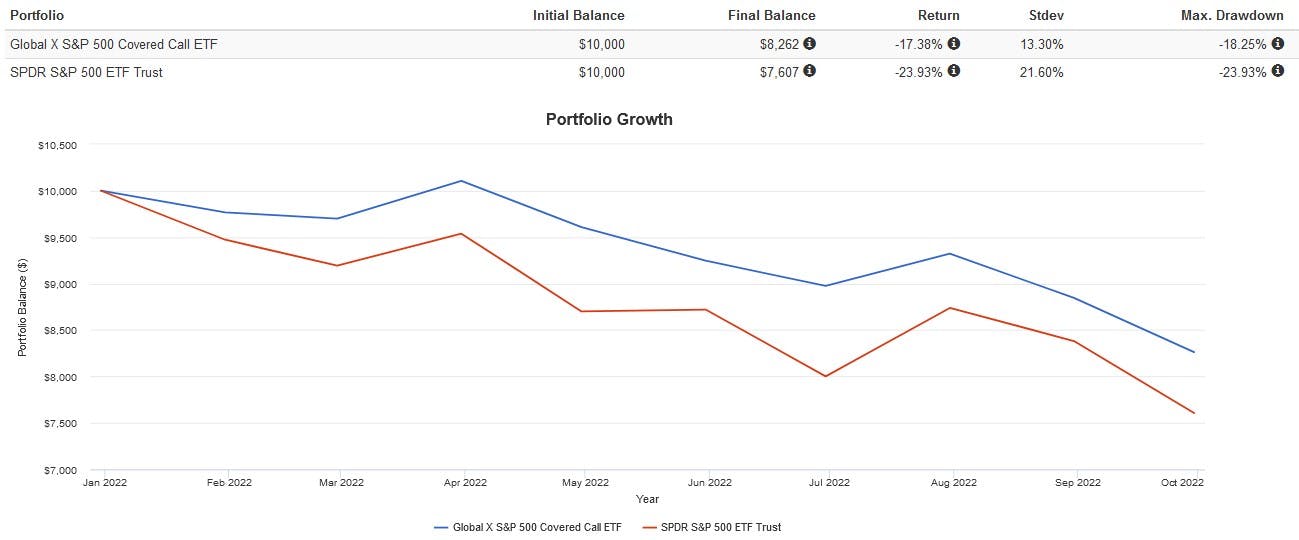
The net result is that under these conditions, covered call funds suffer lower maximum drawdowns and incur less volatility due to the premium acting as a buffer of sorts. Let's compare three Global X covered call ETFs to their index ETF counterparts in 2022 to see this in action.
First up is the Global X S&P 500 Covered Call ETF (XYLD) versus the SPDR S&P 500 ETF Trust (SPY):
Next up is the Global X NASDAQ 100 Covered Call ETF (QYLD) versus the Invesco QQQ ETF (QQQ):

Finally, the Global X Russell 2000 Covered Call ETF (RYLD) versus the iShares Russell 2000 ETF (IWM):
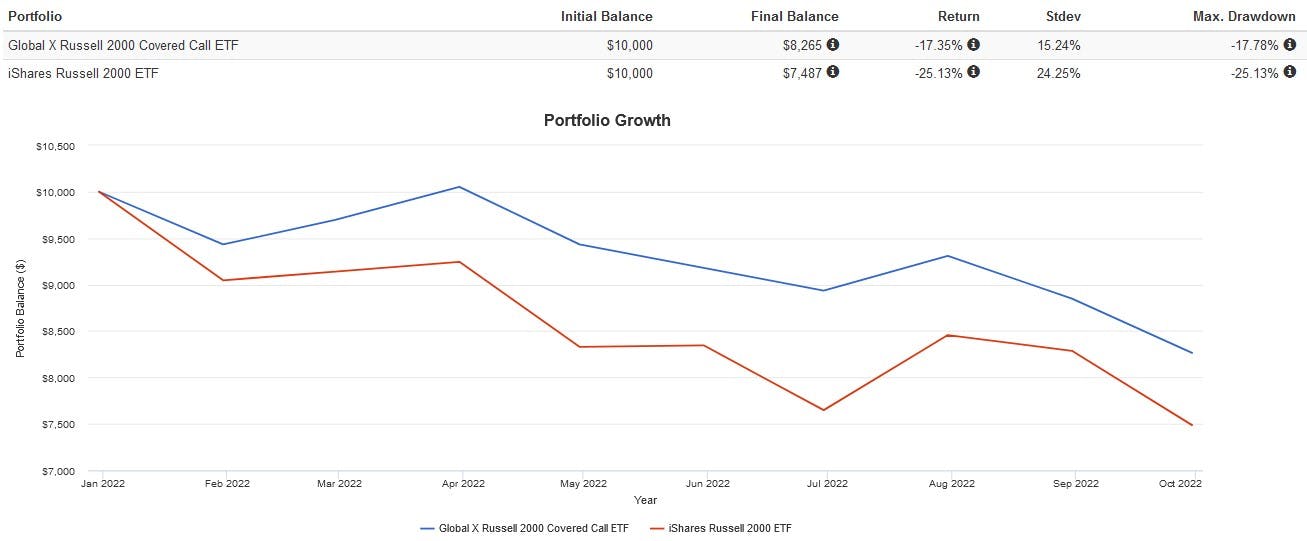
All three covered call ETFs strongly outperformed their index counterparts in 2022. Will this continue moving forward? I don't have a crystal ball, but it's worth noting that covered call ETFs would have been an excellent holding during the "lost decade" of 2000 – 2009 where the S&P 500 saw a flat -1.01% annualized return. It all depends on your thesis for how long the 2022 bear market will continue.
Please note this article is for information purposes only and does not constitute investment advice.
Latest ETF News
See all ETF newsMoneyShow Chart of the Day 9/4/26: Don't Just Watch Oil. Watch THESE.


Chart of the Day 8/14/26: The Great "Hot Money" Migration

MoneyShow Chart of the Day 7/29/26: Now, THAT's What I Call Market Rotation!

MoneyShow Chart of the Day 7/16/26: Good News/Bad News on Inflation (and the Fed)




 Advantages of ETFs over Mutual Funds1/6
Lower Costs
In this guide, we'll explore the advantages of ETFs over mutual funds, giving you valuable insights into why ETFs have gained significant popularity among investors like yourself.
Leveraged ETFs: Unlocking the Potential for Amplified Returns1/6
Understanding Leveraged ETFs
Explore leveraged ETFs: potential for amplified returns & risks. 5 ETFs to consider across equities, commodities & fixed income.
What is a Leveraged ETF?1/6
Introducing Leveraged and Inverse ETFs
In this guide, we'll dive into the world of leveraged ETFs, exploring their definition, mechanics, potential risks, and rewards.
Recent educational content

ETF Trends
ETF Industry KPIs September 8, 2026
This week’s KPI data overview highlights key metrics and trends shaping the ETF landscape.

ETF Trends
ETF Industry KPIs August 31, 2026
This week’s KPI data overview highlights key metrics and trends shaping the ETF landscape.
ETF Trends
ETF Industry KPIs August 24, 2026
This week’s KPI data overview highlights key metrics and trends shaping the ETF landscape.
What’sTheFund
What's the Fund | Ocean Park Diversified Income ETF (DUKZ)
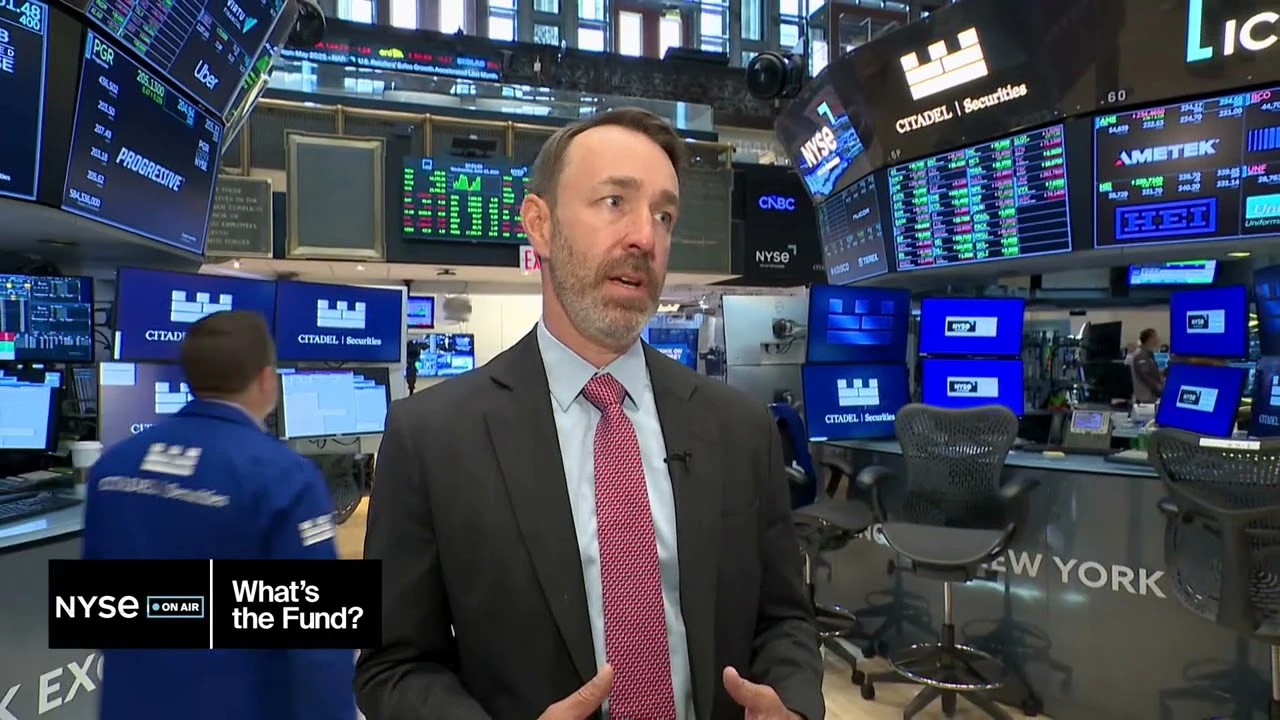
James St Aubin, Chief Investment Officer at Ocean Park Asset Management, discuss the DUKZ ETF, exposing investors to the whole spectrum of asset classes in the fixed income markets, through their rules-based process.

Browse all educational columns



Have you tried our ETF Compare tool?
Compare ETFs like a pro. Analyze fees, performance, exposure & holdings side-by-side.