From idea to ETF portfolio in minutes. Build yours now →



Is JP Morgan’s Active Value ETF (JAVA) Worth a Look?
Factor investors shouldn't instinctively dismiss actively managed ETFs like JAVA. Here's why.


Keep up with what matters in ETFs
Get timely ETF insights, market trends, and top ideas straight to your inbox.
Your newsletter subscriptions with us are subject to ETF Central's Privacy Policy and Terms and Conditions.
The latest results from the S&P Dow Jones Indices' SPIVA Scorecard have been updated to December 31st, 2022, and they speak for themselves: on the whole over long periods of time, the majority of actively managed funds continue to lag their passive index counterparts.
Over the trailing 15 years, 93.40% of U.S. large-cap funds underperformed the S&P 500 Index. However, over shorter periods of time actively managed funds have shown their worth, with just 51.08% underperforming over a trailing one-year period.
A strong contender in the active ETF space this year is JP Morgan's asset management division. The firm saw two of their active ETFs rocket up to the top of the ETF Central Screener rankings for both assets under management (AUM)and one-month inflows in the actively managed ETF category:
Investors flocked to JPST as a refuge from rising interest rates, while JEPI has been particularly popular with investors seeking a defensive, income-oriented fund during the recent market turbulence.
For the value investors out there, JP Morgan also has a solution in the form of the JPMorgan Active Value ETF (JAVA). I think this ETF has some interesting characteristics that set it aside from the usual index or smart-beta based value factor ETFs on the market. Let's examine it closely.
Like what you're reading?
Stay in the loop — get the latest ETF insights: trends, analysis, and expert picks.
Value: index
The value ETF space is quite hotly contested, with the majority of investor inflows going towards two types of value ETFs: index-based and smart-beta.
Index value ETFs typically track value indexes like S&P 500 Value or the CRSP US Large Cap Value Index, which implement additional screeners for low price-to-book, price-to-earnings, and price-to-sales ratios to name a new. These ETFs must rigidly adhere to their benchmarks at all times, changing out their portfolio whenever the underlying index undergoes a reconstitution. Popular examples include:
- Vanguard Value ETF (VTV) - CRSP US Large Cap Value Index.
- iShares S&P 500 Value ETF (IVE) – S&P 500 Value Index.
Value: Smart Beta
Then we have smart-beta ETFs. These ETFs use their own proprietary set of screeners and weighting methodology to target value stocks. They don't track an index, but they aren't completely actively managed either. They tend to be more expensive than value index ETFs, but cheaper than true actively managed value ETFs. Thus, they can be thought of as a hybrid. Popular examples include:
- Dimensional U.S. Targeted Value ETF (DFAT) – screens for low price-to-book, price-to-cash-flow, price-to-earnings ratios, profitability, and momentum factors.
- Avantis U.S. Large Cap Value ETF (AVLV) – screens for value (adjusted price-to-book) and profitability (adjusted cash-from-operations-to-book-value) ratios.
Value: truly active
Truly active value ETFs like JAVA are a "black box". That is, the methodology behind the ETF's security selection process is basically a "secret sauce" – it’s not disclosed. If we look at JAVA's summary prospectus, it doesn't specify the exact metrics that JAVA identifies a "value" stock by:
"The adviser will invest in companies whose securities are, in the adviser’s opinion, undervalued when purchased, but which have the potential to increase the intrinsic value per share. The “intrinsic value” of a stock is an expression of what the adviser believes to be the stock’s true worth."
"The adviser employs a bottom-up approach to stock selection, constructing portfolios based on company fundamentals, quantitative screening, and proprietary fundamental analysis. The adviser’s analysis includes a review of proprietary data, information self-reported by companies, data from third-party vendors and internal fundamental research."
The keyword here is "proprietary" – a bet on JAVA delivering value exposure is a bet on the fund management team (pictured below) having the right expertise and knowledge to identify value stocks.
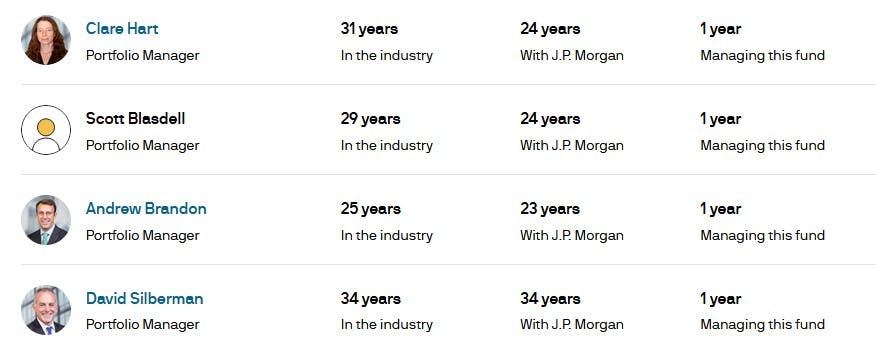
As with most actively managed funds, risks to watch include possible style drift from the team or objective changing over time and higher portfolio turnover and expense ratio (0.44%).
How has JAVA performed?
JAVA has a limited performance history, so take this backtest with a grain of salt. Historically, it has outperformed a passive value index ETF like VTV but underperformed a smart-beta value ETF like DFAT.

During this time, JAVA incurred similar volatility and drawdowns as VTV, but much higher returns. It also fell the least during the 2022 bear market.
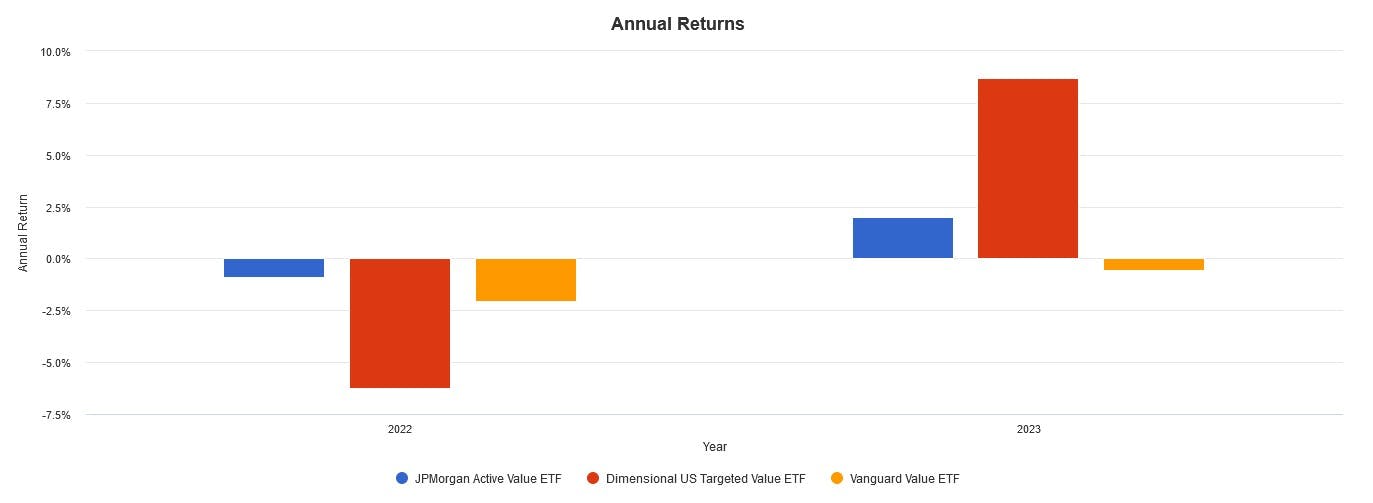
I'm not surprised. According to SPIVA, only 58.70% and 39.46% of actively managed U.S. large-cap value ETFs have underperformed the S&P 500 Value Index over trailing one- and three-year periods. This shows that actively managed value ETFs can shine over the short to medium term.
However, by 15 years the gap narrows immensely, with 79.13% of actively managed U.S. large-cap value ETFs underperforming S&P 500 Value Index. The culprit behind this is likely higher expense ratios that compound over time – consider how JAVA charges 0.44%, 11x that of VTV at 0.04%.
Actively managed value: final thoughts
I think JAVA has so far proven itself to be a decent value ETF worth considering for those willing to pay a higher expense ratio for the chance of outperforming. Historically, it's been more resilient than a comparable value index ETF during poor market conditions.
To summarize my thoughts on the active vs index debate, I'll end by rehashing the five key points I noted in an earlier article on passive vs active REIT ETFs:
- Some actively managed value ETFs will always outperform their passive index counterparts net of fees, but most will underperform.
- As more and more time goes on, both the number of outperforming actively managed value ETFs and the degree to which these ETFs outperform will shrink.
- Actively managed value ETFs face many headwinds that passively managed index ETFs do not, such as higher expense ratios, greater portfolio turnover, and the risk of management style drift.
- Identifying which actively managed value ETFs will outperform ex-ante is highly difficult, if not possible for the average retail investor to do.
- Actively managed value may have a higher chance of outperforming passively managed index ETFs when market conditions are poor or volatile.
Please note this article is for information purposes only and does not in any way constitute investment advice. It is essential that you seek advice from a registered financial professional prior to making any investment decision.
Segments
See all
Mentioned ETFs
No specific ETFs were tagged
Further reading


Latest ETF News
See all ETF newsHow Some ETF Issuers Use Their Own Funds for Cash Management

These Public-Private ETFs Invest in Polymarket and Anduril

There's an ETF for That? Frontier Markets

10-Year Treasury Yield Hits 5%: Which Bond ETFs Offer the Most Direct Exposure?




 Advantages of ETFs over Mutual Funds1/6
Lower Costs
In this guide, we'll explore the advantages of ETFs over mutual funds, giving you valuable insights into why ETFs have gained significant popularity among investors like yourself.
Leveraged ETFs: Unlocking the Potential for Amplified Returns1/6
Understanding Leveraged ETFs
Explore leveraged ETFs: potential for amplified returns & risks. 5 ETFs to consider across equities, commodities & fixed income.
What is a Leveraged ETF?1/6
Introducing Leveraged and Inverse ETFs
In this guide, we'll dive into the world of leveraged ETFs, exploring their definition, mechanics, potential risks, and rewards.
Recent educational content

ETF Trends
ETF Industry KPIs October 5, 2026
This week’s KPI data overview highlights key metrics and trends shaping the ETF landscape.

ETF Trends
ETF Industry KPIs September 28, 2026
This week’s KPI data overview highlights key metrics and trends shaping the ETF landscape.
ETF Trends
ETF Industry KPIs September 22, 2026
This week’s KPI data overview highlights key metrics and trends shaping the ETF landscape.
First Look ETF
First Look ETF: Income, Corporate Arbitrage, and Growth and Value Investing
First Look ETF September 2026: iCapital, Mast Investments and North Square unpack new ETFs targeting monthly income, merger arbitrage and complementary growth and value exposure.

Browse all educational columns



Have you tried our ETF Compare tool?
Compare ETFs like a pro. Analyze fees, performance, exposure & holdings side-by-side.