Ready-made ETF portfolios built for real investor needs. Explore now →



REIT ETFs: Active Management or Passive Indexing?
Here's what the research says when it comes to the active vs. passive debate for REIT ETFs.


Keep up with what matters in ETFs
Get timely ETF insights, market trends, and top ideas straight to your inbox.
Your newsletter subscriptions with us are subject to ETF Central's Privacy Policy and Terms and Conditions.
Last time, I discussed whether or not REITs actually qualify as a distinct asset class (and thus deserve a separate portfolio allocation) and listed some popular ETF picks that provided REIT exposure. However, all of the ETFs listed were passively managed, tracking one of the many benchmark REIT indexes.
This begs the question of: "how have their actively managed counterparts performed?". When most investors consider active management, it's usually in terms of equity ETFs or structured products. However, active REIT ETFs exist as well, though they're not as common.
I think it would be instructive to take a closer look at the research surrounding active vs. passive REIT investing, highlight some of the current ETF offerings out there, and see how their historical performance matches up against our previous picks.
Get data on 14,000+ ETFs
Access Trackinsight's reliable and comprehensive data with 500M+ points on 14,000+ ETFs.
Does active REIT investing work?
Several organizations have performed extensive research when it comes to active versus passive REIT investing, although not in the context of REIT ETFs.
The first one to consider is the annual SPIVA Scorecard compiled by S&P Dow Jones Indices. The SPIVA Scorecard measures the performance of actively managed funds across the world against their index benchmarks. As expected, most tend to underperform.
The real estate fund section is benchmarked against the S&P United States REIT Index, and it details what percentage of actively managed REIT funds underperform the index over 1, 3, 5, 10, and 15 years. The results? 68.49%, 45.57%, 51.81%, 72.73%, and 87.37% underperformed respectively.
The 3-year and 5-year performance figures stand out to me. Compared to other equity categories, the percentage of managed REIT ETFs that underperformed their index benchmarks over 3-year and 5-year periods was much lower. However, there's no telling if this is statistically significant or just an outlier.
Morningstar also conducted analysis in 2014 and found that the percentage of actively managed funds that managed to beat the index began sharply declining after 2002. Over the last decade from 2014, they found that the majority of active REIT funds underperformed their index counterparts.
One of Morningstar's theories was that the inclusion of REITs in indexes like the S&P 500 in 2001 and subsequent investor inflows turned them into a "mainstream" asset class. Prior to this, Morningstar noted that REITs were "under-owned, under-researched, and less liquid", which could have created opportunities a fund manager could capitalize on.
Morningstar's theory lines up with a study from 2000 titled "The Value Added from Investment Managers: An Examination of Funds of REITs". Here, the authors found that the average and median alphas (net of expenses) of REIT funds were positive and were much more likely to be generated when the REIT sector performed poorly.
Active REIT ETFs today
In my opinion, the debate on active versus passive investing for REIT ETFs can be summed up by the following observations:
- A minority of actively managed REIT ETFs will always outperform their passive index counterparts net of fees, but the majority will underperform.
- As more and more time goes on, both the number of outperforming actively managed REIT ETFs and the degree to which these actively managed REIT ETFs outperform will shrink.
- Actively managed REIT ETFs face many headwinds that passively managed ETFs do not, such as higher expense ratios, greater portfolio turnover, and the risk of management style drift.
- Identifying which actively managed REIT ETFs will outperform ex-ante is highly difficult, if not possible for the average retail investor to do.
- Actively managed REITs may have a higher chance of outperforming passively managed REIT index ETFs when market conditions are poor or volatile.
Investors interested in taking their chances with actively managed REIT ETFs can consider the following:
Of the two ETFs, PSR has the longest performance history, dating back to 2009. Here's how it historically performed net of fees versus two popular passive REIT index ETFs, the Vanguard Real Estate ETF (VNQ) and the iShares Core U.S. REIT ETF (USRT) respectively.
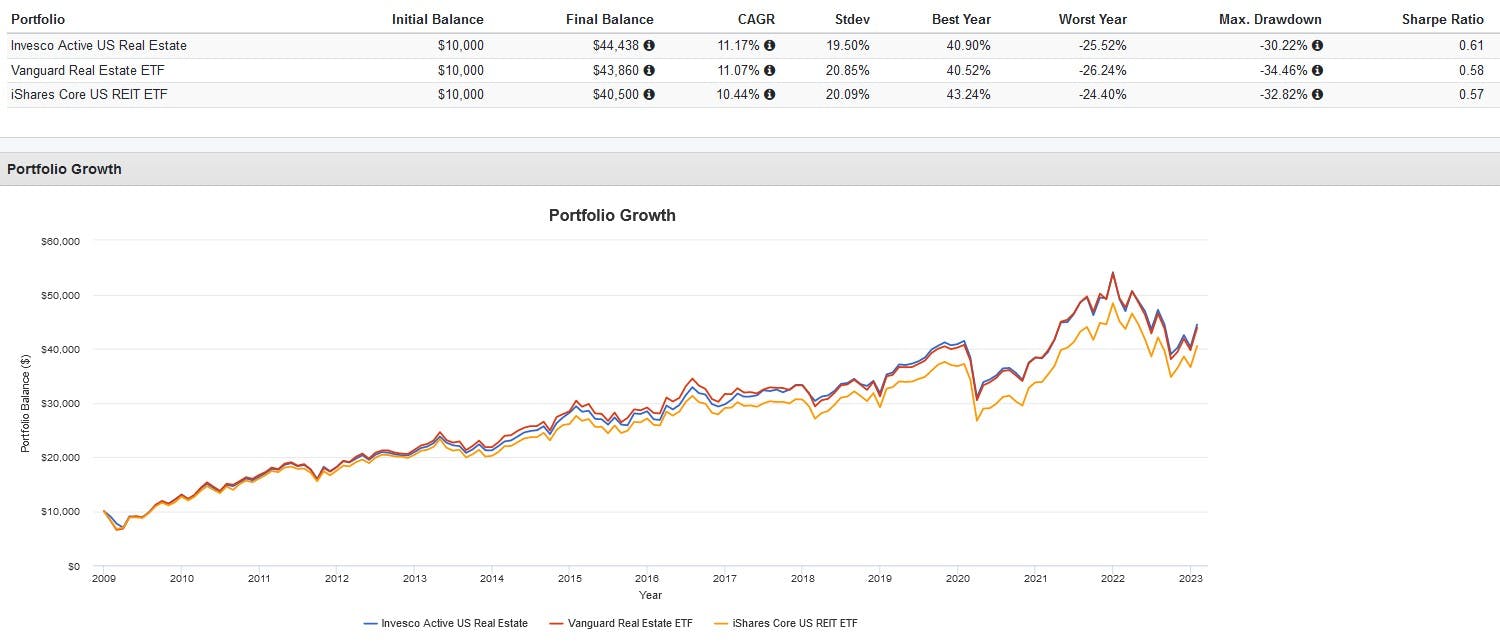

On a trailing basis, PSR outperformed both VNQ and USRT, although just very slightly for the former. It did so with less risk though, with lower volatility and drawdowns for a better risk-adjusted return. On a rolling basis, PSR performed fairly similarly to VNQ, but keep in mind that this is net of fees. If PSR reduced its expense ratio from 0.35% to 0.12% to compete with VNQ, I could see this narrowing.
Please note this article is for information purposes only and does not in any way constitute investment advice. It is essential that you seek advice from a registered financial professional prior to making any investment decision.

Latest ETF News
See all ETF newsCould Water ETFs Be the Next AI Bottleneck Trade?

What is a Boomer Candy ETF?

ETF Comparison: NEOS Nasdaq-100 High Income ETF (QQQI) Versus Goldman Sachs Nasdaq-100 Premium Income ETF (GPIQ)





 Advantages of ETFs over Mutual Funds1/6
Lower Costs
In this guide, we'll explore the advantages of ETFs over mutual funds, giving you valuable insights into why ETFs have gained significant popularity among investors like yourself.
Leveraged ETFs: Unlocking the Potential for Amplified Returns1/6
Understanding Leveraged ETFs
Explore leveraged ETFs: potential for amplified returns & risks. 5 ETFs to consider across equities, commodities & fixed income.
What is a Leveraged ETF?1/6
Introducing Leveraged and Inverse ETFs
In this guide, we'll dive into the world of leveraged ETFs, exploring their definition, mechanics, potential risks, and rewards.
Recent educational content

ETF Trends
ETF Industry KPIs September 8, 2026
This week’s KPI data overview highlights key metrics and trends shaping the ETF landscape.

ETF Trends
ETF Industry KPIs August 31, 2026
This week’s KPI data overview highlights key metrics and trends shaping the ETF landscape.
ETF Trends
ETF Industry KPIs August 24, 2026
This week’s KPI data overview highlights key metrics and trends shaping the ETF landscape.
What’sTheFund
What's the Fund | Ocean Park Diversified Income ETF (DUKZ)
James St Aubin, Chief Investment Officer at Ocean Park Asset Management, discuss the DUKZ ETF, exposing investors to the whole spectrum of asset classes in the fixed income markets, through their rules-based process.

Browse all educational columns



Build and Analyze Your ETF Portfolio Like a Pro
Create your own ETF portfolio in minutes and instantly see allocations, exposures, performance, and risk. Visualize diversification across asset classes, regions, and sectors. Stress-test ideas, compare benchmarks, and refine your strategy with professional-grade analytics.