From idea to ETF portfolio in minutes. Build yours now →



Investing in Sector ETFs: Consumer Staples, Healthcare, & Utilities
Here's what you need to know about the three defensive sectors in the S&P 500


Keep up with what matters in ETFs
Get timely ETF insights, market trends, and top ideas straight to your inbox.
Your newsletter subscriptions with us are subject to ETF Central's Privacy Policy and Terms and Conditions.
In our previous discussion on sector rotation, we emphasized how different market sectors react uniquely to economic cycles.
A standout point from that analysis was the role of "defensive sectors." These sectors are less sensitive to economic fluctuations and tend to perform relatively well even when other sectors are struggling.
According to State Street Global Advisors, the defensive trio—utilities, healthcare, and consumer staples—plays a crucial role in stabilizing portfolios during economic downturns.
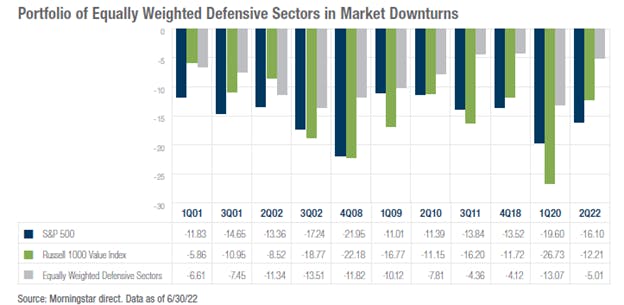
To give you a comprehensive view of these sectors, we'll explore the specifics of each one using their respective SPDR Select Sector ETFs. This will provide a "big picture" understanding of why these sectors are considered defensive and how they can fit into your investment strategy
Like what you're reading?
Stay in the loop — get the latest ETF insights: trends, analysis, and expert picks.
Consumer Staples
Consumer staples, also known as the consumer defensive or durables sector, includes everything from your daily essentials to your favorite snacks and household products.
This sector is divided into three main industry groups: consumer staples distribution and retail, food, beverage, and tobacco, plus household and personal products.
If you take a peek at the top holdings of The Consumer Staples Select Sector SPDR Fund
- Distribution and Retail: Think big names like Costco, Walmart, and Target.
- Food, Beverage, and Tobacco: Companies like Coca-Cola, Pepsi, Mondelez, Altria, and Philip Morris come into play here.
- Household and Personal Products: Giants like Procter & Gamble and Colgate-Palmolive round out the list.
One of the quirks of this sector is its defensive nature, highlighted by its low beta of 0.58. This means it's less tied to the broad market's ups and downs, which is great if you're after some stability in your portfolio.
Plus, this sector isn't just about stability; it's also a haven for dividend lovers. It boasts a ton of dividend aristocrats—those reliable companies that have upped their dividends for over 25 consecutive years.
In fact, it shares 16 overlapping holdings with the ProShares S&P 500 Dividend Aristocrats ETF
Health Care
Like consumer staples, the companies in the health care sector benefit from inelastic demand for their products and services, which is augmented by tailwinds from an aging population.
However, there's a bit more variation within health care, which is split into two main industry groups: healthcare equipment and services, and pharmaceuticals, biotechnology, and life sciences. Let's break down the top holdings in these groups for The Health Care Select Sector SPDR Fund
- Healthcare Equipment and Services: This group includes giants like UnitedHealth Group Inc, known for its insurance services and health technology. Thermo Fisher Scientific Inc, Danaher Corp, Abbott Laboratories, and Intuitive Surgical Inc are key players here too, specializing in everything from medical devices to diagnostic equipment and surgical robotics.
- Pharmaceuticals, Biotechnology, and Life Sciences: Over here, we have Eli Lilly & Co and Merck & Co. Inc leading the charge in pharmaceutical innovations, while Johnson & Johnson and AbbVie Inc blend biotech with a broad range of healthcare products. Amgen Inc rounds out this group, focusing on human therapeutics.
This sector has a beta of 0.69, indicating less sensitivity to market swings compared to broader indices, yet it's more volatile than Consumer Staples due to the inherent risks in healthcare.
Biotech companies, for instance, can experience dramatic ups and downs based on clinical trial results. Pharmaceutical firms rely heavily on maintaining robust patent pipelines to fend off generic competition, posing continuous challenges. Moreover, healthcare insurers like UnitedHealth face regulatory pressures, and traditional pharmacies are adjusting to the disruptions caused by e-commerce.
Utilities
Lastly, we have utilities—the essential, often regulated services that ensure your gas, water, and electricity keep flowing.
Unlike the larger sectors, utilities don't have distinct GICS industry groups as such; it encompasses everything from gas, water, and electric utilities to independent power producers, renewable electricity providers, and multi-utilities.
Checking out The Utilities Select Sector SPDR Fund
Utilities have traditionally been seen as "widow and orphan" stocks because of their stable dividends and perceived low risk. However, they've grown more volatile in recent years, acting more like bond proxies due to their steady, above-average yields and high debt burdens—the latter a result of their capital-intensive nature.
This sensitivity became especially pronounced in 2022 and 2023 as rising interest rates pressured the sector. Here's the kicker: as rates rise, utility stocks often falter because their high debt becomes costlier to service and investors can find better yields in safer assets like Treasury bills.
Despite these challenges, utilities are currently seeing a resurgence. With interest rates expected to drop come September, investors are flowing back into this sector.
Over the past month, according to ETF Central, XLU has netted $1.49 billion in inflows. As rates shift, Utilities might just light up as an attractive option again, still offering a robust yield of around 3%.
Please note this article is for information purposes only and does not in any way constitute investment advice. It is essential that you seek advice from a registered financial professional prior to making any investment decision.
Mentioned ETFs
Further reading

Latest ETF News
See all ETF newsBeyond Big Tech: The Increasing Specialization of AI ETFs

There's an ETF for That? Humanoid Robotics and Physical AI

How Some ETF Issuers Use Their Own Funds for Cash Management

These Public-Private ETFs Invest in Polymarket and Anduril

There's an ETF for That? Frontier Markets



 Advantages of ETFs over Mutual Funds1/6
Lower Costs
In this guide, we'll explore the advantages of ETFs over mutual funds, giving you valuable insights into why ETFs have gained significant popularity among investors like yourself.
Leveraged ETFs: Unlocking the Potential for Amplified Returns1/6
Understanding Leveraged ETFs
Explore leveraged ETFs: potential for amplified returns & risks. 5 ETFs to consider across equities, commodities & fixed income.
What is a Leveraged ETF?1/6
Introducing Leveraged and Inverse ETFs
In this guide, we'll dive into the world of leveraged ETFs, exploring their definition, mechanics, potential risks, and rewards.
Recent educational content

First Look ETF
First Look ETF: Income, International, and Cash Flow ETFs
In this season 6 episode of First Look ETF, Stephanie Stanton @etfguide examines the latest ETF marketplace trends with NYSE and guests.


ETF Trends
ETF Industry KPIs October 5, 2026
This week’s KPI data overview highlights key metrics and trends shaping the ETF landscape.

ETF Trends
ETF Industry KPIs September 28, 2026
This week’s KPI data overview highlights key metrics and trends shaping the ETF landscape.
ETF Trends
ETF Industry KPIs September 22, 2026
This week’s KPI data overview highlights key metrics and trends shaping the ETF landscape.
Browse all educational columns



ETFs’ Next Act: From Access to Selection
With 1,790 new products launched by July 2026, choosing is harder than ever. Our Global ETF Survey 2026, built on 620 professional investors and allocators, shows how active, fixed income, options-based and thematic ETFs are reshaping fund selection.