Global ETF Survey Is Live! 600+ ETF Professionals Weigh In. See Results →



The Golden Butterfly ETF portfolio
The golden butterfly portfolio is a simple but highly effective asset allocation. Let's dive into it.


Keep up with what matters in ETFs
Get timely ETF insights, market trends, and top ideas straight to your inbox.
Your newsletter subscriptions with us are subject to ETF Central's Privacy Policy and Terms and Conditions.
In July, I wrote about Harry Browne's "Permanent Portfolio," which was an equally balanced mixture of the total U.S. stock market, long-term bonds, cash, and gold. I noted how it demonstrated the benefits of diversification well but fell short due to its low equity allocation. Personally, I would have decreased my gold and cash allocation as well, given how both assets are non-productive over the long term.
It turns out I wasn't the only one who thought like this. Tyler of Portfolio Charts took the Permanent Portfolio and juiced it up to create a new asset allocation that has historically delivered stronger risk-adjusted returns. He calls it the "Golden Butterfly Portfolio." Let's see what it's all about.
Like what you're reading?
Stay in the loop — get the latest ETF insights: trends, analysis, and expert picks.
Golden Butterfly rationale
Both the Golden Butterfly and Permanent Portfolio subscribe to a view of "economic seasons." That is, they both posit that the economy and market undergo four different phases, each of which is beneficial to specific types of assets. They are:
- Economic expansion: U.S. stocks.
- Economic deflation: U.S. long-term Treasury bonds.
- Economic recession: Cash & money market instruments.
- Economic inflation: Gold bullion.
The differences start in each portfolio's weighting and view towards the four seasons. Whereas the Permanent Portfolio is agnostic and equally weights its allocation between seasons, the Golden Butterfly is more bullish. It tilts more towards economic expansion, and thus has a heavier stock allocation and swaps the cash for short-term bonds.
The differences don't just end there. Tyler also splits his heavier stock allocation into the total U.S. stock market and U.S. small-cap value to increase expected returns. I reviewed this approach before in my article on the small-cap value risk factor, so give it a read. In short, this is a potential way to outperform the market (and it has historically).
The equal weighting of the portfolio is not mean-variance optimized or accurate for risk parity. I think this was Tyler's way of keeping things simple and easy for investors to implement and rebalance. Using backtests to find the "optimal" allocations is also highly subject to data over-fitting.

The role of stocks
Stocks will drive most of this portfolio's returns during bull markets. As noted earlier, the Golden Butterfly splits its stock allocation evenly between the total U.S. stock market and U.S. small-cap value. However, the S&P 500 can easily be substituted for the former given their similar performance.
The following low-cost index ETFs could work:
Small-cap value is one of those strategies where an actively managed approach actually makes more sense. The construction of the fund and its methodology in screening and selecting holdings matters. Some small-cap value ETFs actually end up holding mid-caps or growth stocks, which is undesirable. The following two ETFs come from fund managers with a strong history of small-cap value investing:
The role of bonds
Bonds (Treasurys) provide deflationary crash protection. When a market crash occurs, central banks often drop interest rates to stimulate the economy, which sends bond prices (especially long-term Treasurys) soaring. This is called the "flight to safety." A bond allocation also helps lower volatility (in a non-rising rate environment). Long-term Treasurys are the best at this, but have the highest sensitivity to interest changes, while short-term Treasurys are more stable, but have a lower yield and flight-to-safety effect. What the Golden Butterfly portfolio does is hold them in equal allocations as part of a "barbell" strategy.
The following low-cost index ETFs could work:
The role of gold
I wrote a guide to investing in gold earlier, so give it a read for the run-down on this asset. In short, an allocation to gold can help shield the portfolio against situations where stocks and bonds fall in tandem. This is because gold has a low historical correlation with both, and has flight-to-safety qualities itself, especially during times of geopolitical crisis and inflation. That being said, gold is highly volatile and doesn't have positive expected returns, so keeping allocations small is good.
The following low-cost index ETFs could work:
Historical performance
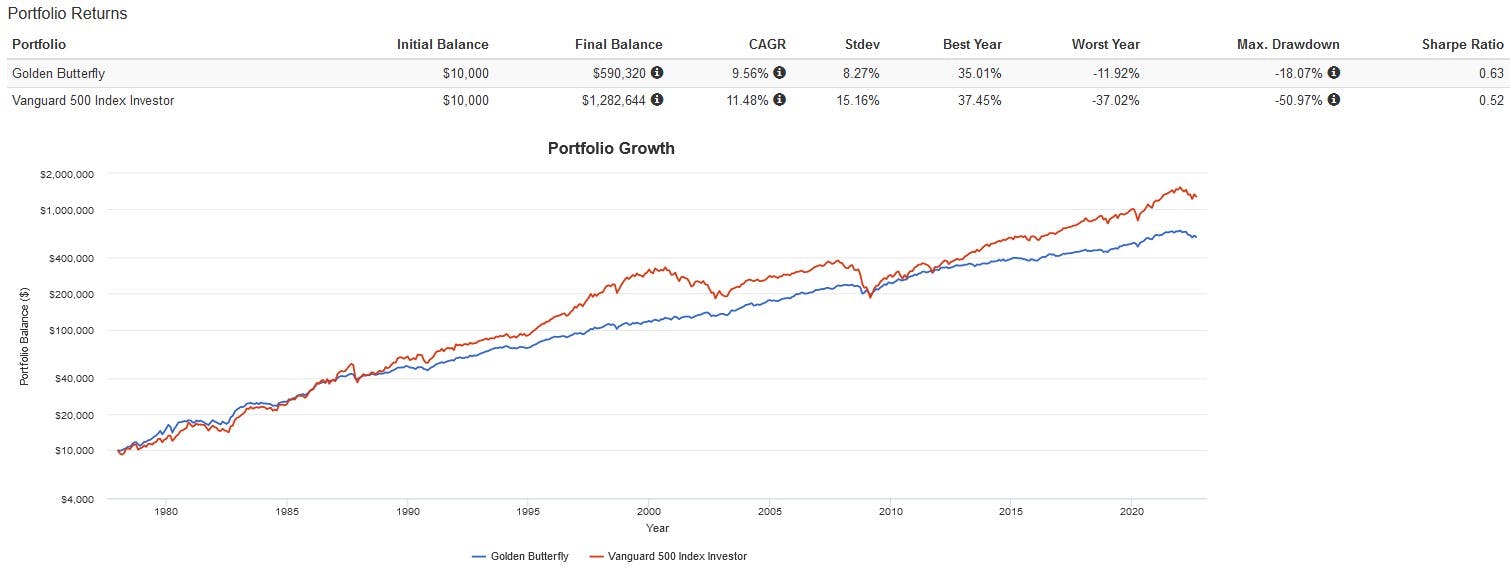
Here's how the Golden Butterfly performed from 1978 to the present versus the S&P 500 index. We see a lower CAGR, but also a much lower standard deviation, worst year, and maximum drawdown. The overall risk-adjusted return was far better with a higher Sharpe ratio.
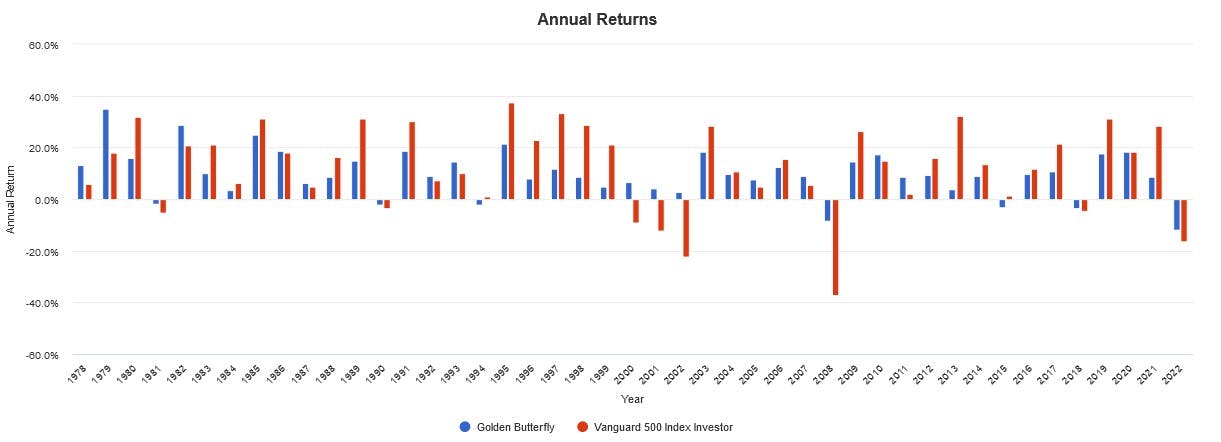

Yes, an investor who bought and held the S&P 500 would have posted a higher total return. This is unrealistic. Very few investors are capable of stomaching 100% equities over a 30-year period. That investor would have had to deal with some severe unrealized losses. Consider how in 2008, the S&P 500 lost -37%, while the Golden Butterfly was down just -8%. For risk-aware investors, the steadier sequence of returns provided by the Golden Butterfly is highly beneficial. Another win for diversification!
Please note this article is for information purposes only and does not constitute investment advice.
Topics
See all
Mentioned ETFs
Further reading
Latest ETF News
See all ETF newsBeyond Big Tech: The Increasing Specialization of AI ETFs

There's an ETF for That? Humanoid Robotics and Physical AI

How Some ETF Issuers Use Their Own Funds for Cash Management

These Public-Private ETFs Invest in Polymarket and Anduril

There's an ETF for That? Frontier Markets



 Advantages of ETFs over Mutual Funds1/6
Lower Costs
In this guide, we'll explore the advantages of ETFs over mutual funds, giving you valuable insights into why ETFs have gained significant popularity among investors like yourself.
Leveraged ETFs: Unlocking the Potential for Amplified Returns1/6
Understanding Leveraged ETFs
Explore leveraged ETFs: potential for amplified returns & risks. 5 ETFs to consider across equities, commodities & fixed income.
What is a Leveraged ETF?1/6
Introducing Leveraged and Inverse ETFs
In this guide, we'll dive into the world of leveraged ETFs, exploring their definition, mechanics, potential risks, and rewards.
Recent educational content

First Look ETF
First Look ETF: Income, International, and Cash Flow ETFs
In this season 6 episode of First Look ETF, Stephanie Stanton @etfguide examines the latest ETF marketplace trends with NYSE and guests.


ETF Trends
ETF Industry KPIs October 5, 2026
This week’s KPI data overview highlights key metrics and trends shaping the ETF landscape.

ETF Trends
ETF Industry KPIs September 28, 2026
This week’s KPI data overview highlights key metrics and trends shaping the ETF landscape.
ETF Trends
ETF Industry KPIs September 22, 2026
This week’s KPI data overview highlights key metrics and trends shaping the ETF landscape.