Keep tabs on your favorite ETFs with a personalized weekly tracker. Create a Watchlist now →



A guide to gold investing via ETFs
A small allocation to gold can help diversify investment portfolios.


Keep up with what matters in ETFs
Get timely ETF insights, market trends, and top ideas straight to your inbox.
Your newsletter subscriptions with us are subject to ETF Central's Privacy Policy and Terms and Conditions.
When it comes to portfolio management, there are three main asset classes: stocks, bonds, and cash. A well-allocated portfolio of these three assets generally provides better and more efficient risk-adjusted returns compared to say, a 100% stock portfolio.
There is an additional asset class though – commodities. Examples include crude oil, natural gas, soybeans, corn, wheat, silver, and of course, gold. As an investment, gold in particular has some interesting traits that make it great for diversifying portfolios.
Investors bullish on gold can buy physical bullion, but this approach has drawbacks, including a wide bid-ask spread charged by dealers, insurance and storage costs, and self-custody risks. A better option that can be implemented in any brokerage account is using gold ETFs.
Global ETF Survey 2026 is Live!
With 1,790 new products launched by July 2026, choosing is harder than ever. Our Global ETF Survey 2026, built on 620 professional investors and allocators, shows how active, fixed income, options-based and thematic ETFs are reshaping fund selection.
Why invest in gold?
We often hear about the ability of gold to withstand inflation, hedge against a weak dollar, or protect against geopolitical risk. All these points are important, but the biggest reason to include gold in a portfolio is its lower-than-average correlation with stocks and bonds.
That is, when stocks and bonds zig, gold can zag. Mixing all three in various proportions can produce more return for less risk, thereby optimizing your portfolio further. Look at this table comparing monthly correlations between the U.S. stock market, long-term Treasurys, and gold from 1978 to the present:

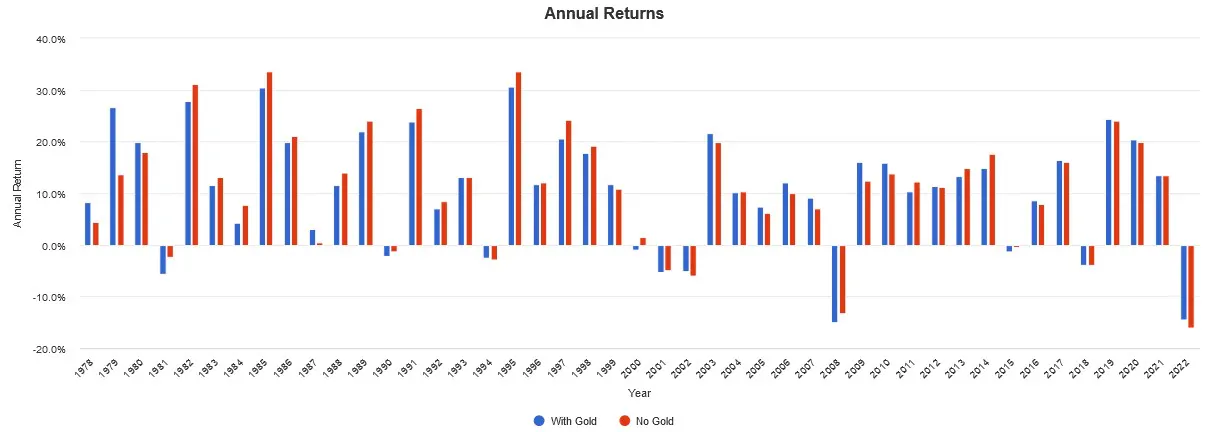
Gold has a low correlation with both, which according to Modern Portfolio Theory, should make it great as a diversifier. Indeed, a portfolio of 60/30/10 stocks/Treasurys/gold has historically produced a similar risk-adjusted return than a 60/40 stocks/Treasury portfolio, with slightly lower volatility and drawdowns.
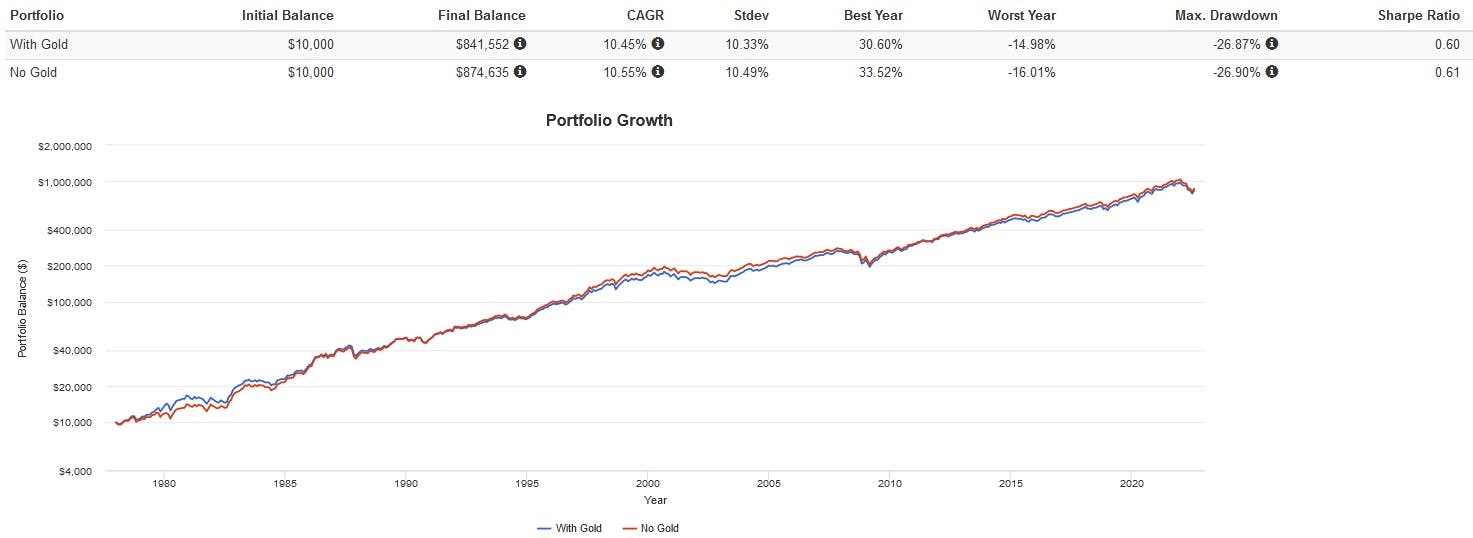

This outperformance was especially noticeable during high inflation, rising interest rate periods like 1978 – 1980 and 2022 where Treasurys lost substantial value and had a higher correlation with stocks.
Investing in physical gold ETFs
The easiest and most passive way to invest in gold ETFs is by using physically backed ones. These ETFs hold corresponding deposits of gold bullion in secured, audited vaults. Each share of the gold ETF you buy corresponds to the beneficial ownership of a fraction.
The main benefits of physically backed gold ETFs are low fees and accurate tracking when it comes to the spot price of gold. However, be aware of funds that aren't true open-ended ETFs, but rather close-ended trusts. These funds can sometimes trade at a premium or discount to their net asset value (NAV).
Another benefit of physically backed gold ETFs is the ability to trade derivatives like options without using gold futures. Some ETFs have well-developed options chains that allow investors to easily purchase or sell calls and puts. Some of the most popular U.S. listed gold ETFs include:
- SPDR Gold Shares ETF (GLD): 0.40% expense ratio.
- SPDR Gold MiniShares Trust (GLDM): 0.10% expense ratio.
- iShares Gold Trust ETF (IAU): 0.25% expense ratio.
- GraniteShares Gold Trust ETF (BAR): 0.17% expense ratio.
- Aberdeen Physical Gold Shares ETF (SGOL): 0.17% expense ratio.
Investing in gold derivative ETFs
Investors with more advanced objectives, such as speculation, day-trading, or hedging needs can use ETFs that gain gold exposure via derivatives. These commonly include futures, options, and swaps. The funds themselves tend to go beyond mere passive exposure to gold. Rather, they offer unique risk-return profiles that aren't always suitable for a long-term hold.
A popular example is the ProShares Ultra Gold ETF (UGL), which uses swaps to provide daily returns that target 2x that of the spot price of gold. If gold rises 1% in a day, UGL will likely rise 2%, and vice-versa if gold falls. In other words, UGL is a leveraged ETF, which is intended to be held for short periods.
Holding UGL longer than a day can lead to long-term returns that differ significantly from the 2x daily leverage target. In addition, UGL is structured as a commodity pool, so investors have to fill out a Schedule K-1 come tax time. Finally, like most leveraged funds, UGL is pricy, costing an expense ratio of 0.95%.
A leveraged gold ETF that is intended for a long-term hold is the WisdomTree Efficient Gold Plus Equity Strategy Fund ETF (GDE). For every $100 invested in GDE, the manager first allocates $90 towards large-cap U.S. equities. The other $10 serves as cash collateral for gold futures contracts, which provide 9x leverage. The ETF has a low expense ratio of just 0.20%.
The notional exposure of this fund is therefore 90% stocks, and 90% gold, for a total 1.8x accounting leverage. This is still risky, but not excessively so. Overall, I consider it a novel and sustainable way to hold a gold allocation long-term, while still investing in enough stocks. I explored this concept earlier in an article on return stacking, so give it a read if you're curious about how this works.
Topics
See all
Mentioned ETFs
Further reading
Latest ETF News
See all ETF newsThere's an ETF for That? Humanoid Robotics and Physical AI

How Some ETF Issuers Use Their Own Funds for Cash Management

These Public-Private ETFs Invest in Polymarket and Anduril

There's an ETF for That? Frontier Markets




 Advantages of ETFs over Mutual Funds1/6
Lower Costs
In this guide, we'll explore the advantages of ETFs over mutual funds, giving you valuable insights into why ETFs have gained significant popularity among investors like yourself.
Leveraged ETFs: Unlocking the Potential for Amplified Returns1/6
Understanding Leveraged ETFs
Explore leveraged ETFs: potential for amplified returns & risks. 5 ETFs to consider across equities, commodities & fixed income.
What is a Leveraged ETF?1/6
Introducing Leveraged and Inverse ETFs
In this guide, we'll dive into the world of leveraged ETFs, exploring their definition, mechanics, potential risks, and rewards.
Recent educational content

ETF Trends
ETF Industry KPIs October 5, 2026
This week’s KPI data overview highlights key metrics and trends shaping the ETF landscape.

ETF Trends
ETF Industry KPIs September 28, 2026
This week’s KPI data overview highlights key metrics and trends shaping the ETF landscape.
ETF Trends
ETF Industry KPIs September 22, 2026
This week’s KPI data overview highlights key metrics and trends shaping the ETF landscape.

First Look ETF
First Look ETF: Income, Corporate Arbitrage, and Growth and Value Investing
First Look ETF September 2026: iCapital, Mast Investments and North Square unpack new ETFs targeting monthly income, merger arbitrage and complementary growth and value exposure.

Browse all educational columns



Expert-Built ETF Portfolios, All in One Place
Don’t start from scratch. Discover ready-made ETF portfolios built by professionals to match different goals, timelines, and market views. Use them as inspiration or as a starting point for your own allocation.