Turn ETF ideas into real portfolios. Try the builder now →



ETFs to protect against a black swan event
When it comes to investing, building overall portfolio resilience might be better than trying to plan for every possible scenario.


Keep up with what matters in ETFs
Get timely ETF insights, market trends, and top ideas straight to your inbox.
Your newsletter subscriptions with us are subject to ETF Central's Privacy Policy and Terms and Conditions.
Earlier in September, I wrote about mitigating tail risks using various ETF strategies. I defined tail risks as "the occurrence of a catastrophic loss event that is otherwise statistically improbable." For an investment portfolio's distribution of returns, tail risk is usually represented by a loss of a magnitude three standard deviations left of the mean.
For example, if my portfolio has returned an average of 10% annualized with a 15% standard deviation, my "left tail risk" three standard deviations away would be a 55% loss. Assuming a normal distribution, the probability of this occurring is around 0.3%. Of course, distributions are often skewed with fatter tails than envisioned, so the probability of this is likely much higher.
In hindsight, I should have talked about black swan events first. This concept does a much better job of educating retail investors about the need for diversification and resilience when it comes to ETF selection and portfolio construction. It's a fantastic thought exercise that really hammers home the need to manage risk over chasing returns.
Like what you're reading?
Stay in the loop — get the latest ETF insights: trends, analysis, and expert picks.
What is a black swan anyway?
The term "black swan" is closely related to the scientific concept of falsifiability, which posits that any observation which contradicts the assumptions of a theory will positively disprove it.
The tale goes that in the 16th century, swans were all predicted to be white. That is, until Dutch explorers discovered a black one in Australia, disproving that entire theory. The general gist of the idea is that nothing is impossible – there is always a chance, albeit remote of it being falsified and disproved.
The term really gained prominence in 2007 when mathematical statistician and trader Nassim Nicholas Taleb published The Black Swan. While Taleb applied the concept of the black swan to events in history outside of the financial markets, he noted three attributes common to all black swans:
- Black swans are outliers: their form, timing, and consequences cannot be accounted for at large by past experiences or future expectations, or statistical models.
- Black swans create outsized consequences: in finance, this occurred in the form of systemic risk affecting the world's economy, like during the 2008 Great Financial Crisis.
- Black swans are obvious in hindsight: After the fact, people are great at rationalizing seemingly sound explanations for it that make it appear as though it was predictable.
Handling black swans
In his book, Taleb cautioned against the "foolishness" of trying to predict and mitigate every conceivable adverse risk event that could occur. When it comes to investing, a good example is an investor who buys pricey portfolio insurance like VIX futures, or SPX put options.
I went over a few of these options in my tail risk article and noted that many of them possessed negative carry, which made them unsuitable for long-term holds, mitigated only specific risks (a sharp decline in the S&P 500 with increasing volatility), and were expensive in terms of fees.
Instead, Taleb argues for building "robustness" against black swan events. When it comes to investing, this usually takes the form of diversification. Practically, this means holding different asset classes suitable to various market and economic conditions. I reviewed a few examples in my article on Ray Dalio's All-Weather Portfolio, so give that a read.
A portfolio full of different asset classes, each with a positive expected return, yet with low correlation, can be expected to produce more units of return for fewer units of risk. We can also weight the portfolio so that each asset contributes an equal amount of the portfolio's volatility, a practice called risk parity.
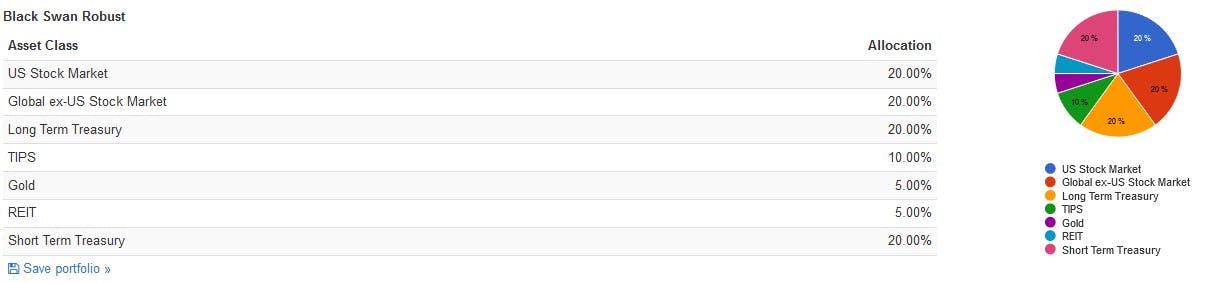
A low-cost, diversified "black swan robust" portfolio might comprise the following assets. Keep in mind that back tests are inherently backward-looking and are an imperfect substitute for true predictability. This asset allocation is not mean-variance optimized or risk-parity weighted. It's meant to serve as an illustration of the benefits of diversification.
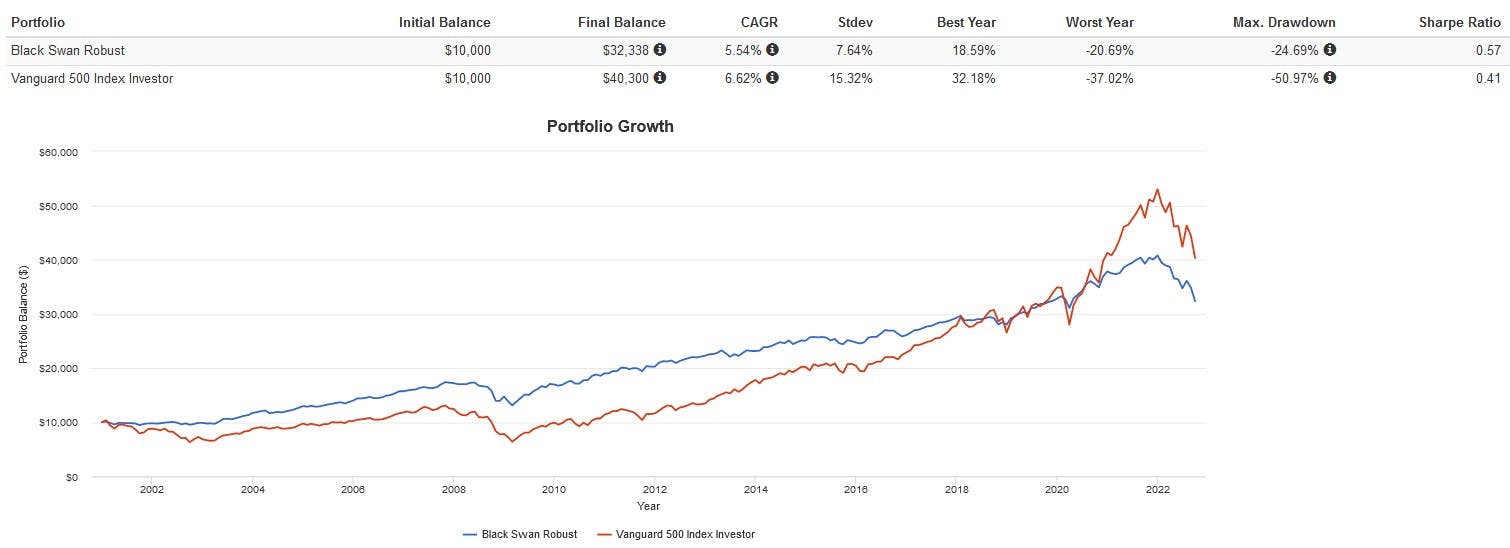
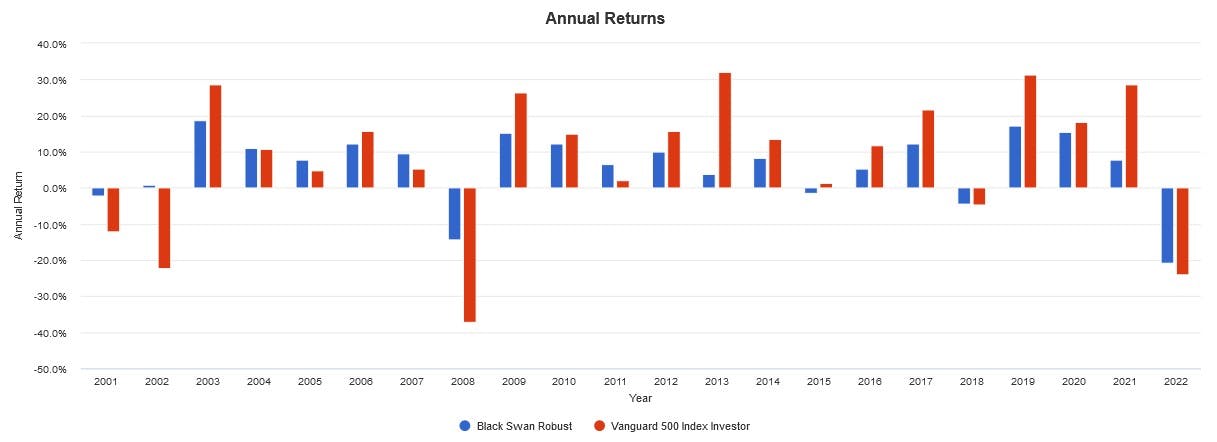
This is all retrospective, of course, but it’s worth noting how this portfolio did an admirable job of surviving the Dot-Com Bubble, the Great Financial Crisis, and the COVID-19 Crash, all while delivering a decent CAGR, less volatility, lower drawdowns, and better Sharpe ratio than the S&P 500.
The following low-cost ETFs from Vanguard and iShares might work for each of the asset classes:
- U.S. and international stock markets: Vanguard Total World Stock ETF (VT+0.89%).
- Long-term Treasury: iShares 20+ Year Treasury Bond (TLT+0.11%).
- Short-term Treasury: Vanguard Short-Term Treasury ETF (VGSH-0.07%).
- TIPS: iShares TIPS Bond ETF (TIP-0.46%).
- Real Estate: Vanguard Real Estate ETF (VNQ+0.72%)
- Gold: iShares Gold Trust (IAU+0.54%)
Exploiting black swans
Sim Segal, Program Director for Columbia University's Master's degree in Enterprise Risk Management program, stated that: "risk concerns both unexpected downside and upside volatility." Taleb himself noted that some of the biggest events in history came from "positive black swans", with massive upside potential. A great example was the 2020 GameStop (GME) short squeeze.
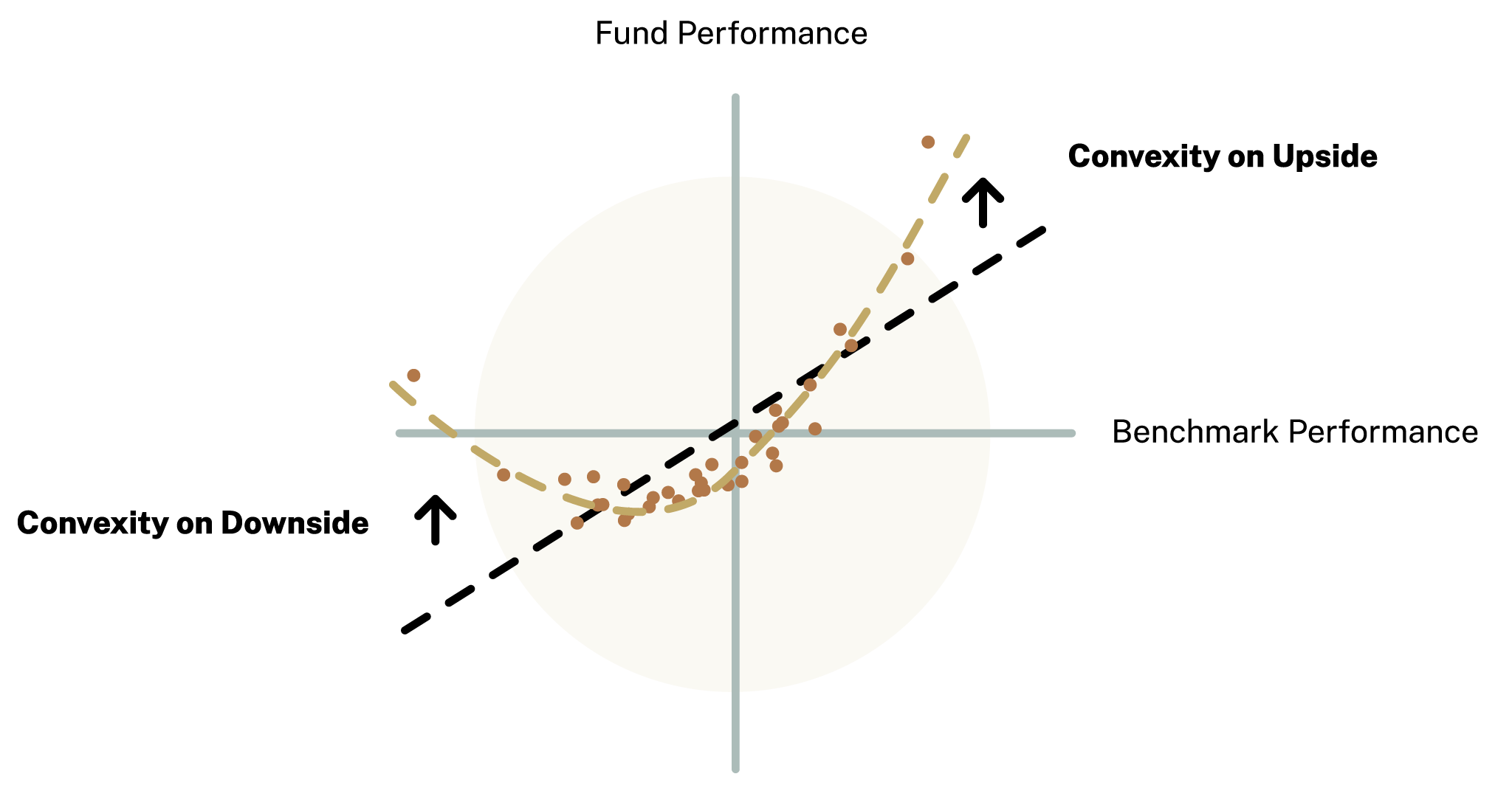
A big factor that comes into play is convexity, which refers to how the returns for some investments scale non-linearly. For example, option prices (especially those out-of-the-money, or OTM) will often accelerate exponentially when the underlying experiences a large movement or increase in volatility. This graph from Simplify explains it well:
Investors can use ETFs like the Simplify US Equity PLUS Convexity ETF (
Please note this article is for information purposes only and does not constitute investment advice.

Latest ETF News
See all ETF newsMoneyShow Chart of the Day 9/4/26: Don't Just Watch Oil. Watch THESE.


Chart of the Day 8/14/26: The Great "Hot Money" Migration

MoneyShow Chart of the Day 7/29/26: Now, THAT's What I Call Market Rotation!

MoneyShow Chart of the Day 7/16/26: Good News/Bad News on Inflation (and the Fed)




 Advantages of ETFs over Mutual Funds1/6
Lower Costs
In this guide, we'll explore the advantages of ETFs over mutual funds, giving you valuable insights into why ETFs have gained significant popularity among investors like yourself.
Leveraged ETFs: Unlocking the Potential for Amplified Returns1/6
Understanding Leveraged ETFs
Explore leveraged ETFs: potential for amplified returns & risks. 5 ETFs to consider across equities, commodities & fixed income.
What is a Leveraged ETF?1/6
Introducing Leveraged and Inverse ETFs
In this guide, we'll dive into the world of leveraged ETFs, exploring their definition, mechanics, potential risks, and rewards.
Recent educational content

ETF Trends
ETF Industry KPIs September 8, 2026
This week’s KPI data overview highlights key metrics and trends shaping the ETF landscape.

ETF Trends
ETF Industry KPIs August 31, 2026
This week’s KPI data overview highlights key metrics and trends shaping the ETF landscape.
ETF Trends
ETF Industry KPIs August 24, 2026
This week’s KPI data overview highlights key metrics and trends shaping the ETF landscape.
What’sTheFund
What's the Fund | Ocean Park Diversified Income ETF (DUKZ)
James St Aubin, Chief Investment Officer at Ocean Park Asset Management, discuss the DUKZ ETF, exposing investors to the whole spectrum of asset classes in the fixed income markets, through their rules-based process.

Browse all educational columns



Build and Analyze Your ETF Portfolio Like a Pro
Create your own ETF portfolio in minutes and instantly see allocations, exposures, performance, and risk. Visualize diversification across asset classes, regions, and sectors. Stress-test ideas, compare benchmarks, and refine your strategy with professional-grade analytics.