ETF model portfolios designed for real investor needs. Discover →



Can growth stock ETFs offer tax efficiency?
Splitting normal index ETFs up into growth versus value components and allocating for tax efficiency can offer potential benefits.


Keep up with what matters in ETFs
Get timely ETF insights, market trends, and top ideas straight to your inbox.
Your newsletter subscriptions with us are subject to ETF Central's Privacy Policy and Terms and Conditions.
I noted in my last article on tax-loss harvesting that investors should not "let the tax tail wag the dog." That is, tax efficiency should not be a primary consideration when it comes to ETF selection. Other factors like expense ratio, strategy, holdings, and volatility should be your primary concerns.
However, optimizing for tax efficiency once these variables are sorted out is always prudent. Tax inefficiency can be one of the biggest sources of drag on your returns, especially in a taxable brokerage account. The result can be a full percentage point more in annualized returns over long periods.
So, today we're going to look at how investors could potentially use various growth-oriented ETFs to increase tax efficiency. I wrote about growth ETFs in a previous article, so give that a read if you're new to the topic. Let's jump into it.
Global ETF Survey 2026 is Live!
With 1,790 new products launched by July 2026, choosing is harder than ever. Our Global ETF Survey 2026, built on 620 professional investors and allocators, shows how active, fixed income, options-based and thematic ETFs are reshaping fund selection.
Why growth ETFs?
The bottom line is that growth stocks often pay small or no dividend yields. As a result, growth stock ETFs tend to pay out minimal distribution.
Take the Vanguard Growth ETF (VUG) for example. This ETF tracks the CRSP US Large Cap Growth Index., which holds 250 large-cap U.S. growth stocks. Currently, the 30-day SEC yield is just 0.71%.
Compare this to a broad-market index ETF like the Vanguard 500 which holds 505 large-cap growth and value stocks for a blended approach. VOO has a much higher 30-day SEC yield of 1.76%.
In a taxable account, VUG would be significantly more efficient than VOO due to its lower yield. However, using VUG in lieu of VOO limits diversification, given that the former only tracks 250 growth stocks. It's basically missing half of the S&P 500. However, there is a way around this.
Combining growth + value
It turns out that VUG has a value-oriented ETF pair, the Vanguard Value ETF (VTV). This ETF tracks the CRSP US Large Cap Value Index, which holds 344 large-cap U.S. value stocks.
VTV has a 30-day SEC yield of 2.76%, which is even higher than VTI and makes it less tax-efficient. However, we can pair it with VUG and allocate each in a tax-efficient manner.
For example, we could hold VUG in a taxable brokerage account, and VTV in a Roth IRA. This way, we don't lose out on diversification but gain better tax efficiency. VTV's larger distributions won't be taxed, and VUG's smaller distributions will incur less tax.
How does this approach fare versus just holding VOO in all accounts? Take a look at this backtest of 50/50 VUG/VTV rebalanced annually versus 100% VOO from 1993 to the present.
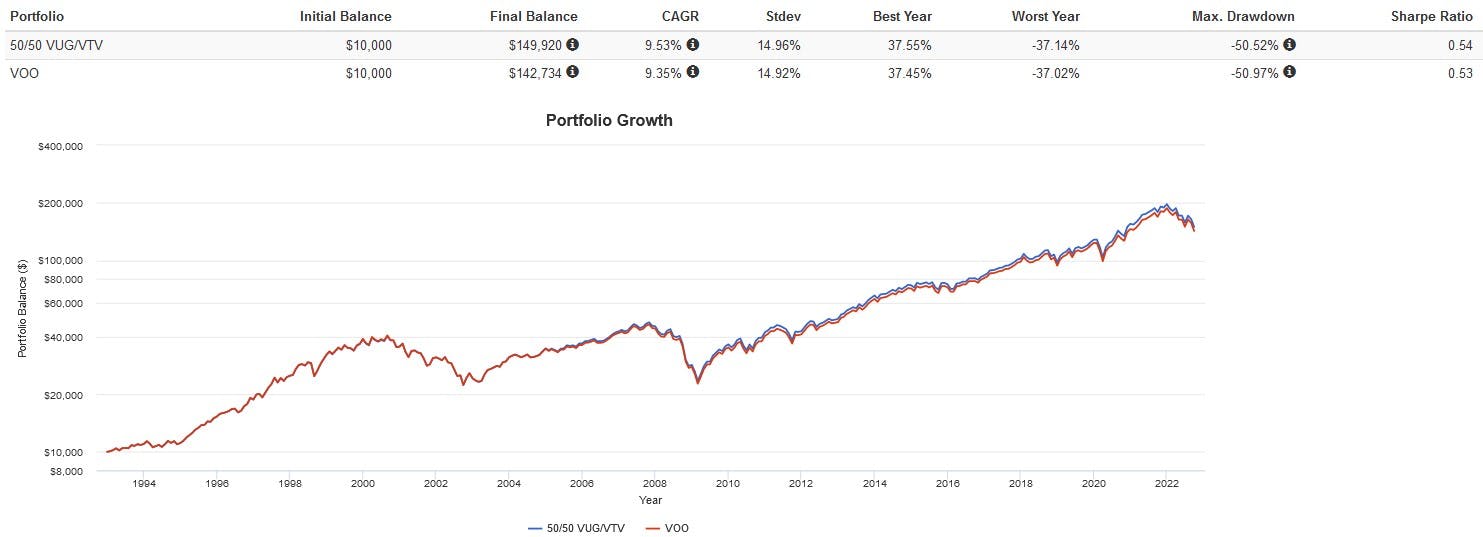
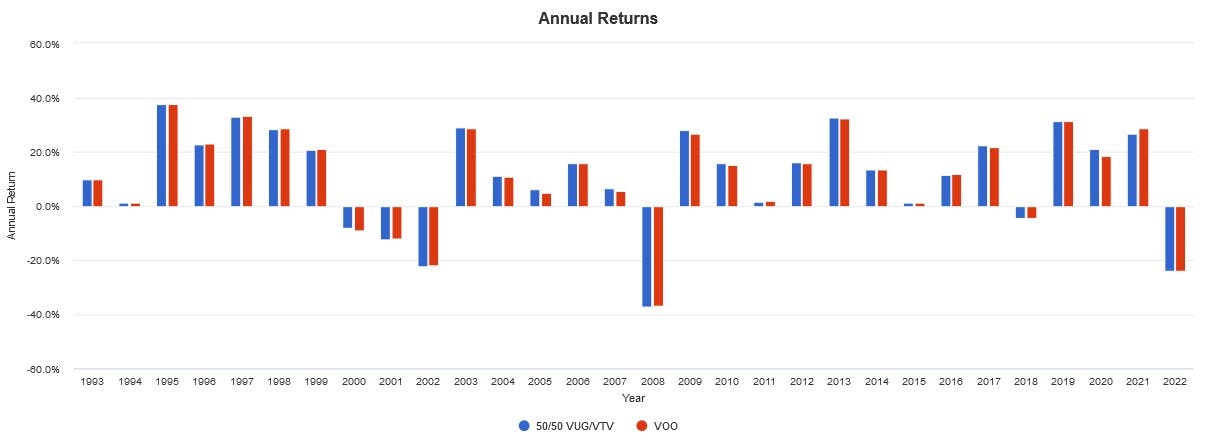

The 50/50 blend of VUG in a taxable account and VTV in a tax-advantaged account performed almost identically to just VOO. In fact, it did slightly better, probably due to a rebalancing bonus, but the difference is so small that it's probably just noise.
Either way, the VUG/VTV combination produced an extremely low tracking error compared to VOO while saving the hypothetical investor substantially on dividend tax. Essentially, all we did was split VOO into its growth and value components and allocated them individually for tax efficiency.
Keep in mind that the above-noted backtest is hypothetical. Investors should always consult a tax attorney or accountant. The information presented above is for general purposes only and should not be construed as legal or investment advice.
Please note this article is for information purposes only and does not constitute investment advice.


Latest ETF News
See all ETF newsBeyond Big Tech: The Increasing Specialization of AI ETFs

There's an ETF for That? Humanoid Robotics and Physical AI

How Some ETF Issuers Use Their Own Funds for Cash Management

These Public-Private ETFs Invest in Polymarket and Anduril

There's an ETF for That? Frontier Markets



 Advantages of ETFs over Mutual Funds1/6
Lower Costs
In this guide, we'll explore the advantages of ETFs over mutual funds, giving you valuable insights into why ETFs have gained significant popularity among investors like yourself.
Leveraged ETFs: Unlocking the Potential for Amplified Returns1/6
Understanding Leveraged ETFs
Explore leveraged ETFs: potential for amplified returns & risks. 5 ETFs to consider across equities, commodities & fixed income.
What is a Leveraged ETF?1/6
Introducing Leveraged and Inverse ETFs
In this guide, we'll dive into the world of leveraged ETFs, exploring their definition, mechanics, potential risks, and rewards.
Recent educational content

First Look ETF
First Look ETF: Income, International, and Cash Flow ETFs
In this season 6 episode of First Look ETF, Stephanie Stanton @etfguide examines the latest ETF marketplace trends with NYSE and guests.


ETF Trends
ETF Industry KPIs October 5, 2026
This week’s KPI data overview highlights key metrics and trends shaping the ETF landscape.

ETF Trends
ETF Industry KPIs September 28, 2026
This week’s KPI data overview highlights key metrics and trends shaping the ETF landscape.
ETF Trends
ETF Industry KPIs September 22, 2026
This week’s KPI data overview highlights key metrics and trends shaping the ETF landscape.
Browse all educational columns



ETFs’ Next Act: From Access to Selection
With 1,790 new products launched by July 2026, choosing is harder than ever. Our Global ETF Survey 2026, built on 620 professional investors and allocators, shows how active, fixed income, options-based and thematic ETFs are reshaping fund selection.