Open Now: The Global ETF Survey Take the Survey →



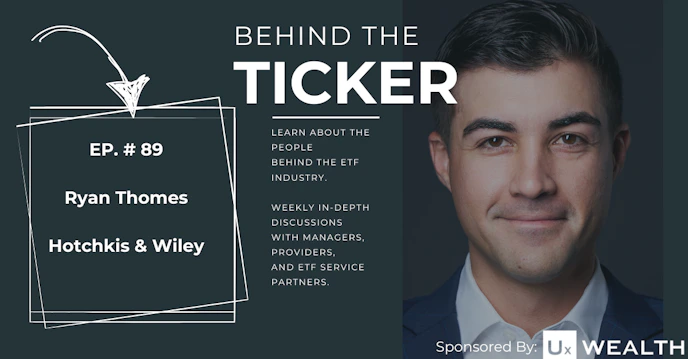
In this episode of Behind the Ticker, Brad Roth interviews Ryan Thomes, Co-Portfolio Manager at Hotchkis & Wiley, to discuss the launch and strategy behind the firm’s newest ETF—HWSM, the Hotchkis & Wiley SMID Cap Diversified Value ETF. Ryan shares his career journey from investment consulting to portfolio management, explaining how his early due diligence work led him to join the very firm he once evaluated. Over the past 17 years at Hotchkis & Wiley, Ryan has been deeply involved in refining the firm’s value-based equity strategies and co-manages both the small-cap and SMID strategies.
The conversation centers on the HWSM ETF, which launched in early 2024 and represents a natural extension of Hotchkis & Wiley’s long-standing small-cap value process. Although the ETF is new, the underlying investment methodology dates back over 20 years. Ryan breaks down the firm’s three-step process: proprietary quantitative modeling, human analyst review, and thoughtful portfolio construction. Unlike traditional quant screens, Hotchkis & Wiley’s models attempt to emulate how a human analyst would value companies based on normalized mid-cycle earnings rather than current market conditions. This combination of rigorous modeling and fundamental judgment allows them to focus on out-of-favor, under-followed stocks with long-term value potential.
HWSM typically holds between 150–200 names, balancing diversification with high active share, and utilizes a tiered weighting system that ties directly to fundamental risk ratings. Analysts assess companies across three pillars—business quality, balance sheet strength, and corporate governance—and these scores directly impact the weightings in the portfolio. The fund is rebalanced biannually with monthly adjustments as needed, helping maintain both conviction and efficiency.
Ryan explains that SMID caps—especially value names—are historically underappreciated and undervalued compared to large-cap growth, making them especially compelling today. Despite large-cap tech’s dominance over the past decade, he sees potential mean reversion in valuations that could favor smaller, overlooked companies. HWSM is positioned as either a core equity holding or a complement to growth-oriented SMID allocations, offering access to Hotchkis & Wiley’s institutional-quality research through a tax-efficient ETF vehicle.



Active Trader Report: Use of Leveraged & Inverse ETFs Way Up
Direxion partnered with Compound Insights and Vanda to explore what’s driving the evolution of active trading — and how active traders are using leveraged and inverse funds across equities, single stocks, commodities, and volatility.