ETF model portfolios designed for real investor needs. Discover →



What’s the Difference: Low Volatility vs. Minimum Volatility
Though both strategies share a similar objective, their respective approaches result in dissimilar, but beneficial, outcomes for investors.


Keep up with what matters in ETFs
Get timely ETF insights, market trends, and top ideas straight to your inbox.
Your newsletter subscriptions with us are subject to ETF Central's Privacy Policy and Terms and Conditions.
‘Similar in spirit, different in approach’ describes how one can view these investment approaches. While both strategies are based on the low volatility anomaly, the way each executes this objective differs meaningfully.
Low volatility investing focuses on the volatility of individual equities within a benchmark, ranking them on their past volatility measures, and then forming a portfolio accordingly. Conversely, minimum volatility portfolios determine the historical return volatilities and correlations of all the individual stocks in the benchmark, then utilize an optimization approach to construct the least volatile portfolio, based on their weightings and observed relationship over time.
Simply put, for low volatility portfolios, the absolute focus is ensuring that only low volatility stocks are present, whereas minimum volatility portfolios may include stocks deemed volatile – but their overarching relationship in the portfolio is what takes precedence.
Like what you're reading?
Stay in the loop — get the latest ETF insights: trends, analysis, and expert picks.
Different approach, different exposures
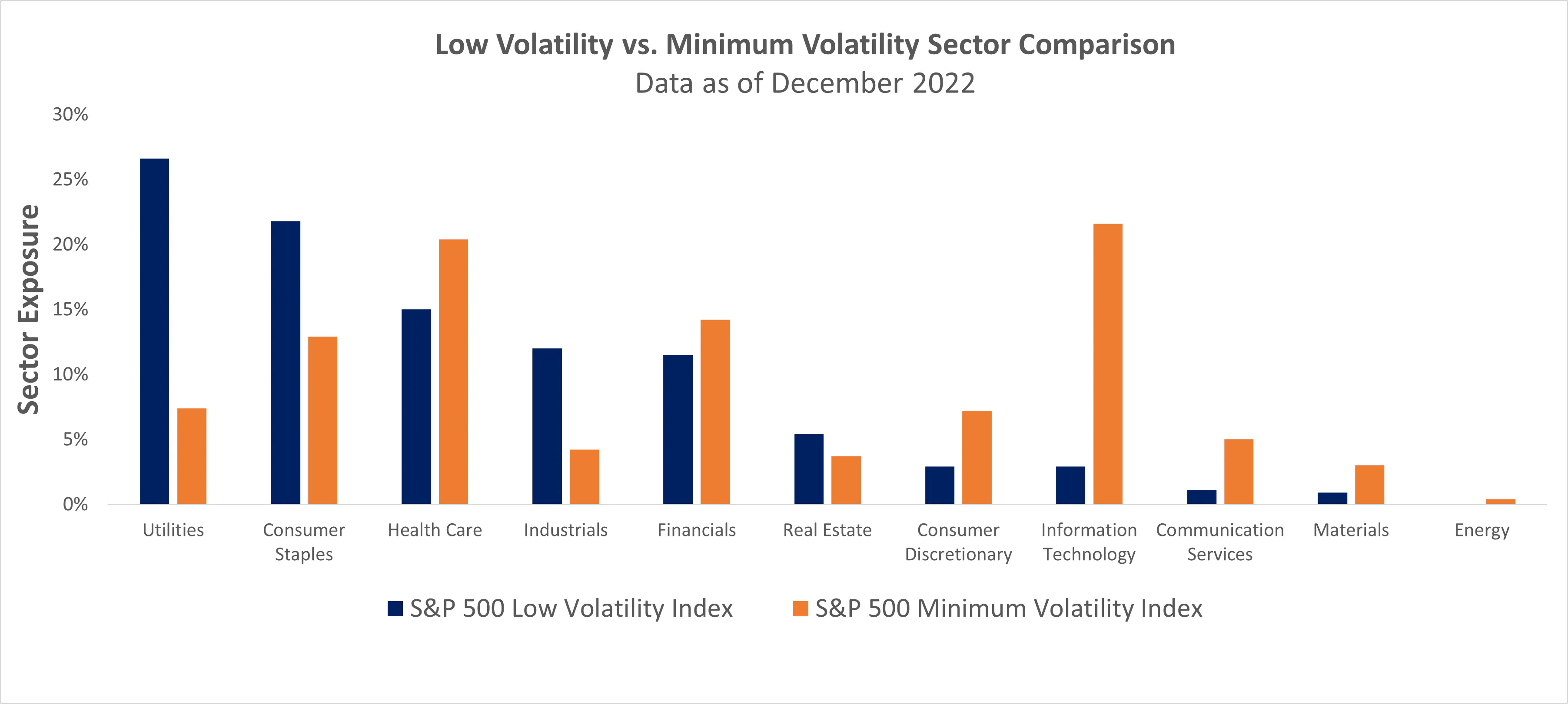
The difference in each investment strategy’s approach is very much reflected within their sector allocations. Using the S&P 500 Low Volatility Index and S&P 500 Minimum Volatility Index as references, low volatility strategies will lean more towards defensive sectors, such as Utilities and Consumer Staples, whereas minimum volatility tilts towards cyclical sectors, such as Information Technology and Financials. It is worth noting that the exposure to the energy sector is non-existent or negligible across both strategies, as of December 2022, given the volatility that is inherent within the sector – particularly over the past 3 years.
The difference in sector allocation truly demonstrates how distinct each investment approach is and where the sources of return (and risk mitigation) are derived from by the portfolio.
A look at performance
In contrasting the performance of Invesco’s S&P 500 Low Volatility ETF (SPLV) and Minimum Variance ETF (SPMV), each proxies for the S&P 500 Low Volatility Index and S&P 500 Minimum Volatility Index, respectively, the difference of both investment strategies is truly exemplified.

Over the 5-year period in question, Invesco’s Low Volatility Index ETF has marginally underperformed its Minimum Variance/Volatility counterpart – but has fulfilled its object of being less risky, by having a materially lower standard deviation. In further comparing the performance of both solutions, utilizing the S&P 500 Index as a benchmark input, the low volatility portfolio has demonstrated its ability to reduce its similarity exposure to the broader market index and provide above-adequate risk-adjusted performance across distinct categories. It should be noted that the max drawdown of the low volatility portfolio was greater than the minimum variance portfolio for the period in question. Given the market-moving events that occurred over the past 3 years (i.e., COVID, supply chain disruptions, Russia-Ukraine War, rising inflation) and the sectoral composition of low volatility investing, they undoubtedly are cause for the slightly large drawdown number.
For investors, while both strategies are guided by a similar objective, the outcome derived is different for each. Based on the data, low volatility investing allows for investors to meaningfully mitigate their risk exposure and still participate in the upside. Whereas, minimum volatility portfolios will provide a lower risk exposure, relative to the parent index, and allow investors to beneficially participate in market gains.
Please note this article is for information purposes only and does not in any way constitute investment advice. It is essential that you seek advice from a registered financial professional prior to making any investment decision.
Latest ETF News
See all ETF newsThese Public-Private ETFs Invest in Polymarket and Anduril


There's an ETF for That? Frontier Markets

10-Year Treasury Yield Hits 5%: Which Bond ETFs Offer the Most Direct Exposure?

ETF comparison: NEOS S&P 500 High Income ETF (SPYI) Versus Goldman Sachs S&P 500 Premium Income ETF (GPIX)




 Advantages of ETFs over Mutual Funds1/6
Lower Costs
In this guide, we'll explore the advantages of ETFs over mutual funds, giving you valuable insights into why ETFs have gained significant popularity among investors like yourself.
Leveraged ETFs: Unlocking the Potential for Amplified Returns1/6
Understanding Leveraged ETFs
Explore leveraged ETFs: potential for amplified returns & risks. 5 ETFs to consider across equities, commodities & fixed income.
What is a Leveraged ETF?1/6
Introducing Leveraged and Inverse ETFs
In this guide, we'll dive into the world of leveraged ETFs, exploring their definition, mechanics, potential risks, and rewards.
Recent educational content

ETF Trends
ETF Industry KPIs September 28, 2026
This week’s KPI data overview highlights key metrics and trends shaping the ETF landscape.

ETF Trends
ETF Industry KPIs September 22, 2026
This week’s KPI data overview highlights key metrics and trends shaping the ETF landscape.
First Look ETF
First Look ETF: Income, Corporate Arbitrage, and Growth and Value Investing
First Look ETF September 2026: iCapital, Mast Investments and North Square unpack new ETFs targeting monthly income, merger arbitrage and complementary growth and value exposure.

ETF Trends
ETF Industry KPIs September 14, 2026
This week’s KPI data overview highlights key metrics and trends shaping the ETF landscape.
Browse all educational columns



Expert-Built ETF Portfolios, All in One Place
Don’t start from scratch. Discover ready-made ETF portfolios built by professionals to match different goals, timelines, and market views. Use them as inspiration or as a starting point for your own allocation.